

 Home
>
Products
>
PLC Programmable Logic Controller
>
Home
>
Products
>
PLC Programmable Logic Controller
>

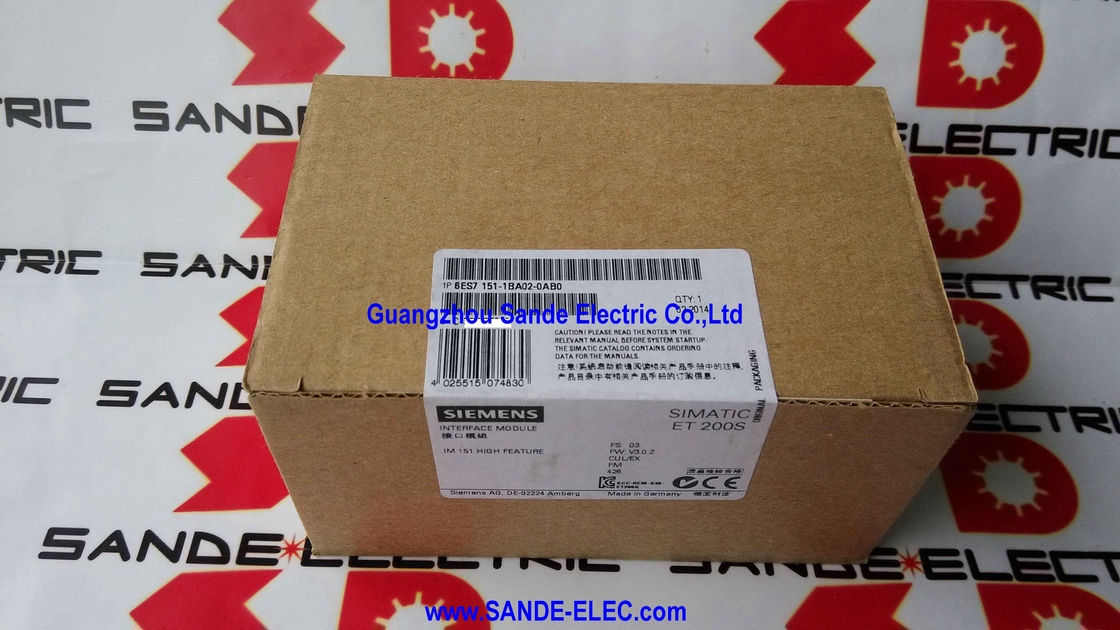
|
| Place of Origin | GERMANY |
| Brand Name | SIMENS |
| Certification | CE RoHS |
| Model Number | 6ES7151-1BA02-0AB0 |
The IM 151-1 HF and IM 151-1 Standard share the same physical form factor, the same 244-byte I/O capacity, and the same 63-module station limit. What the HF adds is specific and non-trivial: isochronous mode, full DP V1 acyclic services, and SIMATIC PDM integration for intelligent field device management.
For most discrete and process I/O applications — reading sensors, controlling valves, measuring temperatures through standard ET 200S modules — the Standard IM covers every requirement. The HF is required when the application demands precise timing synchronisation with the machine cycle, online parameter modification during live operation, or PROFIBUS-connected intelligent device management through SIMATIC PDM. When any of these three capabilities is in the specification, the HF is the correct module; the Standard is not.
| Parameter | Value |
|---|---|
| Part Number | 6ES7151-1BA02-0AB0 |
| Interface | RS-485, 9-pin Sub-D |
| Transfer Rate | Up to 12 Mbit/s |
| I/O Data | 244 bytes in / 244 bytes out |
| Max. Modules | 63 |
| Isochronous Mode | Yes |
| Protocol | DP V0 + DP V1 |
| Isolation | Galvanic, 500V DC |
| Supply | 24VDC (20.4–28.8V) |
| Power Loss | ~3.3W |
| Dimensions | 45 × 119.5 × 75mm |
| Status | Spare part |
In standard PROFIBUS DP, the bus cycle runs free — it repeats at the configured cycle time, but the phase relationship between the bus cycle and the machine's mechanical cycle drifts continuously. For discrete I/O and most analogue measurements, this is acceptable. For high-speed position measurement, coordinated multi-axis drive control, or any measurement where the phase of acquisition relative to the machine cycle affects the result, it is not.
Isochronous Mode locks the PROFIBUS DP cycle to an external synchronisation signal from the DP master's servo interrupt. The ET 200S modules update their data at a defined, reproducible phase relative to this signal — so every scan cycle, the captured data corresponds to exactly the same point in the machine's mechanical cycle. This repeatability is what makes PROFIBUS-connected ET 200S stations usable as data sources for closed-loop motion control and precision measurement, not just for monitoring.
DP V1 enables the DP master to read and write data records to individual ET 200S modules while cyclic I/O exchange continues. In practical terms: a process controller can read a pressure transmitter's calibration data, adjust a temperature module's engineering unit range, or update a motor starter's overload threshold — over the existing PROFIBUS cable, during live production, without stopping the station.
Extended DP V1 diagnostics route structured fault data from individual modules through the IM 151-1 HF to the DP master: which channel, on which module, with what fault type — rather than a generic "station fault" indication that leaves the maintenance technician without specific location information.
SIMATIC PDM integration uses the same DP V1 channel to parameterise and diagnose intelligent field devices (flowmeters, transmitters, valve positioners) through the ET 200S station — the production I/O cable doubles as the device management communication path.
Q1: What exactly separates the Standard IM 151-1 from the High Feature?
The Standard (AA) supports DPV0 cyclic I/O exchange and DPV1 acyclic services but not isochronous mode. The High Feature (BA) adds isochronous mode for timing-synchronised data acquisition and deeper DP V1 integration including SIMATIC PDM-based intelligent device management. For digital and analogue I/O without timing or PDM requirements, the Standard is adequate. For motion-synchronised measurement or intelligent device parameterisation, the HF is required.
Q2: Can PROFIBUS IM 151-1 and PROFINET IM 151-3 stations coexist on the same machine?
Yes. An S7-300 or S7-400 controller with both a PROFIBUS DP master interface and a PROFINET IO controller can support ET 200S stations on both networks simultaneously. Each station uses the interface module matching its network type. Both networks operate independently in parallel under the same STEP 7 / TIA Portal hardware configuration.
Q3: How is the station address set on the IM 151-1 HF?
Via a rotary selector on the module's face — accessible with a small screwdriver, settable from 1 to 125. The selector address must match the value assigned in the DP master's STEP 7 hardware configuration. A mismatch activates the BF (Bus Fault) LED and excludes the station from the PROFIBUS bus cycle until corrected.
Q4: What is Option Handling and when is it used?
Option Handling allows the ET 200S station to operate with module slots occupied by RESERVE modules rather than the specified electronics — without the DP master generating a fault. This supports flexible machine designs where the same programme and hardware configuration runs multiple product variants: the high-specification variant has the optional module installed; the base variant has a RESERVE module in the same slot. Without Option Handling, any deviation from the configured station structure prevents the station from entering RUN.
Q5: For new ET 200S distributed I/O designs, should the IM 151-1 HF or the IM 151-3 PN be specified?
For new designs, Siemens recommends the IM 151-3 PN (PROFINET) as the current-generation interface module. PROFINET IO offers faster cycle times, larger I/O data capacity, integrated diagnostics, and active Siemens development support. The IM 151-1 HF is the correct choice only for existing PROFIBUS ET 200S installations requiring replacement parts, or for expansion of installed PROFIBUS systems where migrating to PROFINET is not practical.
Contact Us at Any Time

