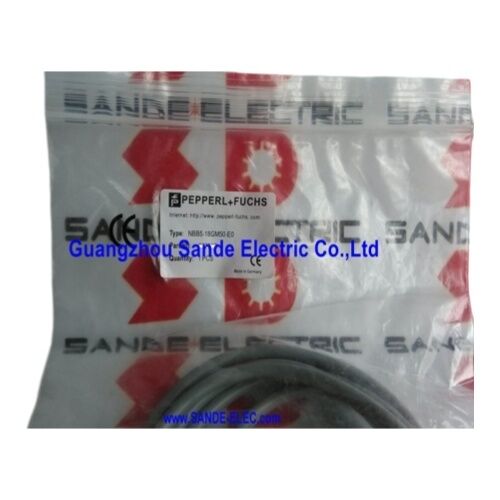
Pepperl+Fuchs NBB5-18GM50-E0 | M18 Flush Inductive Proximity Sensor — 5mm / NPN NO / 5–36V / 1950Hz / IP67 / −40°C to +85°C
Three Specifications That Differentiate This Sensor
Three parameters separate the NBB5-18GM50-E0 from a standard M18 proximity sensor: a 1,950Hz switching frequency (versus 300–800Hz for most M18 class sensors), a 5–36V DC supply range (versus 10–30V for most), and an extended −40°C to +85°C operating temperature. Each addresses a specific application requirement that a standard sensor cannot meet.
In any selection where one of these three parameters is critical, this sensor is the appropriate specification; where all three are relevant simultaneously, no standard alternative covers all three at once.
Key Specifications
| Parameter |
Value |
| Sensing Distance |
5 mm (flush mount) |
| Housing |
M18 × 1mm, 50mm length |
| Mounting |
Flush (embeddable in metal) |
| Output |
NPN, NO (sinking), 3-wire |
| Supply Voltage |
5–36V DC |
| Load Current |
200 mA max |
| Switching Frequency |
Up to 1,950 Hz |
| Connection |
2m PVC cable |
| IP Rating |
IP67 |
| Operating Temperature |
−40°C to +85°C |
| Housing Material |
Nickel-plated brass |
1,950Hz — When Standard Sensors Cannot Keep Up
Most inductive proximity sensors complete a switching cycle in the 200–800Hz range. At 1,950Hz, the NBB5-18GM50-E0 completes a full cycle in approximately 0.5ms. The practical consequence: at 1,000 RPM on a 20-tooth gear, the sensor must detect 333 tooth-passing events per second. A 400Hz sensor handles this at a safety factor of 1.2×; the NBB5-18GM50-E0 handles it at nearly 6×, ensuring no tooth is missed when rotation speed varies or switching time shifts with temperature.
Tachometry from gear or encoder disc, turbine flow measurement from closely-spaced vanes, high-rate machine cycle counting, and position detection on fast-indexing rotary tables are the applications where 1,950Hz is the enabling specification rather than a performance margin. When detection rates exceed a few hundred events per second, switching frequency is the first filter in sensor selection.
5–36V Supply Range — 5V Logic to 36V Industrial
Standard proximity sensors need at least 10V DC. The 5V lower bound bridges industrial 24V DC automation and the 5V logic supplies in microcontroller-based systems, test equipment, and instrumentation panels where 24V is not available. The sensor connects directly to the 5V system supply, its NPN output connects to a GPIO input with a pull-up resistor, and no boost converter or separate power supply is needed.
At the upper end, 36V DC accommodates the full regulation range of 24V industrial supplies (±15% = up to 27.6V) and transient spikes without fault conditions.
FAQ
Q1: What makes the NBB5-18GM50-E0 different from a standard M18 proximity sensor?
Three specifications: 1,950Hz switching frequency, 5–36V supply range, and −40°C to +85°C operating temperature. Standard sensors are adequate for typical presence/absence detection. This sensor is specified where high detection frequency, wide supply compatibility, or extreme temperature performance is required — especially when more than one of these applies simultaneously.
Q2: How is it used for speed measurement from a gear wheel?
Connect the NPN output to a pulse-counting input on a PLC, counter module, or microcontroller. Count per unit time divided by teeth per revolution gives rotation speed. For a 60-tooth gear at 1,000 RPM, the tooth-passing rate is 1,000 events per second — within the 1,950Hz capability with nearly 2× headroom.
Q3: Is it compatible with a 24V DC PLC NPN input card?
Yes. At 24V supply the NPN output operates normally within the sensor's rated range. The output sinks current through the PLC input to the common supply. The PLC input card must be wired for NPN (sinking) inputs. Standard PLC inputs draw 5–15mA — within the 200mA load current maximum.
Q4: The housing is 50mm long — is a shorter version available?
The GM50 indicates 50mm body length. Pepperl+Fuchs offers M18 NBB sensors in different body lengths. Confirm the mounting hole depth and thread engagement against the 50mm length before installation. For a shorter housing, review the NBB M18 series for variants meeting the frequency and temperature requirements in a reduced body.
Q5: Does the NPN output leakage current cause false detection on sensitive PLC inputs?
NPN 3-wire sensors of this class typically have 1–2mA OFF-state leakage. If the PLC input has a low ON-current threshold, this may cause a false ON state. A pull-down resistor (5.6kΩ–10kΩ) between the output wire and common shunts the leakage and prevents false activation. Confirm the exact leakage current from the current Pepperl+Fuchs datasheet.



 Your message must be between 20-3,000 characters!