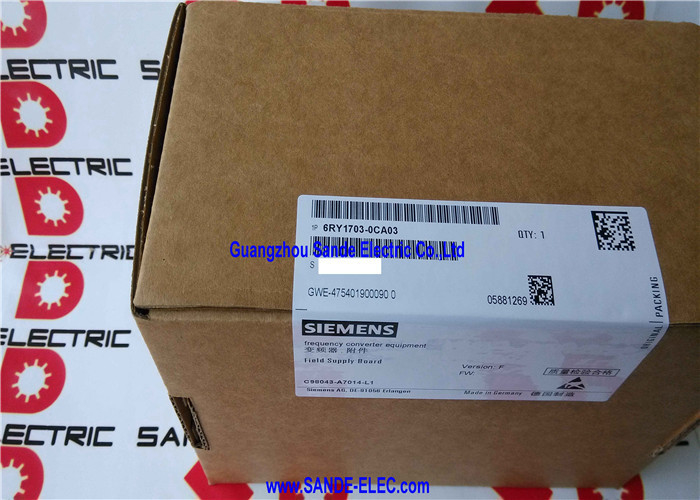
Siemens 6RY1703-0CA03 | SIMOREG DC-MASTER 6RA70 Field Supply Board — C98043-A7014-L1, For 30 to 100A Armature Current Ratings, Active Product
Overview
The Siemens 6RY1703-0CA03 is the Field Supply Board for SIMOREG DC-MASTER 6RA70 drives in the 30A to 100A armature current range — the dedicated board that manages the controlled DC supply to the DC motor's field winding.
In a DC motor drive system, the field winding and the armature winding are supplied independently: the armature winding (where the drive's main power section converts AC to controlled DC) carries the load current and produces torque, while the field winding establishes the motor's magnetic flux.
The field supply board controls this magnetic flux, and through it, the motor's back-EMF, torque constant, and operating characteristics across the full speed range.
Understanding why the field supply board matters requires a brief look at DC motor physics.
A shunt-wound or separately excited DC motor's armature voltage is related to its speed and field strength through the back-EMF equation: V_a ≈ K × φ × n, where K is a machine constant, φ is the field flux, and n is the rotational speed. At base speed (the speed at which the armature voltage reaches its rated value), the field is at full strength and the motor delivers full torque at rated current.
Above base speed, the field is progressively weakened — reducing φ — which allows speed to increase while armature voltage stays constant. This field weakening is the mechanism that extends a DC motor's speed range above base speed, and the field supply board executes it under the command of the SIMOREG's CUD1 control board.
For drives in the 30–100A armature current range — which covers DC motors from approximately a few kilowatts up to around 45 kW depending on voltage — the C98043-A7014-L1 field supply board provides the rectified and regulated DC output needed by the motor's field winding.
The board receives its field current setpoint from the CUD1 microprocessor board, compares the actual field current (measured via a shunt or current transformer) against the setpoint, and regulates the firing angle of its own thyristors to maintain the commanded field current precisely.
Key Specifications
| Parameter |
Value |
| Cross-Reference |
C98043-A7014-L1 |
| Board Function |
Field Supply Board |
| Compatible Armature Ratings |
30A to 100A (6RA70 drives) |
| Motor Application |
Separately excited DC motor field winding |
| PLM Status |
PM300 — Active Product |
| Companion (larger ratings) |
6RY1703-0CA01 (140–510A) |
| Drive Series |
SIMOREG DC-MASTER 6RA70 |
DC Motor Field Control — Why It Matters
The field supply board occupies a position in the 6RA70 that is easy to overlook when attention is focused on the main armature power section.
But field control is not a secondary function — it is the mechanism through which the drive controls motor speed above base speed, motor field orientation during reversal, and the critical field economy mode that reduces no-load power consumption during standby.
Field weakening for extended speed range: As the armature voltage approaches its rated ceiling, further speed increase requires reducing the field current.
The field supply board's regulation loop executes this reduction smoothly and continuously, maintaining stable motor operation through the field-weakening range.
Abrupt or poorly regulated field weakening produces speed instability and can cause armature current spikes that trip the drive's overcurrent protection.
Field economy: During standby periods when the motor is stopped or running at minimal load, the CUD1 can command the field supply board to reduce field current to a programmed economy level — typically 30–50% of rated field current.
This reduces no-load power consumption (the field winding resistance dissipates real power proportional to I²R) without requiring a full field discharge and re-establishment cycle each time the motor resumes operation.
For large motors with heavy field windings, this function produces meaningful energy savings over a production shift.
Field reversal monitoring: In 4-quadrant SIMOREG drives used for reversible applications, the CUD1 monitors field current during motor reversal sequences.
The field supply board must maintain stable field current through the direction change; field current instability during reversal causes armature current spikes and potentially unstable commutation in the DC motor's brush/commutator system.
6RY1703-0CA03 in the 6RA70 Board Architecture
The 6RA70 SIMOREG architecture distributes drive functions across multiple specialised boards: the CUD1 (6RY1703-0AA00) handles all digital control, parameterisation, and communication; the Power Interface Board (6RY1703-0DA01 or -0DA02) manages thyristor firing for the armature power section; and the Field Supply Board (this unit) provides dedicated thyristor firing and control for the field circuit. Each board is matched to the drive's armature current rating.
Within the 30–100A armature range, the C98043-A7014-L1 field supply board serves all units.
The companion board 6RY1703-0CA01 (C98043-A7014-L2) takes over for the larger 140–510A drives, and a completely different board family (6RY1703-0EA01 and 0EA03) serves the highest current range (850–1680A).
This rating-specific board selection ensures that the field thyristors and current measurement components are appropriately sized for each drive class.
The field supply board connects to the drive electronics backplane and receives its operating parameters and field current setpoint from the CUD1 via the internal bus.
Field current feedback from the motor's field circuit returns to the board through dedicated field current measurement inputs, closing the field current regulation loop at the board level without loading the CUD1's processing resources.
Active Product Status — Long-Term Availability
Unlike many boards in the 6RA70 SIMOREG spare parts catalogue that have reached PM900 (discontinued) status as the platform ages, the 6RY1703-0CA03 maintains PM300 (Active Product) classification.
Siemens continues to manufacture and supply this board as a standard spare part, reflecting the substantial installed base of 6RA70 drives in heavy industry that will continue operating for years or decades beyond the original machine commissioning date.
Rolling mills, paper machines, mine winders, large extruders, and shipboard propulsion systems often have service lives measured in decades, and the SIMOREG 6RA70's robustness makes it the DC drive of choice for applications where uptime and longevity are the primary engineering criteria.
The ongoing availability of the field supply board — one of the key maintenance items in any DC drive system — is essential to the total cost of ownership proposition for these long-lived installations.
FAQ
Q1: Can the same 6RY1703-0CA03 field supply board be used across all 30–100A 6RA70 drives regardless of armature voltage rating?
Yes. The field supply board's rating refers to the armature current range of the 6RA70 drive it is installed in, not the field current itself. DC motor field windings typically draw a fraction of the motor's full-load armature current — field currents of 2–15A are common for motors in the 30–100A armature class.
The C98043-A7014-L1 board handles the field supply function for the full 30–100A armature range, regardless of whether the drive is a 400V, 460V, or 575V unit, because the field supply thyristors take their AC input from the same supply as the armature circuit through the drive's internal connections.
Q2: What are the signs that the field supply board has failed, and how does failure affect drive operation?
Field supply board failure typically manifests as one of several fault conditions.
If the board loses its field current regulation capability, the drive's CUD1 will detect abnormal field current via the parameter set and generate fault codes related to field circuit faults. Symptoms may include the drive refusing to start (because the CUD1 verifies field current before enabling the armature), unstable motor speed at higher speeds in the field-weakening range (where field current accuracy is most critical), or the drive running at full field current and being unable to exceed base speed.
In some failure modes, the field thyristor gate drive fails and the motor loses all field excitation — which in a running motor causes the armature to accelerate toward runaway (if the motor is also driving a load that spins it up).
The drive's monitoring functions detect this loss of field condition and trip the armature output.
Q3: The 6RY1703-0CA03 is listed as an active product. Does it carry the original Siemens factory warranty when purchased through authorised channels?
Yes. Active-status products purchased through Siemens' authorised distribution network carry the manufacturer's standard warranty terms. The PM300 status confirms that Siemens continues to manufacture and support this board.
When sourcing from the surplus or aftermarket channels — which provide tested and refurbished boards from decommissioned equipment — the manufacturer's warranty does not apply, but reputable suppliers provide their own warranty coverage.
For critical drive applications, sourcing from authorised channels or a documented testing program is recommended to verify field board functionality before installation.
Q4: During a field supply board replacement, is it necessary to perform a full drive re-commissioning?
Not typically. The field supply board does not store the drive's application parameters — those are held on the CUD1 (microprocessor control board). Replacing the field supply board while keeping the CUD1 intact preserves the drive's complete parameter set.
After replacement, a verification of the field circuit operation is required: confirm the field current regulation is stable at the commanded setpoint across the field-weakening range, and check that field economy mode functions correctly.
The SIMOREG's built-in diagnostics (accessible through the PMU operator panel or STARTER software) allow field current monitoring in real time to confirm correct board operation after installation.
Q5: How does the field supply board interact with the armature reversing circuit in a 4-quadrant SIMOREG drive?
In a 4-quadrant SIMOREG drive, the armature power section has two anti-parallel thyristor bridges that allow both forward and reverse armature current.
During a direction reversal, the CUD1 coordinates the armature and field circuits: the armature current is ramped to zero, the field circuit maintains its commanded flux level throughout, and then the armature current is re-established in the reverse direction.
The field supply board's role is to hold the field current stable through the reversal — any field current disturbance during reversal can cause commutation problems in the DC motor (particularly in motors with weak interpoles) and must be avoided.
The field supply board's regulation loop bandwidth is set by the CUD1's field controller parameters to be consistent with the armature controller's dynamic requirements.



 Your message must be between 20-3,000 characters!