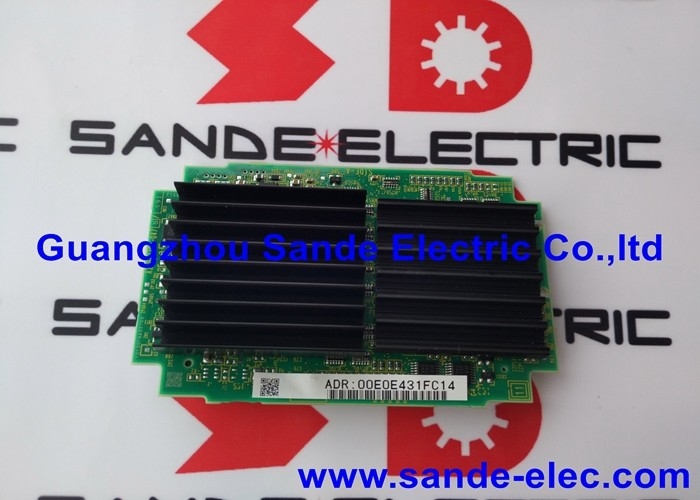
A20B-3300-0475 | FANUC A3 CPU Module — 128MB Integrated DRAM / A3-Type Main Board / Combined Processor and Working Memory Card
CPU Module — The Processor at the Heart of the CNC
The CNC's CPU module is responsible for every calculation the control system performs. Every interpolation step — converting a commanded feedrate into axis position increments one interpolation period at a time — happens in this module. So does PMC ladder scanning, display rendering, communication management, and system diagnostic processing.
The A20B-3300-0475 integrates two essential resources on a single card:
The processor core: The CPU that runs the CNC operating software, processes the G-code programme, coordinates multi-axis motion, and manages all real-time and background tasks.
128MB DRAM: The processor's working memory. Every variable, every interpolation result, every programme block in the look-ahead buffer, and every background system state occupies space in this DRAM during operation.
Combining both on one card means a single A20B-3300-0475 replacement addresses CPU failures and DRAM failures in a single part exchange — maintaining the correct configuration without the complexity of managing separate processor and DRAM modules.
Key Specifications
| Parameter | Value |
|---|
| Board Type | A3 |
| DRAM | 128MB (integrated) |
| Form Factor | Plug-in module |
| Compatible | A3-type CNC main board |
| Series | A20B-3300 |
128MB DRAM — What It Supports in CNC Operation
The 128MB DRAM allocation reflects the processing demands of the CNC platform this module serves. Several operational features benefit from or require substantial working memory:
Tool path look-ahead: The CNC reads ahead in the programme — computing future motion blocks before the current block finishes executing — to maintain consistent feedrate around corners and curves. A larger look-ahead buffer (supported by more DRAM) produces smoother contouring at higher feedrates.
Multi-axis simultaneous interpolation: For each interpolation cycle, the CNC must hold position commands, feedback values, error values, and gain-modified output values for every active axis simultaneously. At higher axis counts, the per-cycle memory requirement scales accordingly.
System software and options: The CNC operating software and active option software (contouring options, communication options, custom macro libraries) are loaded from
FROM into DRAM at startup and remain resident during operation. 128MB accommodates a fully-featured software image without compromising the space available for runtime data.
Application Scenarios
CPU/DRAM module alarm on A3-type CNC: A FANUC CNC with an A3-type main board generates alarms pointing to a CPU card failure. The FROM modules and SRAM are confirmed intact. Replacing the A20B-3300-0475 resolves the fault, and the CNC reloads its software from FROM into the new module's DRAM.
Planned spare: A machine shop operating CNC systems with A3-type main boards maintains an A20B-3300-0475 as a local critical spare, enabling immediate response to a CPU module failure.
FAQ
Q1: Is the A20B-3300-0475 the same as the A20B-3300-0472 — both are 128MB DRAM?
They share the same 128MB DRAM capacity but serve different CNC platforms. The A20B-3300-0472 is the A6-type module for Series 30i; the A20B-3300-0475 is the A3-type. The A3 and A6 designations reflect different connector interfaces and processor configurations matched to different CNC generations. They are not interchangeable.
Q2: After replacing the A20B-3300-0475, how does the CNC reload its operating software?
The CNC system software is stored in FROM (Flash ROM) modules — separate plug-in items on the main board. On first power-up after fitting the new A20B-3300-0475, the CNC's boot process loads the operating software from the FROM modules into the new module's 128MB DRAM. This happens automatically. FROM content is preserved through the CPU module replacement.
Q3: Does replacing the A20B-3300-0475 erase CNC parameters?
No. CNC parameters reside in SRAM modules — battery-backed modules separate from the CPU card. The SRAM content is unaffected by CPU module replacement. After fitting the new A20B-3300-0475, the CNC reads parameters from the SRAM modules as normal.
Q4: What are the diagnostic symptoms of a failed A20B-3300-0475?
Symptoms include: system fails to complete boot (stops partway through initialisation); random resets during operation not correlated with machine events; RAM parity alarms or system alarms pointing to CPU card; CNC powers on but display remains blank or shows incorrect content. Memory-type failures may show intermittent behaviour under load or at temperature.
Q5: Can the A20B-3300-0475 be repaired at component level?
CPU module repair is technically possible by specialist CNC electronics service centres for fault modes involving discrete components (bypass capacitors, memory interface drivers). For in-production machines where downtime cost is high, module-for-module replacement is typically preferred over the longer turnaround time of board repair. Both options are valid depending on urgency and available stock.


 Your message must be between 20-3,000 characters!