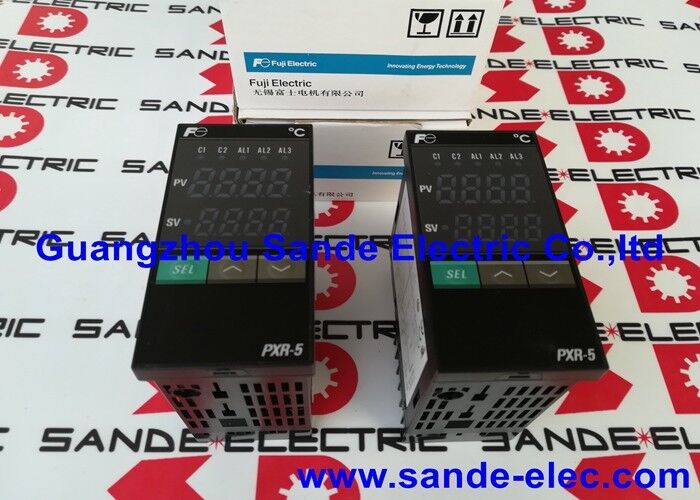
Fuji Electric PXR5TAY1-FV000-C Digital Temperature Controller
Overview
The PXR5TAY1-FV000-C belongs to Fuji Electric’s PXR5 digital temperature-controller family. Fuji’s PXR documentation identifies PXR5 as the 48 × 96 mm format in the PXR4/5/7/9 controller range, and the PXR manual shows the family with PV/SV display, status lamps, front-key parameter setting, and auto-tuning / self-tuning / manual mode functions.
Fuji also lists the PXR series as digital temperature controllers with broad input and output flexibility inside the series.
For the PXR5 family, the published manual lists support for thermocouple, Pt100, 1 to 5 V DC, and 4 to 20 mA DC input classes at the series level, with multiple control-output and option combinations available in the lineup.
The face-panel description includes PV display, SV display, alarm indication, output indication, and front-key operation, which confirms the product’s role as a compact panel temperature controller rather than a PLC or simple thermostat relay.
Technical Data
| Parameter | Value |
|---|
| Part Number | PXR5TAY1-FV000-C |
| Manufacturer | Fuji Electric |
| Product Family | PXR Series |
| Series / Size Class | PXR5 |
| Front Dimensions | 48 × 96 mm |
| Product Type | Digital temperature controller |
| Display | PV / SV display |
| Front Indicators | Output lamps, alarm lamp, mode lamp |
| Setting Method | Front-key parameter setting |
| Control Modes Listed in Manual | Auto-tuning, self-tuning, manual mode |
| Series Input Classes | Thermocouple, Pt100, 1 to 5 V DC, 4 to 20 mA DC |
Application Value
This controller fits panel temperature control, compact equipment heating control, small process loops, thermal monitoring panels, and other installations where a compact front-panel controller is preferred over a PLC-based temperature strategy.
The PXR5 form factor is well suited to space-conscious control panels, while the published PV/SV display structure and front-key operation support direct local setup and monitoring.
The PXR family is also relevant in maintenance and retrofit work because Fuji Electric identifies the older PXR4/5/7/9 models as part of its legacy temperature-controller lineup, with later PXF products available in the broader controller range.
That makes the PXR5 especially relevant in installed equipment that already uses this controller family and panel size.
Selection Notes
The main checks are the PXR5 size class, the 48 × 96 mm panel format, the required temperature-controller function, and the installed input/output configuration already used in the panel.
The family manual shows multiple input and output combinations across the PXR range, so the exact installed code should be matched to preserve the existing control and wiring setup.
FAQ
Q1: What kind of product is PXR5TAY1-FV000-C?
It is a Fuji Electric digital temperature controller in the PXR5 family. Fuji’s own PXR family documentation identifies PXR5 as the 48 × 96 mm controller format in the PXR4/5/7/9 range, with front-panel PV/SV display and controller operation functions.
Q2: Is this a PLC or a dedicated temperature controller?
It is a dedicated temperature controller. The PXR manual describes a controller face with PV display, SV display, alarm lamp, control-output lamps, and setting keys, which is the structure of a standalone panel controller rather than a PLC CPU or I/O module.
Q3: What panel size does PXR5 use?
Fuji’s PXR manual lists PXR5 in the 48 × 96 mm class. That size is one of the most important practical checks in replacement work, because it determines whether the controller fits the existing panel cutout and front-panel layout.
Q4: What functions are clearly documented for the PXR5 family?
The manual documents PV/SV display, front-key parameter setting, alarm indication, control-output indication, and auto-tuning / self-tuning / manual mode.
These are core controller functions and part of the series identity for the PXR family.
Q5: What should be checked before ordering?
Check the full installed code, confirm the controller is in the PXR5 size class, verify the panel requires the 48 × 96 mm format, and make sure the installed control loop depends on the same controller family and configured input/output structure.
Those points are the most important match criteria for this model.



 Your message must be between 20-3,000 characters!