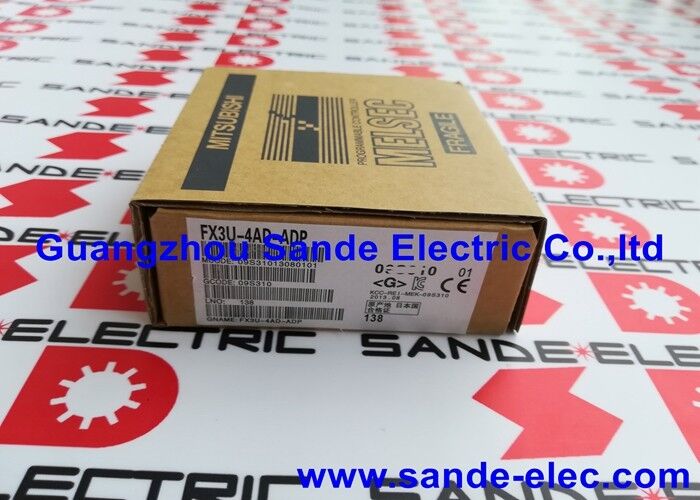
Mitsubishi FX3U-4AD-ADP | FX3U 4-Channel Analog Input Adapter — 0–10V / 4–20mA / 12-Bit / Programless / 0 I/O Points
Part Number: FX3U-4AD-ADP
Manufacturer: Mitsubishi Electric (Japan)
Product Type: Analog Input Adapter — ADP Type (left-side connection)
ADP Type: Left Side, No I/O Points, No FROM/TO Instructions
The distinction between an FX3U-4AD-ADP adapter and a standard FX3U-4AD special function unit matters practically. A special function unit mounts on the right side of the FX3U, consumes I/O points from the 256-point expansion budget, and requires FROM/TO instructions in the PLC ladder to read analog values. The ADP adapter mounts on the left side through a direct interface connector, uses zero I/O points, and transfers its four analog readings automatically into fixed special data registers — no dedicated analog ladder instructions needed.
For machines where the FX3U expansion slots are already occupied by digital modules, or where simplifying the PLC program is a priority, this is a meaningful difference. An FX3U at its expansion limit can still gain four analog inputs by adding the FX3U-4AD-ADP without modifying the existing I/O configuration.
Programless operation means the analog readings appear in registers D8280–D8299 (for the first adapter) automatically after power-on. The PLC ladder reads them with standard MOV and arithmetic instructions — the same way it reads any data register.
Per-Channel Mode Selection — Voltage and Current on the Same Adapter
Each of the four channels independently accepts either 0–10V DC or 4–20mA — the selection is per channel, set by writing to special configuration registers at program startup. A single FX3U-4AD-ADP can simultaneously handle voltage-output transmitters on some channels and 4–20mA loop-powered transmitters on others.
At 12-bit resolution for voltage, each step is 2.5mV — across a 0–10V range, that is 4096 discrete levels. For most industrial measurements (temperature, pressure, level, position), this resolution is finer than the transmitter's own accuracy allows. Current input at 11-bit gives approximately 7.8µA per step across the 4–20mA span, equivalent to about 0.05% of full-scale — again more than adequate for standard transmitter accuracy classes.
Key Specifications
| Parameter |
Value |
| Channels |
4 (voltage or current per channel) |
| Voltage |
0–10V DC / 12-bit |
| Current |
4–20mA / 11-bit |
| Speed |
500 µs / channel |
| I/O Points |
0 |
| Power |
24V DC / 40mA |
| Dimensions |
27.4 × 90 × 75 mm |
| Weight |
0.1 kg |
| Compatible |
FX3U, FX3UC, FX3G, FX3GE, FX3S |
FAQ
Q1: Does the FX3U-4AD-ADP work with FX2N or FX1N PLCs?
No. The ADP connection interface is specific to FX3U, FX3UC, FX3G, FX3GE, and FX3S platforms. FX2N and FX1N use a different right-side expansion system and do not have the left-side adapter connector. For FX2N analog input, use the FX2N-4AD special function unit.
Q2: How many FX3U-4AD-ADP units can connect to one FX3U?
Up to four ADP adapter units total can connect to the left side, including all adapter types. Two FX3U-4AD-ADP units provide eight analog input channels. For more than eight analog inputs, combine ADP adapters with FX3U-4AD or FX3U-8AD special function units on the right-side expansion chain.
Q3: Can the FX3U-4AD-ADP handle negative voltages or signals below 4mA?
No — the specified input ranges are 0–10V DC (unipolar) and 4–20mA. Negative voltages and sub-4mA signals are outside the module's input specification. For bipolar voltage (−10V to +10V) or full 0–20mA current range, use the FX3U-4AD special function unit which supports these wider ranges at 15-bit and 14-bit resolution.
Q4: What accuracy is specified, and under what conditions?
Voltage accuracy is ±0.5%, current accuracy is ±1.0%, both at 25°C ambient. The current input's lower accuracy reflects additional uncertainty from the shunt resistor measurement. These figures degrade slightly with temperature away from 25°C. For measurements where ±1.0% is insufficient, use the FX3U-4AD special function unit with higher bit-depth conversion.
Q5: Is special ladder programming required to read the analog values?
No — that is the key advantage of programless operation. The FX3U-4AD-ADP automatically transfers channel readings to special data registers (D8280–D8283 for channels 1–4 of the first adapter) each scan. The PLC program reads these with standard MOV or arithmetic instructions, the same as any data register. Channel mode configuration (voltage or current) is set by writing to configuration registers at program initialisation.


 Your message must be between 20-3,000 characters!