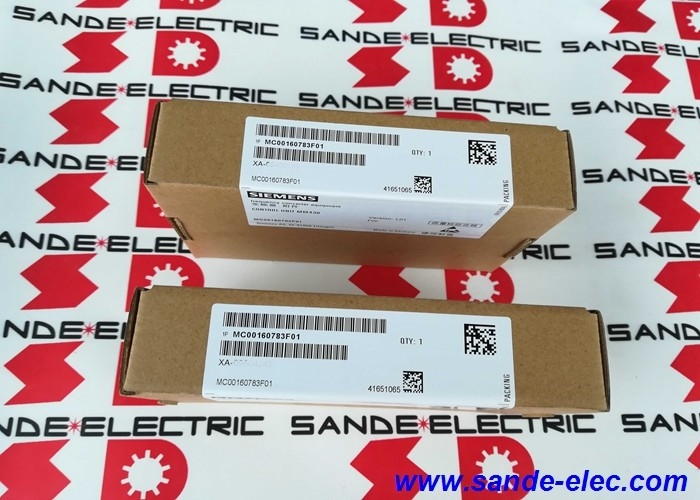
Siemens MC00160783F01 | Industrial Inverter Board — AC/DC Power Conversion, Drive Control, Industrial Automation Applications
Overview
The Siemens MC00160783F01 is an inverter board engineered for the precise control and conversion of electrical power within industrial drive and automation systems.
In the context of drive electronics, an inverter board sits at the heart of power conversion: it takes DC bus voltage from the rectifier section and synthesises the controlled AC output that drives the connected load, whether that is a motor, an actuator, or another power-consuming industrial process.
The quality of this conversion — how cleanly and accurately the inverter switches, how efficiently it manages heat, and how reliably it responds to control signals — determines the performance of the entire drive system.
Siemens designs its inverter boards to the same industrial robustness standards applied across its drive product families.
The board-level components are selected for long service life under the thermal cycling, vibration, and electrical stress conditions found in continuous-duty industrial environments. Gate driver circuits on the board provide the precise switching signals to the power semiconductors, while protection logic monitors for overcurrent, overvoltage, and overtemperature conditions, shutting the output stage down safely before damage occurs.
The MC00160783F01 serves as a replacement or spare board in Siemens drive systems that use this inverter assembly as part of their power conversion architecture. In practice, the inverter board is among the components most likely to require replacement over a drive's service life — power semiconductors are subject to cumulative stress from switching events and thermal cycles, and the board-level capacitors and gate drivers age in parallel.
Keeping a tested spare or exchange unit on hand is the standard maintenance strategy for facilities that cannot afford unplanned downtime on affected production equipment.
What an Inverter Board Does in a Drive System
Industrial drive systems — whether variable-frequency drives (VFDs), DC-to-AC inverters, or DC bus inverters — follow a consistent power conversion architecture. The incoming AC supply is first rectified to a DC bus, which stores and stabilises the intermediate energy in a bank of capacitors.
The inverter stage then converts this DC bus voltage back into the controlled AC (or DC) output the load requires, with the frequency, voltage, and waveform shaped precisely by the inverter's switching pattern.
The inverter board controls this switching process. Its gate driver circuits translate low-voltage control signals from the drive's processor into the high-power gate pulses that turn the output transistors (typically IGBTs) on and off at precisely the right moments.
The switching pattern — generated by Pulse Width Modulation (PWM) algorithms running in the drive's control processor — determines both the output voltage and frequency, and the smoothness of the resulting motor current waveform.
Because the inverter board interfaces directly between the low-voltage control circuitry and the high-voltage power stage, it carries special importance in the drive's safety architecture.
The board typically includes optocoupler isolation between the control and power domains, overcurrent desaturation detection on each transistor, and temperature monitoring linked to the drive's fault management system.
Reliability and Maintenance Considerations
Industrial inverter boards in continuous-duty applications face several degradation mechanisms over their operating life.
The IGBT gate driver components are subject to wear from repeated switching transients; electrolytic capacitors on the board experience degradation from heat; and solder joints on high-power components can develop micro-fractures from repeated thermal expansion and contraction cycles.
In practice, symptoms of inverter board deterioration often appear intermittently before complete failure: nuisance overcurrent trips without observable load changes, phase imbalance alarms, or increased motor noise at certain frequencies.
These symptoms typically indicate a gate driver that is losing consistent timing, a protection circuit with shifted threshold voltages, or a transistor approaching its end of life.
When these patterns appear, board-level replacement rather than component-level diagnosis is the fastest path to restoration, particularly in production environments where every hour of downtime has a direct cost.
The MC00160783F01 serves as the appropriate like-for-like board replacement in affected systems, restoring full inverter performance when the original board is no longer serviceable.
Applications
Industrial power conversion and motor drive control systems are deployed across a wide range of sectors, and the Siemens inverter board family supports applications wherever reliable, high-quality AC/DC conversion is required.
Manufacturing lines with variable-speed conveyors, pumping and fan systems with duty-cycle control, machine tools requiring precise spindle speed management, and processing lines with torque-controlled winding or unwinding equipment all represent typical environments for Siemens drive electronics of this class.
The board's role in power conversion makes it relevant wherever a Siemens drive system of the matching architecture is operating — the inverter board is a universal enabling component for the drive's fundamental output function.
FAQ
Q1: How do I confirm the MC00160783F01 is the correct inverter board replacement for my Siemens drive system?
Verify the original board's part number on the PCB silkscreen or the drive's spare parts documentation. The MC00160783F01 part number should appear on the board label or in the drive's spare parts list.
If neither is accessible, identify the parent drive's full model number and consult Siemens' spare parts documentation or a qualified service distributor to confirm the correct board part number before ordering.
Q2: Can an inverter board be replaced in the field, or does it require a specialist?
Board replacement itself — physically removing the failed board and installing the replacement — is within the capability of a competent drive maintenance technician who has been trained on Siemens drive hardware.
The procedure requires lockout/tagout of the drive, discharge of the DC bus capacitors (which retain lethal voltage after mains disconnection — always wait the specified discharge time), ESD precautions when handling the board, and correct torque on fasteners and connectors.
Commissioning verification after replacement should confirm the drive starts up without fault and runs the load through its normal duty cycle before returning to production.
Q3: What is the typical failure mode that requires inverter board replacement, rather than replacement of the drive as a whole?
Board-level replacement is appropriate when the drive's control electronics (operator interface, parameter storage, communication modules) are functioning correctly and fault diagnostics point to the power conversion output stage.
Overcurrent faults that appear at load, phase imbalance faults, or output transistor desaturation faults all indicate the inverter stage. If the fault originates in control electronics, communication interfaces, or the power supply section, different boards are implicated.
A systematic fault diagnostic following Siemens' troubleshooting procedure for the specific drive model confirms the root cause before committing to any board replacement.
Q4: Is it necessary to reconfigure parameters after replacing only the inverter board?
In most Siemens drive architectures, motor and application parameters are stored on the control board or in non-volatile memory on the control unit — not on the inverter board itself.
Replacing the inverter board alone does not typically require parameter re-entry, since the inverter board contains no parameter storage.
However, the drive should be powered up and the parameter set verified as intact before returning to production, and a brief function test should confirm normal operation.
Q5: How should the MC00160783F01 board be stored if held as a spare before use?
Inverter boards contain electrostatic discharge sensitive (ESD) components and should be stored in the original ESD-protective packaging or equivalent antistatic bags with moisture barrier protection.
Storage temperature should remain within the range specified for electronic components — typically −25°C to +70°C — in a dry, clean environment away from direct sunlight.
Avoid storing the board in locations subject to temperature extremes, condensation, or mechanical vibration.
Mark the storage date; electrolytic capacitors on boards stored for more than two years may require reforming before the board is placed into service.



 Your message must be between 20-3,000 characters!