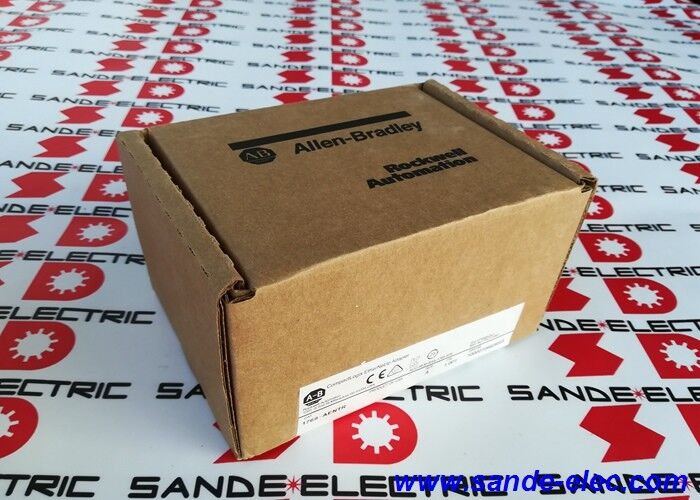
Allen-Bradley 1769-AENTR EtherNet/IP Adapter
Overview
The 1769-AENTR is an EtherNet/IP adapter for distributed 1769 Compact I/O assemblies.
Rockwell describes it as a module that lets users reuse 1769 I/O in a distributed EtherNet/IP architecture, helping standardize on a scalable platform while keeping existing 1769 I/O investment.
Rockwell’s Compact I/O technical data also lists 1769 modules as usable in an assembly with a 1769-AENTR Ethernet adapter, confirming its role as the network-side entry point for a 1769 remote I/O bank.
From an installation standpoint, Rockwell lists the 1769-AENTR with DIN rail or panel mounting, approximate weight of 0.28 kg, maximum surrounding air temperature of 60 °C, Class A emissions, 2 G vibration resistance, 6 kV contact / 8 kV air ESD immunity, ±3 kV EFT/B immunity on communications ports, and 5 to 95% noncondensing humidity. These details place it clearly in the industrial communication layer of a Compact I/O system rather than in the signal-module category.
Technical Data
| Parameter | Value |
|---|
| Part Number | 1769-AENTR |
| Manufacturer | Allen-Bradley / Rockwell Automation |
| Product Type | EtherNet/IP adapter |
| System Role | Distributed adapter for 1769 Compact I/O |
| Mounting | DIN rail or panel mount |
| Weight, approx. | 0.28 kg |
| Surrounding Air Temperature, max. | 60 °C |
| Emissions | CISPR 11 (IEC 61000-6-4): Class A |
| Vibration | 2 G @ 10...500 Hz |
| ESD Immunity | 6 kV contact, 8 kV air |
| EFT/B Immunity | ±3 kV @ 5 kHz on communications ports |
| Relative Humidity | 5...95% noncondensing |
Application Value
The 1769-AENTR is well suited to distributed 1769 Compact I/O stations, networked machine panels, remote I/O islands, and CompactLogix-based architectures where 1769 I/O must be placed away from the main controller while staying on EtherNet/IP.
Its published role is especially useful in projects that want to keep existing 1769 I/O hardware in service while moving the system toward a more distributed network structure.
This adapter is also practical in modernization work.
Rockwell specifically positions it as a way to reuse 1769 I/O when migrating to newer CompactLogix-based systems, which makes it relevant not only in new distributed layouts but also in retrofit paths where preserving I/O hardware is part of the project strategy.
Selection Notes
The most important checks are the 1769 I/O platform, the need for an EtherNet/IP distributed adapter, the mounting arrangement, and the environmental limits of the installation. Rockwell’s technical data also notes that, unless connected to a MicroLogix 1500 base, each bank of 1769 I/O modules must include its own power supply.
FAQ
Q1: What is 1769-AENTR used for?
It is used to connect a 1769 Compact I/O bank to an EtherNet/IP network as a distributed I/O assembly.
Rockwell describes it as an adapter that allows 1769 I/O to be reused in a scalable, distributed architecture, which makes it useful when the I/O needs to be installed remotely from the controller.
Q2: Is 1769-AENTR itself an input or output module?
No. It is not a signal I/O module. It is the network adapter for the 1769 I/O assembly, while the digital, analog, and specialty signal modules are installed alongside it in the Compact I/O bank.
Rockwell’s Compact I/O documentation separates the 1769-AENTR from the actual signal modules and lists it as the Ethernet adapter in that assembly.
Q3: Why do the environmental specifications matter on this adapter?
Because the adapter sits at the communication entry point of the remote I/O bank and has to remain stable in industrial conditions.
Rockwell publishes limits for temperature, humidity, vibration, ESD, and EFT/B immunity, which are all relevant when the module is installed in control cabinets, machine frames, or distributed field enclosures.
Those ratings help confirm whether the adapter matches the environmental demands of the target installation.
Q4: Can this adapter help in upgrading older 1769 I/O systems?
Yes. Rockwell’s own product literature states that the 1769-AENTR allows CompactLogix users to reuse existing 1769 I/O when moving toward a next-generation controller architecture. That makes it especially useful in retrofit projects where the objective is to preserve installed I/O hardware while changing the network layout or controller strategy.
Q5: What should be checked before ordering?
Check that the installed system is based on 1769 Compact I/O, confirm the application needs an EtherNet/IP distributed adapter, verify the mounting method and environmental requirements, and make sure the I/O bank has the required power-supply arrangement.
Those are the main compatibility points for the 1769-AENTR.



 Your message must be between 20-3,000 characters!