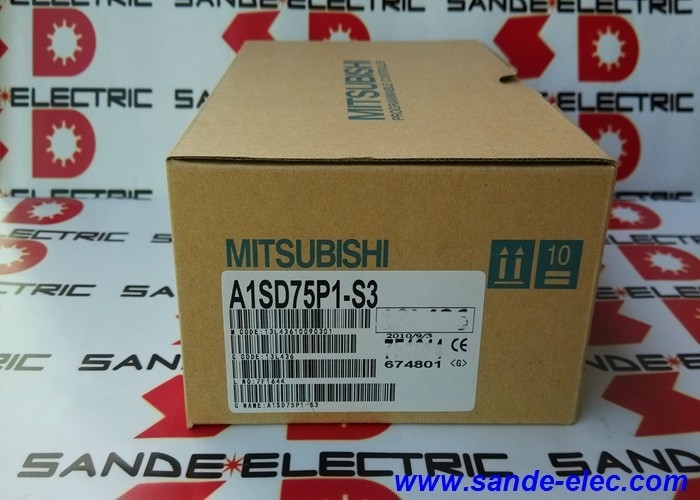
Mitsubishi A1SD75P1-S3 | MELSEC-A 1-Axis Positioning Module — 200kpps / 400kpps / 32 I/O Points / Rack-Integrated
Pulse-Train Positioning Inside the PLC Rack
The A1SD75P1-S3 is a single-axis positioning module for Mitsubishi's MELSEC-A PLC rack — a dedicated motion card that integrates directly into the rack architecture rather than operating as a standalone controller. The module occupies 32 I/O points in the MELSEC-A rack configuration and handles the pulse train output that commands a servo driver or stepper driver for the connected axis.
Keeping positioning inside the PLC rack means the motion sequence runs in close synchronisation with the PLC's ladder logic. For machines where the axis move must be tightly interlocked with discrete I/O events — index position confirmation, feed length counting, transfer arm sequencing — this rack-integrated approach removes the communication latency that would exist between a PLC and a separate standalone controller.
Key Specifications
| Parameter | Value |
|---|
| Part Number | A1SD75P1-S3 |
| Axes | 1 |
| Platform | MELSEC-A |
| Pulse Output (open-collector) | 200 kpps max |
| Pulse Output (differential driver) | 400 kpps max |
| I/O Points Occupied | 32 |
| Current Consumption | 5V DC, 0.7A max |
| Dimensions (H×W×D) | 130 × 34.5 × 93.6 mm |
| Weight | 0.35 kg |
Open-Collector vs Differential Driver — Which Matters for Your Drive
The A1SD75P1-S3 supports two pulse output methods at different maximum rates:
Open-collector (200 kpps): Suitable for servo drivers and stepper drivers with NPN-input pulse interfaces at cable distances where the reduced noise immunity of a single-ended signal is acceptable. Many older and current drive products accept open-collector pulse inputs directly.
Differential driver (400 kpps): Provides superior noise immunity over longer cable runs by transmitting the pulse signal as a differential pair — the drive's input rejects common-mode interference. The doubled pulse output rate (400 kpps vs 200 kpps) also supports faster positioning or higher-resolution feedback applications where the extra bandwidth matters.
The connected servo driver's pulse input specification determines which output method applies. For new installations, differential driver connection is preferred where the drive supports it.
MELSEC-A Platform — Replacement Context
The MELSEC-A series is a mature platform. Machines built on MELSEC-A hardware continue in production worldwide, and the A1SD75P1-S3 remains the correct module for single-axis positioning in this rack architecture. Replacing with a different positioning module — even one from a later Mitsubishi series — may change the rack address allocation, ladder instruction set, and parameter format, requiring programme modifications.
For machines already running with this module, like-for-like replacement with A1SD75P1-S3 preserves the existing ladder logic, I/O addressing, and positioning data table without modifications to the control programme.
FAQ
Q1: What is the maximum positioning speed with this module?
Maximum pulse output rate is 200 kpps in open-collector mode and 400 kpps in differential driver mode. The corresponding mechanical speed at the load depends on the servo drive's electronic gear ratio setting and the mechanical transmission ratio. At 400 kpps with a typical servo motor and 0.1µm/pulse mechanical resolution, this covers most industrial axis traverse requirements.
Q2: Can the A1SD75P1-S3 be used in MELSEC-Q or iQ-R racks?
No. The A1SD75P1-S3 is designed for the MELSEC-A rack platform. MELSEC-Q and iQ-R series use different bus architectures, connector formats, and instruction sets. The A1SD75 module family has equivalents for the Q series (QD75 series) and the iQ-R series, but these are separate products and are not mechanically or electrically interchangeable.
Q3: The module occupies 32 I/O points. What does this mean for rack configuration?
Intelligent positioning modules like the A1SD75P1-S3 consume a defined block of I/O address space in the MELSEC-A rack, separate from standard digital I/O modules. The 32 points occupied by this module must be allocated in the PLC's I/O assignment during system configuration. For replacement work, the new module is installed in the same slot position and I/O allocation remains unchanged.
Q4: What positioning operations are supported?
The MELSEC-A D75P1 family supports point-to-point positioning (absolute and incremental), speed control, speed-position switching, and position-speed switching operations. Trapezoidal acceleration/deceleration profiles and multiple speed sections are configurable in the module's positioning data table. The specific parameter table format is defined in the Mitsubishi A1SD75 Positioning Module User's Manual.
Q5: When replacing the A1SD75P1-S3, is the positioning data preserved?
Positioning data (target positions, speeds, acceleration times) is stored in the module's internal memory, not in the PLC's main CPU. The data must be backed up before removal — typically via the PLC programming software (GX Developer or compatible) or via the module's RS-232 interface if available. After fitting the replacement module, reload the positioning data before running the axis.



 Your message must be between 20-3,000 characters!