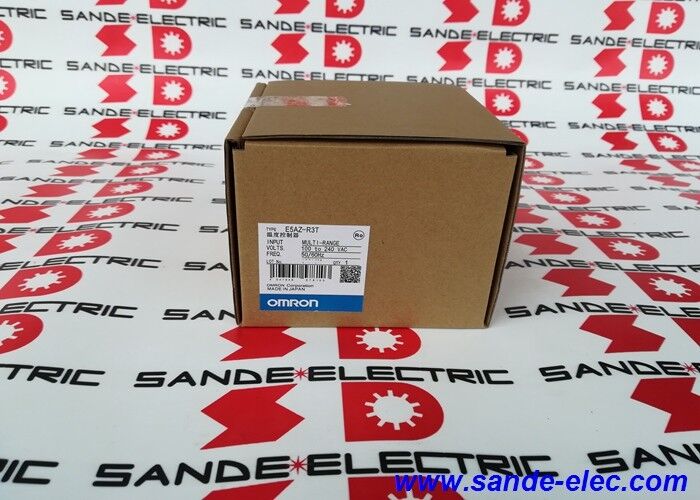
Omron E5AZ-R3T | E5AZ Series 1/4 DIN Digital Temperature Controller — Universal Input (TC/RTD), Relay Output, 3 Alarm Outputs, 100–240VAC, 96×96×78mm, 250ms Sampling
Overview
The Omron E5AZ-R3T is a 1/4 DIN digital temperature controller from Omron's E5AZ series — the 96×96mm size controller that sits in the middle of Omron's E5_Z controller family, above the compact 1/16 DIN (E5CZ) and beside the half-size 1/8 DIN (E5EZ). The E5AZ-R3T is the relay output variant with three alarm outputs — the R in the designation indicates relay control output, and the 3T identifies three alarm points.
Temperature controllers of this type seem straightforward — they read a sensor, compare it to a setpoint, and switch an output on or off to regulate the temperature. But the engineering inside a capable controller like the E5AZ-R3T goes considerably further than that simple description suggests.
The universal input stage accepts a wide range of sensor types — eight or more thermocouple types and the standard platinum RTD families — without requiring sensor-specific hardware.
The PID algorithm continuously calculates proportional, integral, and derivative corrections to the output cycle time, keeping temperature steady through load changes and ambient disturbances that ON/OFF control would chase reactively.
The three alarm outputs handle process monitoring functions independently of the primary control loop.
The 250ms sampling period is notably faster than older-generation temperature controllers, which typically sampled at 500ms intervals.
Halving the sampling time improves the controller's ability to detect and respond to rapid temperature changes — relevant in applications where heater inertia is low or where process dynamics change quickly, such as thin film heat sealing or semiconductor process chambers.
Key Specifications
| Parameter |
Value |
| Form Factor |
1/4 DIN — 96×96mm |
| Dimensions (W×H×D) |
96×96×78mm |
| Power Supply |
100–240VAC |
| Input |
Universal TC/RTD |
| Control Output |
Relay (SPST-NO) |
| Alarm Outputs |
3 |
| Sampling |
250ms |
| Transfer Output |
Yes |
| Auto-Tuning |
Yes |
| Status |
Discontinued |
Universal Input — One Controller for Many Sensor Types
The E5AZ-R3T's universal input is one of its most practically valuable features for maintenance managers and spare parts inventory planners.
In a plant with multiple machines and multiple temperature zones — some using K-type thermocouples because they cover a wide temperature range economically, some using J-type because they suit lower-temperature food processing applications, some using Pt100 RTDs because precision matters — a non-universal temperature controller would require stocking separate models for each sensor type.
A universal input controller like the E5AZ-R3T covers all of these from a single spare part.
The input type is configured by a parameter setting, not by hardware jumpers or different circuit boards. When a replacement controller is installed, the sensor type is selected from a menu on the controller's front panel (or programmed via serial communication), and the controller adjusts its linearisation, display scaling, and alarm range accordingly.
This software-selectable input type also means that if a machine's temperature zone is redesigned to use a different sensor type, the same controller hardware can be reconfigured rather than replaced.
The controller displays temperature in degrees Celsius or Fahrenheit, selectable by parameter.
Three Alarm Outputs — Independent Process Monitoring
The three alarm outputs in the E5AZ-R3T provide configurable alarm functions that monitor process conditions independently of the primary temperature control output. Each alarm output can be configured for different alarm types from the controller's parameter settings:
Upper limit alarm: Alarm activates when the process temperature exceeds a defined threshold above the setpoint or above an absolute temperature limit — protecting equipment or product from overtemperature.
Lower limit alarm: Alarm activates when temperature falls below a defined threshold — detecting heater failure, process stoppage, or cold feed introduction.
Deviation alarms: Alarm triggers when temperature deviates from setpoint by more than a configured amount in either direction — detecting loss of control without requiring separate limit values.
Absolute value alarms: The alarm threshold is an absolute temperature value rather than a deviation from setpoint.
With three independent alarm outputs, a single E5AZ-R3T can simultaneously provide: a process deviation warning alarm (modest deviation from setpoint), a process deviation emergency alarm (large deviation), and a high-absolute-limit alarm — three layers of process protection from one controller.
Transfer Output — Integration with Recorders and SCADA
The transfer output on the E5AZ-R3T retransmits the measured process value as an analog signal (current or voltage, configurable) proportional to the temperature.
This analog output connects to a strip chart recorder, a paperless recorder, a DCS/SCADA analog input card, or a supervisory computer's data acquisition system — allowing the temperature profile to be logged over time independently of the controller's own display.
In process validation applications — pharmaceutical manufacturing, food safety documentation, medical device production — continuous temperature recording with a calibrated independent recorder is often a regulatory requirement.
The E5AZ-R3T's transfer output enables this independent recording without modifying the sensor installation or adding a separate measurement instrument.
FAQ
Q1: What is the difference between the E5AZ-R3T and the E5AZ-R3MT, and which should be chosen?
The E5AZ-R3T is the standard model without a manual output function. The E5AZ-R3MT adds manual output capability — the operator can override the PID algorithm and manually set the output value (e.g., 50% duty cycle) independently of the automatic control loop.
Manual output is useful during commissioning (to verify heater and actuator response before enabling automatic control), during troubleshooting (to hold output at a fixed value while diagnosing the process), and in applications where temporary manual override is a process requirement.
For standard automatic temperature control without manual override needs, the R3T is sufficient.
Q2: Can the E5AZ-R3T communicate with a PLC or computer for remote setpoint changes?
The standard E5AZ-R3T does not include a built-in serial communication interface. Communication capability can be added by installing a compatible Option Unit (such as the E53-AZR) in the controller's option unit slot, which provides RS-485 CompoWay/F or Modbus communication.
With the communication option, setpoints, alarm thresholds, process values, and controller status can be read and written remotely from a SCADA system, PLC, or PC without operator intervention at the controller's front panel.
Q3: What is auto-tuning, and when should it be triggered?
Auto-tuning is a built-in PID parameter calculation function. When triggered by the operator, the controller applies a step change to the output and measures the temperature response — observing the delay time, rise time, and overshoot characteristics.
From this response, it calculates the proportional band, integral time, and derivative time values that will provide stable, responsive control for this specific process and heater combination.
Auto-tuning should be run during initial commissioning and after any significant change to the process — new heater elements, changed thermal load, different product — because the optimal PID parameters depend on the actual process thermal dynamics.
Q4: The relay output is rated at 250VAC. Can it directly drive a 230VAC heater contactor coil?
The E5AZ-R3T's relay output is rated for resistive loads at 250VAC and 5A maximum. Driving a contactor coil directly from the controller's relay output is generally acceptable if the contactor coil's inrush current is within the relay's rated switching capacity.
However, the relay's electrical life (number of switching operations) is reduced by inductive loads.
For long-term reliability in high-cycle applications — where the temperature controller switches thousands of times per day — an SSR (Solid State Relay) or an intermediate relay module between the E5AZ-R3T output and the contactor provides improved switching life.
The E5AZ-Q3T voltage output variant is specifically designed to drive SSRs directly.
Q5: What is the panel cutout size required to mount the E5AZ-R3T?
The E5AZ-R3T requires a panel cutout of 92 × 92mm. The controller's front face is 96 × 96mm, which overlaps the panel surface around the cutout. The mounting depth behind the panel face is 78mm — the controller projects 78mm into the panel.
Standard DIN rail mounting is not used for this type of panel-mount controller; the E5AZ-R3T installs by inserting it from the front through the panel cutout and securing it with the two side mounting clips that are tightened from behind the panel.
Panel thickness should be within the range specified in the E5AZ installation documentation.



 Your message must be between 20-3,000 characters!