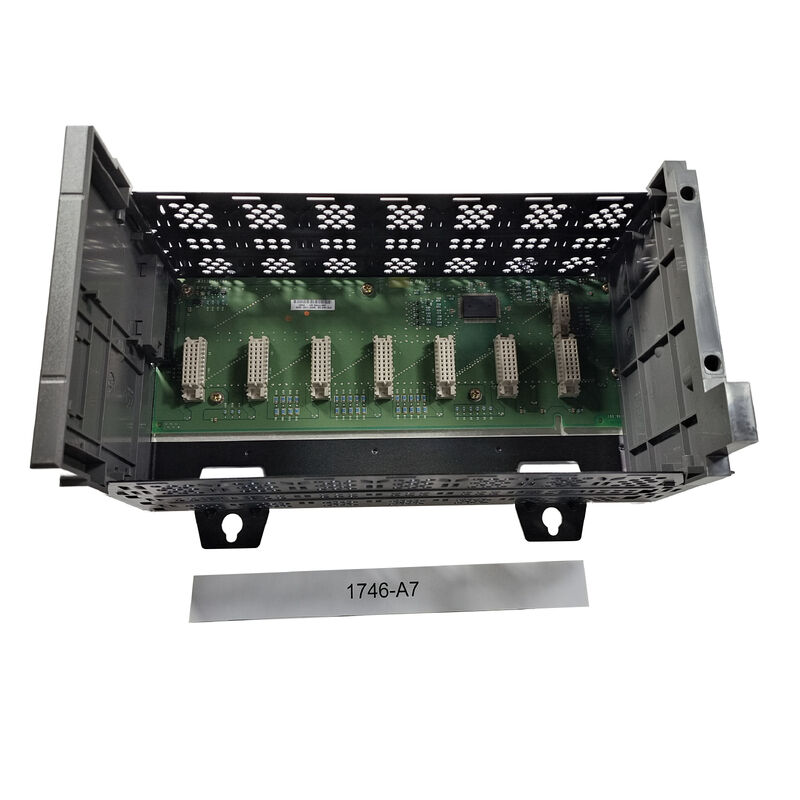
Allen-Bradley 1746-A7 SLC 500 Modular Chassis
Overview
The 1746-A7 is a 7-slot modular chassis for the SLC 500 family. Rockwell’s product page identifies it as a 7-slot chassis-modular hardware style, and system literature describes the 1746 chassis family as back-panel-mounted hardware available in 4-, 7-, 10-, and 13-slot versions.
The 1746-A7 is also listed as discontinued, which explains why it remains important in lifecycle support and spare-parts work.
In practical control systems, the value of a chassis is easy to underestimate.
The chassis defines the physical and electrical home for the processor, power supply, and I/O modules, so replacing the right chassis is often essential to preserving the original structure of an SLC system.
For installed machines, using the same 7-slot chassis usually avoids cabinet rework and keeps the module arrangement, backplane format, and panel footprint familiar.
That is an engineering inference based on the published role of the SLC 1746 chassis family and the exact 1746-A7 slot format.
Technical Data
| Parameter |
Value |
| Part Number |
1746-A7 |
| Manufacturer |
Allen-Bradley / Rockwell Automation |
| Product Type |
PLC Rack / Modular Chassis |
| Product Family |
SLC 500 / 1746 System |
| Number of Slots |
7 |
| Hardware Style |
Chassis-Modular Hardware Style |
| Mounting Style |
Back-panel / panel mount |
| Current Capacity |
10 A at 5 VDC |
| Dimensions |
171 × 282 × 145 mm |
| Mounting Tabs |
Four mounting tabs |
| Product Position |
Installed-base replacement chassis |
| Lifecycle Status |
Discontinued |
Application Value
The 1746-A7 is well suited to installed SLC 500 systems, machine control cabinets, utility panels, retrofit projects, and local I/O stations where a 7-slot modular chassis is already part of the design.
It is particularly practical in legacy systems that do not need a larger 10-slot or 13-slot hardware frame but still require more flexibility than a very small chassis can provide. In real service work, this makes it a common choice when an existing SLC cabinet needs physical restoration rather than platform migration.
This application view follows from the published 7-slot chassis identity and the SLC 500 modular hardware architecture.
The chassis installation style also matters. Rockwell installation material shows back-panel mounting and references mounting hardware associated with the chassis tabs, while SLC modular hardware documentation describes direct back-panel mounting using the mounting tabs and standard screws.
That is important in the field because chassis replacement is as much a mechanical task as an electrical one.
Replacement and Selection Perspective
The 1746-A7 should be selected as a system-matched chassis, not simply by the number of slots.
Buyers should verify the installed chassis size, mounting style, slot count, the processor and power supply arrangement already in use, and the required chassis current capacity before ordering.
In SLC systems, the physical chassis is part of the machine architecture, so an exact replacement usually prevents more trouble than trying to adapt a different size or hardware style.
This is an engineering recommendation grounded in the published 1746-A7 product identity and SLC chassis family documentation.
FAQ
Q1: What kind of hardware is 1746-A7?
It is a 7-slot SLC 500 modular chassis used to hold the processor, power supply, and I/O modules in a 1746-based control system. In practical terms, it is the structural and backplane foundation of the SLC rack.
Q2: What applications fit this chassis best?
It fits legacy SLC 500 machine panels, local I/O stations, retrofit projects, and utility cabinets where a 7-slot rack is already part of the installed design. That use profile follows directly from the model’s published slot count and SLC family role.
Q3: Why does the exact slot count matter?
Because the chassis determines how many modules the system can physically and electrically support, and it also affects panel layout and cable routing. Replacing a 7-slot chassis with the same size usually keeps the cabinet arrangement much closer to the original design. This is an engineering inference based on the published SLC chassis family architecture.
Q4: Why is mounting style important on this part?
Because chassis replacement is not only about the backplane. The mounting tabs, panel footprint, and enclosure layout all affect how quickly the hardware can be installed and grounded properly in the cabinet. Rockwell installation material specifically ties the chassis to back-panel mounting using chassis tabs.
Q5: What should be checked before ordering?
Check the installed chassis part number, the required slot count, the processor and power-supply arrangement, the mounting footprint, and the current-capacity needs of the existing rack. Those checks usually matter more than appearance alone.



 Your message must be between 20-3,000 characters!