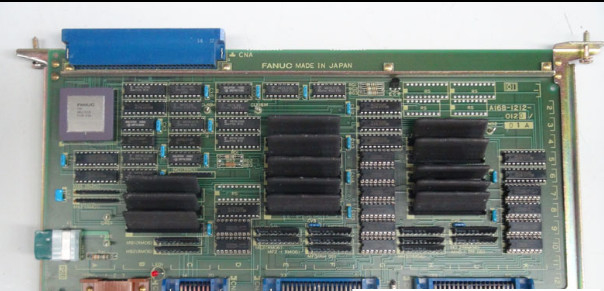
A16B-1212-0120 | FANUC Robot RG Control DI/DO I/O PCB — Digital Input/Output Interface Board / Robot Controller Spare
DI/DO — The Language Between the Robot and Its World
An industrial robot does not operate in isolation. It interacts constantly with the machines, fixtures, conveyors, and safety systems around it. Every one of those interactions is mediated by digital signals:
Digital Inputs (DI): Signals arriving at the robot controller from the outside world — end-effector sensor confirming a part is gripped, conveyor position sensor indicating a pallet is ready, safety gate switch confirming the cell is clear, interlock signal from an upstream machine.
Digital Outputs (DO): Signals the robot sends to its environment — gripper open/close command, tool change request, cycle complete signal to the host PLC, indicator lamp on the operator station, request for a new pallet.
The A16B-1212-0120 is the I/O PCB that provides these DI/DO signal paths in the applicable FANUC robot controller. It connects external field wiring to the robot's internal control bus, allowing the robot programme to read input states and command output states during execution.
Key Product Information
| Parameter |
Value |
| Part Number |
A16B-1212-0120 |
| Description |
RG Control I/O PCB |
| Type |
DI/DO I/O board |
| Application |
FANUC robot controllers |
| Category |
FANUC Robot PCB |
| Series |
A16B-1212 |
RG Control — Robot I/O Interface Designation
The "RG Control" designation in the board description identifies this as a FANUC robot-specific I/O board rather than a CNC machine tool I/O board. While the A16B-1212 series covers multiple board types across FANUC's product range, the 0120 board is specifically categorised in the robot PCB family — its signal interface, connector pinout, and electrical specification match the I/O requirements of FANUC robot controller hardware.
Robot I/O boards differ from CNC machine I/O boards in their signal assignments and the specific robot controller bus interface. The A16B-1212-0120 is designed to interface with the robot controller's internal signal bus and the I/O communication protocol used in FANUC robot control cabinets.
Application Scenarios
Robot cell I/O fault: A FANUC robot develops intermittent alarm codes related to its digital inputs. Field wiring checks confirm all sensor signals are present and correct at the terminal block level. The A16B-1212-0120 I/O board is identified as the fault source. Replacement restores reliable DI/DO signal processing.
Robot controller preventive maintenance: A facility performing scheduled maintenance on a FANUC robot controller replaces the A16B-1212-0120 I/O board as part of a board-level refresh to prevent age-related I/O failures.
FAQ
Q1: How many DI and DO points does the A16B-1212-0120 provide?
The DI/DO point count is defined by the specific I/O board design and the robot controller configuration. Confirm the point count from the robot controller's hardware maintenance manual or the I/O board specification in the spare parts list for the applicable controller model. FANUC robot I/O boards in this generation typically provide 32 to 96 DI points and 32 to 64 DO points per board, depending on the variant.
Q2: What robot controller models is the A16B-1212-0120 compatible with?
The A16B-1212-0120 is categorised as a FANUC Robot PCB. The specific controller compatibility — R-J2, R-J3, or another FANUC robot controller generation — depends on which controller the board was originally installed in. Confirm the target robot controller model from the maintenance documentation before ordering.
Q3: Does replacing the A16B-1212-0120 require robot programme reloading?
The I/O board does not store robot programmes or system parameters. Replacing the board does not affect programme content. However, if the I/O board also carries any address configuration or DIP switch settings that define its I/O assignment, confirm the settings from the failed board before fitting the replacement. Always back up all robot programmes and system variables before any controller maintenance.
Q4: What revision suffixes exist for A16B-1212-0120?
The A16B-1212-0120 is known to have at least revision /01A and /02A. Later revisions are typically backward compatible with the same controller hardware. If the exact revision is visible on the installed board label, note it and confirm the available replacement revision is compatible before ordering.
Q5: What ESD precautions apply when handling A16B-1212-0120?
Handle with a grounded anti-static wrist strap on a grounded ESD-safe work surface. Store in anti-static packaging. The CMOS and mixed-signal ICs on the board are sensitive to electrostatic discharge. Power down the robot controller completely and follow the controller's lockout procedure before accessing any internal boards.


 Your message must be between 20-3,000 characters!