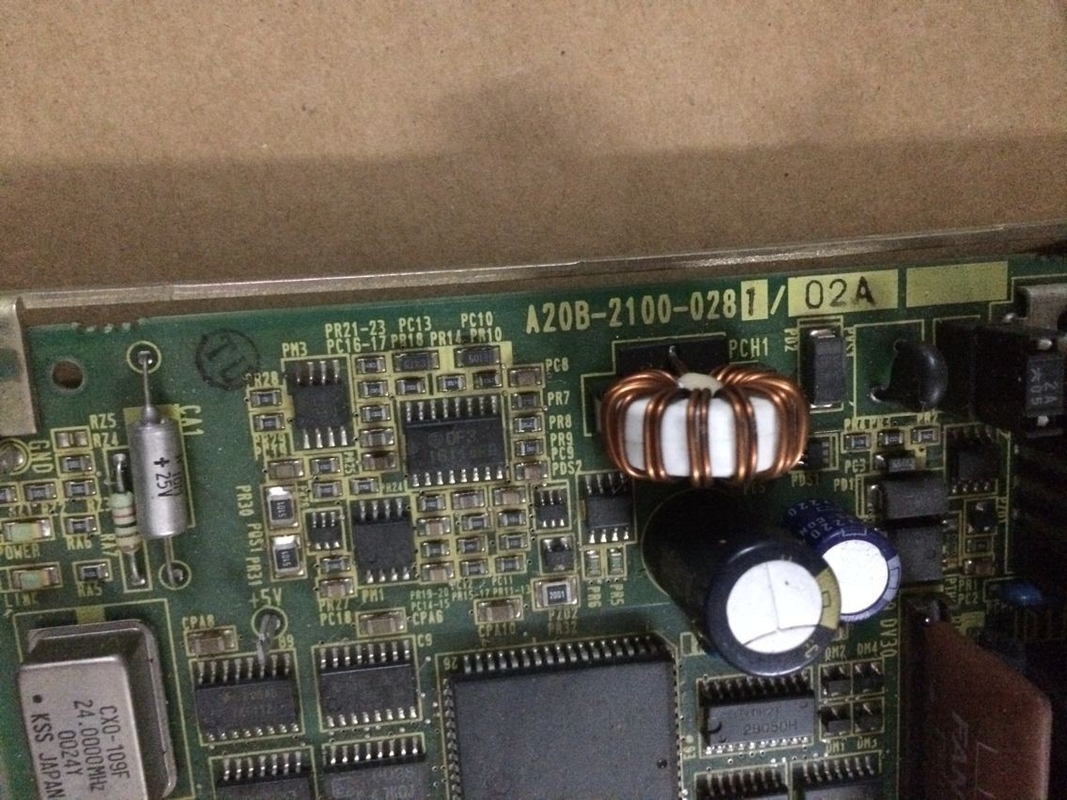
A20B-2100-0280 | FANUC Loader I/O PCB — CNC-Integrated Parts Loader Interface Board / A20B-2100 Series
What a Loader Does — and Why It Needs Its Own I/O Board
Many CNC machine tools — particularly turning centres and machining cells — integrate an automatic loader as an extension of their production capability. A loader is the automated handling system that feeds workpieces into the machine and removes finished parts, allowing unattended or minimally attended production:
Bar feeders: Supply raw bar stock continuously to a CNC lathe, allowing the lathe to part off multiple components from a single bar without operator loading between parts.
Gantry loaders: Overhead cartesian handling systems that pick raw castings or blanks from a queue, load them into the CNC chuck or fixture, and remove finished parts to an output conveyor.
Parts transfer units: Mechanical systems that move workpieces between lathe chucks (sub-spindle transfer, for example) or between machines in a flexible manufacturing cell.
All of these systems exchange digital signals with the CNC. The loader signals the CNC when a part is in position; the CNC signals the loader when the chuck is clamped, the door is closed, or the cycle is complete. The A20B-2100-0280 provides the dedicated I/O interface for this signal exchange.
Key Product Information
| Parameter |
Value |
| Part Number |
A20B-2100-0280 |
| Description |
Loader I/O PCB |
| Series |
A20B-2100 |
| Type |
Digital I/O interface board |
| Application |
CNC-integrated loader systems |
Dedicated Loader I/O — Why Separation from Standard Machine I/O Matters
CNC machine tools use two types of I/O in their PMC:
Standard machine I/O: Covers the machine's own functions — coolant, door interlocks, axis brakes, spindle starters, hydraulic system.
Loader I/O: Covers the loader system's functions — loader arm position sensors, gripper open/close, part presence detection, loading cycle request, door open/close permission.
Separating loader I/O onto a dedicated board (A20B-2100-0280) keeps the loader interface hardware isolated from the machine's own I/O. This has practical benefits:
When the loader is removed from the machine for maintenance or when a machine is temporarily operated without the loader, the loader I/O board can be disconnected without affecting the machine's standard I/O functions. Loader-specific alarm codes and signal faults are traceable to the A20B-2100-0280, simplifying fault diagnosis in combined machine/loader systems.
PMC Signal Coordination
The CNC's PMC ladder programme coordinates the machine and loader as one integrated system. A typical loading sequence:
- CNC completes the machining cycle and sends a "cycle complete" signal via the A20B-2100-0280 to the loader
- Loader receives the signal and sends a "door open request" back to the CNC
- CNC opens the door and sends "door open confirmed"
- Loader enters the machine, exchanges parts, and sends "clear"
- CNC closes the door and confirms closure before starting the next cycle
All of these exchanges pass through the A20B-2100-0280. When this board fails, the loader-CNC handshaking breaks down — the loader either fails to respond to CNC signals or the CNC fails to receive loader confirmation, causing production interruption.
Application Scenarios
Loader handshaking failure: A CNC lathe with a gantry loader develops intermittent production stops — the loader signals are not reliably reaching the CNC. Machine I/O functions work correctly, but loader cycle initiation fails. The A20B-2100-0280 is identified as the fault. Replacement restores reliable loader integration.
System commissioning: A machine tool builder integrating a new loader system with a FANUC CNC installs the A20B-2100-0280 to provide the dedicated I/O channels for the loader interface.
FAQ
Q1: How does the PMC address the I/O points on the A20B-2100-0280?
The A20B-2100-0280 connects to the CNC's I/O Link bus, providing its digital I/O points to the PMC through a defined I/O Link address range. The PMC ladder programme reads loader input states and writes loader output commands through these addresses. The address assignment is set during commissioning and documented in the machine's electrical specification. After board replacement, verify the I/O Link address configuration matches the original to ensure the PMC ladder continues addressing the correct physical signals.
Q2: Can the standard machine I/O continue to operate if the A20B-2100-0280 fails?
Yes. The A20B-2100-0280 is a dedicated loader I/O board — a separate node on the I/O Link bus from the machine's standard I/O boards. If the loader I/O board fails, the CNC will generate an I/O Link alarm for the loader node but the machine's own I/O (coolant, doors, axis brakes, spindle) can continue to operate if the PMC is programmed to handle the loader fault gracefully. The PMC ladder's response to loader I/O loss depends on how the machine builder implemented the loader safety logic.
Q3: What is the digital I/O point count on the A20B-2100-0280?
The specific input and output count depends on the board's internal configuration and the I/O Link address block assigned to it. FANUC I/O boards in the A20B-2100 series typically provide 32 to 64 DI and DO points in combinations matching the loader application requirement. Confirm the point count from the machine's electrical documentation or the FANUC maintenance manual for the specific CNC and loader configuration.
Q4: Does replacing the A20B-2100-0280 require changes to the PMC programme?
No, provided the replacement board is the same model and is configured with the same I/O Link address as the failed board. The PMC programme addresses I/O by address, not by hardware identity. A like-for-like replacement at the same address restores loader I/O communication transparently. If the PMC programme does need changes — for example, if the replacement board has a different I/O point layout — the machine builder's support is required.
Q5: What safety considerations apply when the loader I/O board is being replaced?
Loader systems involve moving mechanical arms, pneumatic grippers, and door actuators. Before replacing the A20B-2100-0280, confirm the loader is fully retracted and parked in its home position. Disable the loader system's power supply (pneumatic and electrical) independently of the CNC before accessing any loader-related electrical components. Follow the machine tool builder's lockout procedure for combined machine/loader maintenance.


 Your message must be between 20-3,000 characters!