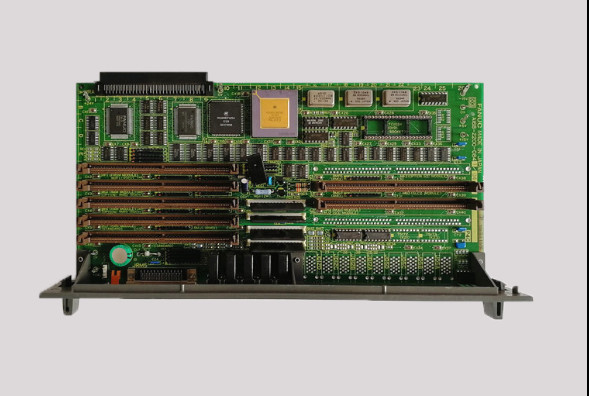
A16B-2202-0850 | FANUC 6-Axis Option-2 CPU Board — 7 Plug-In Slots / Series 16/18 Axis Expansion / Sub-CPU Architecture
Option-2 — Extending the Axis Count Beyond the Base Board
In the FANUC Series 16/18 CNC hardware architecture, the main CPU board handles the base axis count — typically 4 axes in a standard configuration. When a machine tool requires more axes, the Option-2 sub-CPU board extends the system beyond this base limit.
The A16B-2202-0850 is the 6-axis variant of the Option-2 board — a dedicated sub-CPU that takes responsibility for servo axis processing for additional axes beyond those handled by the main CPU board.
This architecture appears consistently across the FANUC CNC product line of this era:
A16B-2203-0031 (OPTION-2 2-AXIS): Described elsewhere in this session — a 2-axis expansion sub-CPU for Series 16/18 applications.
A16B-2203-0033 (OPTION-2 SUB-CPU with sub-CPU): The higher-capability option board with embedded sub-CPU, also confirmed in this session.
A16B-2202-0850 (6-AXIS OPTION-2): The 6-axis expansion variant — for machines requiring up to 6 servo axes coordinated through this option board.
Key Product Information
| Parameter |
Value |
| Axis Count |
6 axes |
| Plug-In Slots |
7 |
| Board Type |
Option-2 CPU board |
| Series |
A16B-2202 |
| Application |
Series 16/18 CNC expansion |
6-Axis CNC — Machine Tool Applications
Why would a machine need 6 axes on its Option-2 board? The axis count reflects the machine tool's mechanical complexity:
5-axis machining centres with indexer: X, Y, Z are base axes; A, B (rotary axes), and a 6th tool magazine axis or pallet indexer all need servo control.
Multi-turret turning centres: Z, X, C (main spindle), Y (additional milling), second turret Z2 and X2 axes — six total servo axes for a complex turn-mill centre.
Transfer machine cells: In a flexible transfer machine, multiple independent servo axes position parts through sequential operations — the 6-axis count covers the full station complement.
Application Scenarios
Series 18-B 6-axis machining centre expansion board fault: A FANUC Series 18-B 5-axis machining centre with an additional B-axis develops alarms on the expansion axes. The A16B-2202-0850 is identified as the fault. Replacement restores all 6 axes handled by the option board.
Series 16-B multi-axis turning centre maintenance: A complex CNC turning centre with dual turrets and a C-axis requires Option-2 sub-CPU replacement. The A16B-2202-0850's 6-axis capability covers the complete expanded axis set.
FAQ
Q1: What is the maximum total axis count when A16B-2202-0850 is added to a Series 16/18 system?
The Series 16/18 main CPU board supports a base number of axes (typically 4 with the base main board). Adding A16B-2202-0850 with 6 axes on the option board provides a combined system axis count. The exact total depends on the specific Series 16/18 model, software version, and other option configurations. The FANUC Series 16/18 model hardware documentation specifies the maximum supported axis count for each main board and option combination.
Q2: Does A16B-2202-0850 require matching option boards on the 7 slots for its 6-axis operation?
Yes. The A16B-2202-0850 board provides the physical slots and CPU infrastructure, but the servo interface cards, FROM/SRAM memory modules, and communication boards that populate those 7 slots must be correctly fitted and configured for the 6-axis operation to function. The applicable FANUC Series 16/18 hardware connection manual documents the required card configuration for 6-axis setup.
Q3: Does replacing A16B-2202-0850 require re-commissioning of the expansion axes?
CNC parameters for all axes — including those handled by the A16B-2202-0850 — are stored in the CNC's main SRAM. Replacing the option board with all parameter data intact means the expansion axis parameters are automatically reapplied at startup. If SRAM data was also lost, the expansion axis parameters must be re-entered from backup before the machine can run.
Q4: What alarm codes indicate A16B-2202-0850 has failed?
Alarms specific to the expansion axes (alarms on axes 5, 6, or higher depending on the axis numbering configuration), communication errors pointing to the option slot, or failure of all expansion axes simultaneously while base axes continue normally all indicate the A16B-2202-0850 may be the fault. Confirm by checking if the fault isolates to the axes assigned to this option board versus the main CPU board.


 Your message must be between 20-3,000 characters!