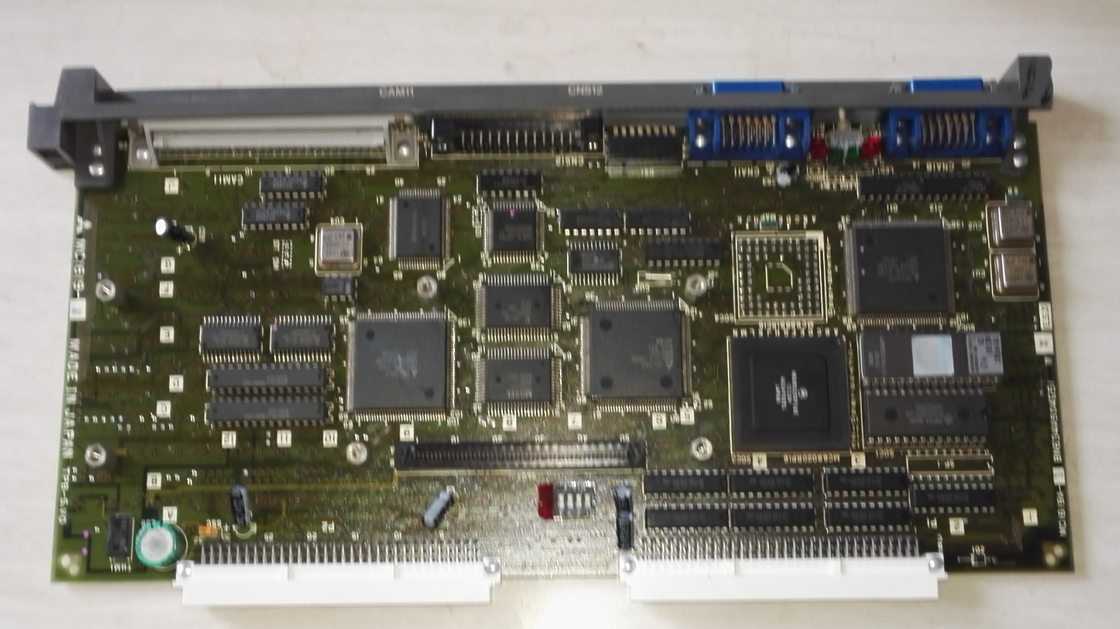
Mitsubishi MC1619-1 | M3/MC Series Printed Circuit Board for MELDAS M300 CNC — Part No. A3002, New & Refurbished Available
Overview
The Mitsubishi MC1619-1 (catalog code A3002) is a printed circuit board from the M3/MC series, designed for the Mitsubishi MELDAS M300 CNC control platform.
Like all PCBs in the M3/MC board family, it is an application-specific component — configured for a defined function within the M300 system's control architecture and not interchangeable with boards from other CNC generations without confirmed compatibility review.
The MELDAS M300 series holds a significant place in CNC history: introduced in 1986 as the world's first 32-bit CNC processor, it set the benchmark for high-performance machine tool control through the late 1980s and early 1990s.
Many M300-equipped turning centres, machining centres, and multi-axis machines from that era are still operational in production environments today, underpinned by the platform's robust construction and the continued availability of replacement boards — which is precisely what the MC1619-1 addresses.
When a PCB in an M300 system fails, the machine stops.
There is no workaround, no parameter adjustment that restores function when a board's hardware has failed. Sourcing the correct replacement board — with a confirmed part number match verified against the installed board's label — is the direct path back to production.
The MC1619-1 is available in new (A3002) and factory-tested refurbished (MC1619-1-EX, A3002EX) conditions, with the refurbished variant having been fully evaluated and restored to original specifications by qualified Mitsubishi repair technicians.
Key Product Information
| Parameter |
Value |
| Part Number |
MC1619-1 |
| Catalog Code |
A3002 |
| Also Known As |
MC16191 / MC1619-1 |
| Product Type |
Printed Circuit Board (PCB) |
| Series |
M3/MC Series |
| CNC Platform |
MELDAS M300 |
| Refurbished Version |
MC1619-1-EX (A3002EX) |
| Manufacturer |
Mitsubishi Electric |
| Availability |
New / Refurbished / Repair Service |
The MELDAS M300 Platform — Context for the MC1619-1
The M300 series was Mitsubishi Electric's flagship CNC control system for most of the period between its 1986 introduction and discontinuation in 1994.
Built around a 32-bit processor architecture at a time when 16-bit was the industry standard, the M300 delivered the processing speed and multi-axis coordination capability that the high-performance machine tools of that era needed.
It was succeeded by the M500 series, which carried forward the M300's capability while condensing the drive cabinet design.
The M3/MC circuit board family is the hardware layer that implements the M300's control functions.
The family includes boards covering the full range of CNC control tasks: main CPU and memory boards, display interface boards, system ROM boards, sequence device boards, backplane and interconnect assemblies, and specialised function boards.
Each board carries a unique part number in the MC-prefix series, and each occupies a defined slot or position in the M300 control cabinet's backplane.
The MC1619-1 fits within this family as a component whose specific role within the M300 system is confirmed by the physical installation and the system documentation associated with the machine on which it is installed.
Mitsubishi Electric's MEAU spare parts portal and service network maintain availability of the M3/MC board family to support M300-equipped machines across their extended service lives — a commitment to legacy support that reflects both the installed base's continued activity and the practical impossibility of upgrading all M300-equipped machines simultaneously.
New vs Refurbished — Choosing the Right Supply Condition
The MC1619-1 is available in two confirmed supply conditions from Mitsubishi Electric's authorized parts network.
The new condition (A3002) is the original, unrepaired, factory-fresh board — the same component that would have been installed in a new machine during the M300's production run.
New boards carry full factory specifications and, where available through the authorized Mitsubishi parts network, the manufacturer's warranty terms applicable to spare parts. For machines where the part is available new and budget permits, new condition provides the maximum initial service life expectation.
The refurbished condition (MC1619-1-EX, A3002EX) is a board that has been returned, evaluated, repaired as required, and tested to original factory specifications by Mitsubishi Electric's qualified repair technicians.
Mitsubishi's refurbished boards are tested to verify they meet the same electrical and functional specifications as new boards before being returned to stock.
The refurbished variant is backed by Mitsubishi's one-year warranty on refurbished parts — a meaningful assurance given that the repair work was performed by the OEM's own technical staff rather than a third-party repair shop.
For M300 machines operating in production environments where minimising downtime cost is the priority, the refurbished variant typically offers the faster path to stock availability, particularly for boards whose new stock has been depleted over the decades since the M300's discontinuation.
Confirm availability of both conditions at the time of ordering, as stock levels fluctuate.
Identifying the Correct Board — Part Number Verification
The most important step before ordering any M300 PCB replacement is direct physical verification of the part number on the failed board's label.
The M3/MC series contains many boards with similar prefix structures — MC415, MC431, MC721, MC943A, MC0119, MC161-1, MC1619-1 and others — that differ in function and are not interchangeable despite superficial part number similarities.
The MC1619-1 label on the installed board, cross-referenced against the catalog code A3002, confirms the correct replacement.
The equivalent designations MC16191 (without hyphens) are the same part referenced without punctuation, as appears in some procurement and database systems that do not support hyphens in part number fields.
When the failed board's label is damaged, missing, or illegible, identifying the correct replacement requires access to the machine's maintenance documentation — specifically the hardware connection and parts manual for the machine's M300 variant.
Attempting to substitute based on physical form factor alone is not reliable in the M3/MC series, as multiple boards share the same mechanical envelope while performing different functions.
Handling, ESD Protection, and Installation
All M3/MC series PCBs, including the MC1619-1, are static-sensitive electronic assemblies. Electrostatic discharge (ESD) damage is a leading cause of premature PCB failure in industrial electronics, and it is particularly insidious because ESD damage may not produce an immediate failure — instead producing latent damage that manifests as intermittent faults or reduced service life months after the damaging event.
Correct handling procedure requires an ESD wrist strap connected to a known ground, an ESD-safe work surface, and anti-static packaging during transport. The board should be removed from its ESD bag only immediately before installation.
The M300 control cabinet power must be fully isolated and verified off before the failed board is removed and the replacement installed — hot-swapping M300 boards is not supported and risks damaging both the board and the control cabinet's backplane.
After installation, the machine's parameters should be verified against the machine builder's or operator's backup before resuming production, as some board replacements may affect parameter retention depending on the board's role in the M300's memory architecture.
FAQ
Q1: How do I confirm the MC1619-1 is the correct replacement for my machine?
Read the part number printed on the label of the failed board directly — the board label is the definitive identification. Cross-reference the label number against Mitsubishi's M3/MC series parts catalog or the machine's hardware maintenance manual to confirm the A3002 catalog code matches.
Do not rely on board position or physical appearance alone, as multiple boards in the M3/MC series share similar form factors. If the board label is damaged, consult the machine's connection manual or contact Mitsubishi Electric's parts support team with the machine model and serial number.
Q2: What is the difference between MC1619-1 (A3002) and MC1619-1-EX (A3002EX)?
The MC1619-1 (A3002) is a new, unrepaired board at original factory specification. The MC1619-1-EX (A3002EX) is the refurbished variant — a returned board that has been tested, repaired where required, and re-verified to original specifications by Mitsubishi Electric's qualified technicians. Refurbished boards are backed by Mitsubishi's one-year refurbished parts warranty.
For most maintenance applications, either condition is electrically equivalent; the choice typically comes down to availability and cost, with refurbished boards often offering better stock availability on legacy part numbers.
Q3: The M300 CNC was discontinued in 1994 — can replacement boards still be sourced?
Yes. Mitsubishi Electric maintains spare parts availability for legacy CNC generations well beyond the platform's production end-of-life, as part of its commitment to supporting installed machine bases.
The M300 series boards remain available through the authorized Mitsubishi Electric Americas (MEAU) parts portal and service network, in both new and refurbished conditions depending on stock.
Availability of specific part numbers varies over time and should be confirmed at the point of need. Third-party CNC parts suppliers also maintain stocks of M300-series boards, typically in tested-surplus or repaired condition.
Q4: Should the CNC parameters be backed up before replacing an M3/MC series PCB?
Yes, always. Parameter backup before any board replacement is standard practice on CNC systems, regardless of the board's specific function. On the M300, NC parameters, PLC programs, and tool data are stored in battery-backed RAM in certain boards of the M3/MC architecture.
Replacing a board that forms part of this memory structure — or replacing any board while power is removed from the system — carries a risk of parameter loss that a current backup eliminates.
If a backup does not exist, the machine's parameters must be re-entered manually from the machine builder's original documentation before production can resume safely.
Q5: What ESD precautions are required when handling the MC1619-1?
The MC1619-1, like all M3/MC series PCBs, is a static-sensitive assembly. Always use a grounded ESD wrist strap connected to a verified earth ground when handling the board. Work on an ESD-safe mat.
Keep the board in its anti-static packaging until the moment of installation. Ensure the M300 control cabinet is powered down and the main disconnect is locked out before removing the failed board or installing the replacement.
Avoid touching the board's component side or connector contacts with bare hands.
These precautions apply to both removal of the failed board and installation of the replacement — ESD damage to a new board during installation is as costly as the original failure.


 Your message must be between 20-3,000 characters!