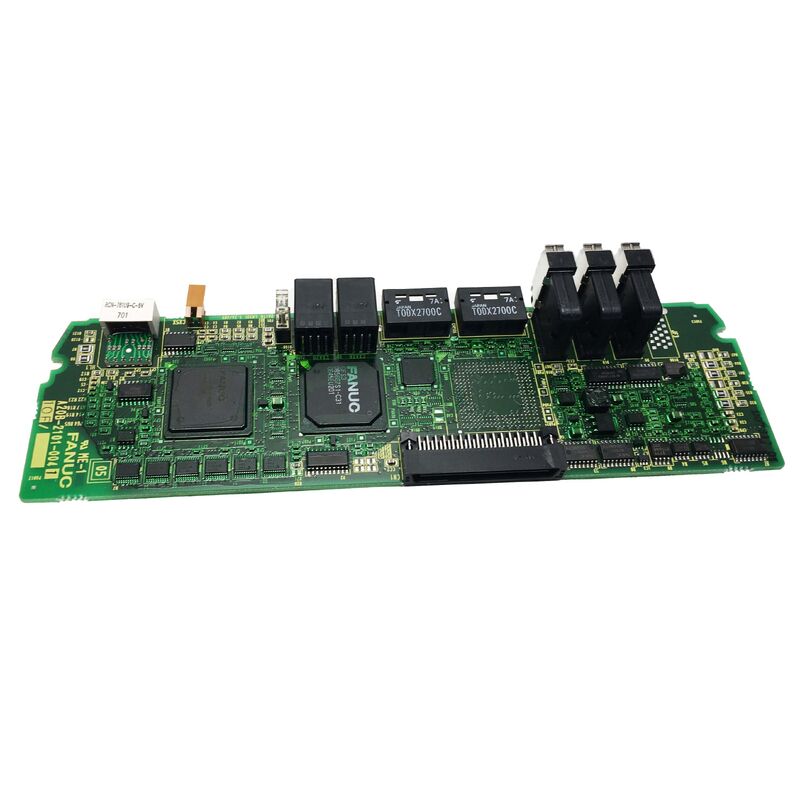
A20B-2101-0041 | FANUC Alpha-i aiSV 2-Axis HRV Servo Drive Board — Dual Channel / 4–160A / 200V or HV / A06B-6117 Series
Alpha-i aiSV — FANUC's HRV Servo Drive Generation
The FANUC Alpha-i series represents the generation of servo and spindle drive modules that succeeded the original Alpha series. The "i" suffix identifies the i-generation — featuring High Response Vector (HRV) control as its defining technological advancement.
HRV (High Response Vector) control is FANUC's implementation of high-bandwidth current control for servo motors. HRV operates the current control loop at a significantly higher update rate than previous drive generations. The faster current control loop allows the servo system to respond more quickly to load disturbances and to follow position commands more precisely at high speeds and accelerations — characteristics critical for demanding machining applications such as high-speed milling, threading, and multi-axis contouring.
The A20B-2101-0041 is the drive board that implements this HRV control algorithm in a dual-channel (2-axis) servo amplifier module.
Key Specifications
| Parameter |
Value |
| Channels |
2 (dual axis) |
| Current Range |
4A to 160A per axis |
| Input |
200V or high voltage (HV) |
| HRV |
Yes |
| Compatible |
A06B-6117 series aiSV modules |
| Weight |
Approx. 0.1 kg |
Dual Channel — Two Axes, One Board
The A20B-2101-0041 controls two servo axes from a single board. Both channels share the same PCB, the same HRV control processor, and the same power connections — but each channel maintains its own independent current control loop.
In practice, this dual-channel architecture means:
Axis independence: An overcurrent event or motor fault on one axis trips that channel independently. The other axis may continue operating if the fault is contained to one channel.
Shared bus: Both axes draw from the same DC bus section of the amplifier module, sharing the capacitor bank and the connection to the PSM (Power Supply Module). A DC bus fault affects both channels simultaneously.
Simultaneous update: Both axis channels are updated in the same HRV processing cycle, maintaining the timing synchronisation required for multi-axis contouring.
Application Scenarios
SVM2 aiSV drive board replacement: A machining centre develops a servo alarm on one or both axes of a FANUC aiSV servo module. Drive diagnosis isolates the fault to the A20B-2101-0041 board. Replacement with a tested board and correct snap-fit installation restores both axis servo functions.
High-speed contouring CNC: A 2-axis CNC system performing high-speed contouring requires the HRV control capability of the aiSV series. The A20B-2101-0041 provides the dual-channel HRV control board ensuring precise current loop response for both axes during demanding profiles.
FAQ
Q1: What is the difference between the Alpha series SVM2 and the Alpha-i aiSV in which this board is used?
The original Alpha series SVM2 uses control boards in the A20B-2001-0931 range and relies on an earlier servo control architecture. The Alpha-i aiSV series — using the A20B-2101-0041 — implements HRV (High Response Vector) control with a faster current control loop update rate. The HRV improvement results in better servo stiffness, lower following error at high feedrates, and improved disturbance rejection. These are the practical machining performance differences between the two generations.
Q2: What companion boards are needed alongside the A20B-2101-0041 in a complete aiSV module?
The complete A06B-6117 aiSV module contains the A20B-2101-0041 drive/control board and a companion wiring board. The wiring board provides the physical connectors — the DC bus input terminals, three-phase motor output terminals, and encoder feedback connectors for both axes. The A20B-2101-0041 is the active processing layer that controls the switching of the power devices. Both boards are required for a functional module.
Q3: Does the A20B-2101-0041 need to be re-programmed after installation?
The A20B-2101-0041 is a hardware control board. Servo parameters — axis gains, motor ID codes, current limits — are stored in the CNC's parameter memory, not in the servo drive board. After fitting the replacement board and powering the system, the CNC applies the existing servo parameters through the FSSB communication link. No separate board programming is required, but verify that axis servo readiness is achieved and confirm correct servo operation at low speed before full production resumption.
Q4: What servo alarms indicate the A20B-2101-0041 has failed rather than the motor or wiring?
Alarms pointing to the drive board (rather than motor or wiring) include: FSSB communication alarms affecting both channels of the same module simultaneously (both axes on the same aiSV board go into alarm together); persistent SV alarms with correct motor and encoder wiring confirmed; and HRV-specific alarm codes that indicate internal drive processing faults rather than external circuit conditions. A single-axis alarm with confirmed correct wiring typically points to the motor, encoder, or power device for that specific axis rather than the control board.



 Your message must be between 20-3,000 characters!