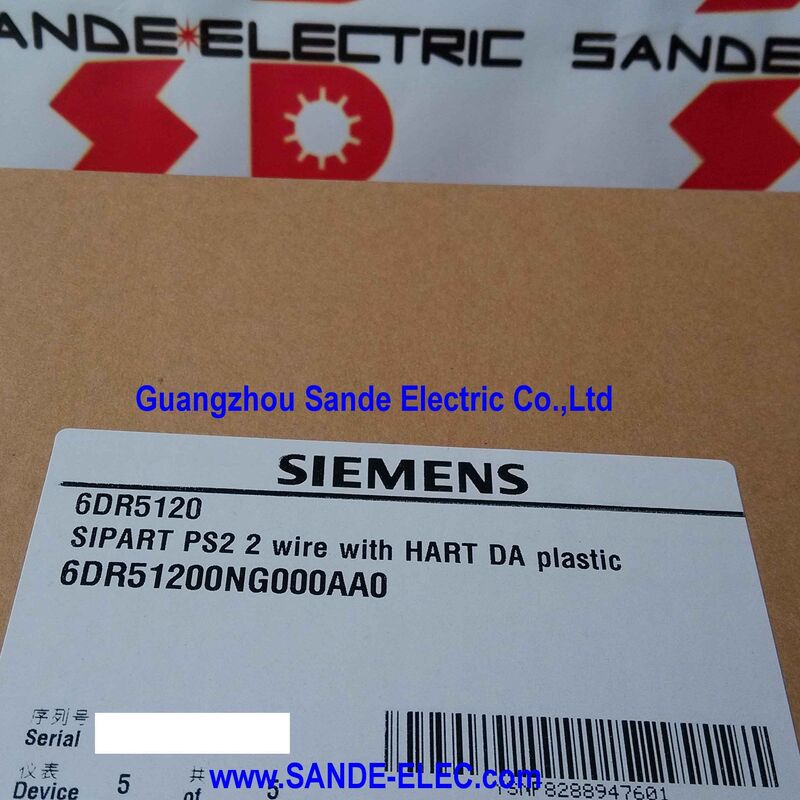
Siemens 6DR5120-0NG00-0AA0 | SIPART PS2 Smart Electropneumatic Positioner — 4–20mA / HART, Double-Acting, Polycarbonate IP66, M20×1.5 / G 1/4, Fixable Slipping Clutch
Overview
The Siemens 6DR5120-0NG00-0AA0 is the SIPART PS2 smart electropneumatic positioner configured for double-acting pneumatic actuators with HART digital communication over a standard 4–20mA two-wire loop.
It is one of the most widely deployed positioner variants in process automation — the double-acting output combined with HART protocol covers the majority of control valve installations where both opening and closing movements require pneumatic drive (as opposed to spring-return single-acting actuators), and where digital communication to a handheld communicator or asset management system is a standard site requirement.
The SIPART PS2 series has been a fixture in process plants for decades, valued for a combination of tight positioning accuracy, a self-calibration routine that adapts the positioner to the actuator without manual span or zero adjustment, and an extensive diagnostics package that tracks valve and actuator condition over time.
The specific variant in this part number — polycarbonate enclosure, M20×1.5 electrical connection, G 1/4 pneumatic connection, fixable slipping clutch — is the standard European-thread configuration for installations in non-hazardous areas.
The fixable slipping clutch on the feedback shaft is a practical detail that affects installation and maintenance.
The feedback shaft transmits actuator position back to the positioner's internal potentiometer.
The clutch allows the feedback coupling to slip if the actuator movement exceeds the positioner's mechanical travel limit — preventing mechanical damage to the position sensor if the valve or actuator reaches its hard stop before the positioner's feedback mechanism does.
The "fixable" characteristic allows the clutch to be locked in position once the correct range is set, eliminating play in the feedback that would otherwise cause control hysteresis.
The polycarbonate enclosure (Macrolon) provides IP66 protection — dust-tight and resistant to powerful water jets — and NEMA 4X equivalency.
For typical above-ground process installations in petrochemical, chemical, water treatment, and general process plants without explosion risk, the polycarbonate variant is the standard choice. It is lighter than the aluminium version and easier to work with in the field.
Key Specifications
| Parameter |
Value |
| Actuator Type |
Double-acting pneumatic |
| Input Signal |
4–20mA, 2-wire |
| Digital Protocol |
HART |
| Enclosure |
Polycarbonate IP66 / NEMA 4X |
| Electrical Connection |
M20×1.5 |
| Pneumatic Connection |
G 1/4 |
| Feedback |
Fixable slipping clutch |
| Linear Stroke Range |
3–130mm (up to 200mm on request) |
| Part-Turn Range |
30°–100° |
| Max. Supply Pressure |
7 bar (101.5 PSI) |
| Explosion Protection |
None |
| Limit Monitor |
Not included |
| Software |
SIMATIC PDM / HART communicator |
Double-Acting vs Single-Acting — Why It Matters
The designation "double-acting" in the 6DR5120-0NG00-0AA0 specification describes the pneumatic output arrangement: the positioner delivers regulated air pressure to both the opening and closing chambers of a double-acting actuator, controlling movement in both directions through active pneumatic force.
This contrasts with single-acting (spring-return) actuators where one direction is driven by air pressure and the other by a compressed spring.
Double-acting actuators offer several application advantages over spring-return designs: they can provide higher thrust or torque in both directions, they are not subject to spring degradation over time affecting fail-safe behaviour, and they can be specified where the actuator's physical size envelope does not allow for a spring pack of the required force.
For large-diameter valves where the force to move the plug or disc is substantial in both directions, double-acting is the standard actuator architecture.
The specific part number 6DR5120-0NG00-0AA0 is for double-acting (the "NG" in the suffix indicates double-acting polycarbonate with slipping clutch and M20×1.5 connection). Users specifying for a spring-return (single-acting) actuator should confirm the correct suffix code before ordering, as single-acting variants carry different suffix designations and differ internally in the pneumatic output circuitry.
HART Integration and SIMATIC PDM
HART communication over the 4–20mA loop allows the positioner's diagnostics, configuration parameters, and operating data to be accessed remotely using a HART handheld communicator (such as a Emerson 475 Field Communicator) or through asset management software including Siemens' own SIMATIC PDM (Process Device Manager).
From SIMATIC PDM, an operator can read the positioner's current position, set point, and deviation in real time; review the control valve's travel accumulation, zero-point drift, and response time history; run the full stroke test (FST) and partial stroke test (PST) to verify valve movement without taking the valve offline; access the step response diagnostic, which characterises the pneumatic actuator's dynamic behaviour; and configure all internal parameters — dead band, tight close function, split range settings, and the setpoint characterisation curve.
This diagnostic depth is one of the principal reasons process plants specify SIPART PS2 positioners: the HART data provides a continuous assessment of valve condition that enables predictive maintenance rather than reactive breakdown response.
Self-Calibration — Automatic Initialisation
One of the SIPART PS2's most operationally valued features is its automatic initialisation routine. Once installed and powered, the positioner can be commanded to run AUTO (automatic calibration), during which it:
- Drives the actuator slowly to the close limit and records the zero position.
- Drives to the open limit and records the full-travel position.
- Calculates the mechanical travel and adapts its internal parameters for the actuator.
- Runs a brief dynamic test to characterise the actuator's pneumatic response for controller tuning.
The entire routine typically completes in a few minutes. Manual span and zero adjustment potentiometers are not required — the positioner determines these values computationally from the automatic travel measurement.
For maintenance teams replacing a failed positioner, this self-calibration dramatically reduces the time required to put a new unit in service.
FAQ
Q1: This positioner is specified for double-acting actuators. Can it be connected to a single-acting (spring-return) actuator by simply not using one of the pneumatic output ports?
No. The internal pneumatic circuit of the double-acting variant is specifically designed for two pneumatic outputs.
The control algorithm assumes both chambers are pneumatically driven.
For a spring-return actuator, the single-acting variant must be specified — the internal circuitry routes the pneumatic output differently, and the fail-safe depressurisation logic on loss of electrical power functions correctly only in the single-acting configuration.
Q2: The fixable slipping clutch is mentioned as a key feature. How is it set during installation?
After mounting the positioner on the actuator, the feedback shaft coupling is connected to the actuator's travel indicator pin or yoke arm.
With the actuator positioned at mid-stroke, the clutch is engaged by tightening the locking mechanism, fixing the feedback shaft at the position corresponding to the actuator's actual position. The clutch will then transmit accurate position feedback throughout the actuator's travel range.
If the actuator reaches a hard mechanical stop, the clutch slips rather than transmitting the over-travel force to the internal potentiometer.
The SIPART PS2 operating manual provides the specific clutch engagement procedure.
Q3: Is the polycarbonate (Macrolon) enclosure of the 6DR5120-0NG00-0AA0 suitable for outdoor use in direct sunlight?
Polycarbonate degrades with prolonged UV exposure, which can cause embrittlement and colour change over years of outdoor use.
For outdoor installations, Siemens recommends either UV-stable variants of the polycarbonate enclosure, a suitable sun shield, or the aluminium housing variant.
The IP66 rating protects against rain and water jets regardless of UV concern, but the long-term mechanical integrity of the enclosure in high-UV outdoor environments is the consideration that typically drives the preference for aluminium in such installations.
Q4: What is the minimum electrical supply current the positioner requires from the 4–20mA loop?
The SIPART PS2 in 2-wire configuration is a loop-powered device — it draws its electrical operating power from the 4–20mA current loop itself.
The minimum current for the positioner to maintain operation is approximately 3.6mA, slightly below the 4mA lower range value of the setpoint signal.
This means the positioner remains operational even when the setpoint is at its minimum (4mA) value, with the remaining 3.6mA providing the operating power.
The loop supply must be capable of maintaining the required voltage across the loop resistance at all loop current values, as specified in the SIPART PS2 operating manual.
Q5: Can the partial stroke test (PST) be initiated from a HART handheld communicator without SIMATIC PDM software?
Yes. The SIPART PS2 HART device description (DD) includes the partial stroke test function, which can be initiated from any HART-compatible communicator that has loaded the SIPART PS2 DD file.
The communicator displays the current position, allows the stroke parameters to be set, initiates the test, and records the result.
SIMATIC PDM is not required for basic diagnostic access, though it provides a richer interface with historical data logging and report generation that a handheld communicator does not offer.



 Your message must be between 20-3,000 characters!