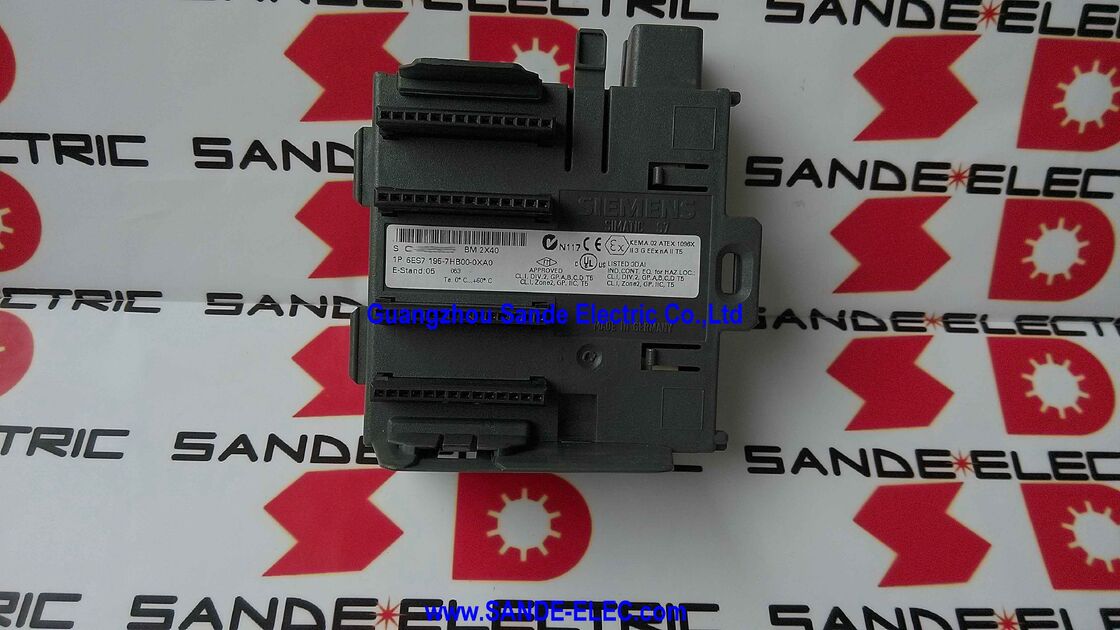
Siemens 6ES7195-7HB00-0XA0 | SIMATIC ET 200M Bus Module BM 240 — For Two 40mm I/O Modules, Hot-Swap Removal/Insertion, IP20, 97×92×30mm, 140g
Overview
The Siemens 6ES7195-7HB00-0XA0 is the BM 240 — an active bus module for the SIMATIC ET 200M distributed I/O system.
In a standard ET 200M station without bus modules, the S7-300 signal modules are mounted directly on the station's DIN rail bus connector row, and removing any one of them requires powering down the entire station.
The BM 240 changes this constraint fundamentally: it inserts into the station's backplane between adjacent modules, provides a hot-swap socket for two 40mm-wide signal modules, and allows those modules to be physically removed and reinserted without interrupting the station's power or its PROFIBUS/PROFINET communication.
The significance of this is most apparent in high-availability process plant environments.
A pharmaceutical batch reactor's PROFIBUS ET 200M station may control heating, cooling, dosing, and agitation — each function through its own I/O module.
Without bus modules, performing even routine maintenance (checking a suspected faulty analog input module) requires shutting down the entire I/O station, which means taking the batch reactor offline.
With the BM 240 installed, the maintenance technician can swap the suspect module while the station continues operating, the batch continues, and only the two channels connected to the swapped module experience a brief interruption.
The 40mm width specification matches the standard S7-300 signal module format — the most common module width in the ET 200M system.
For signal modules that are 80mm wide, the BM 480 (6ES7195-7HF00-0XA0) is the equivalent bus module accommodating one 80mm or two 40mm modules.
Key Specifications
| Parameter |
Value |
| Module Capacity |
2 × 40mm wide I/O modules |
| Width (installed) |
80mm |
| Width (uninstalled) |
97mm |
| Height |
92mm |
| Depth |
30mm |
| Weight |
140g |
| Hot-Swap |
Yes — insert/remove in RUN |
| Protection |
IP20 |
| Operating Temp |
0°C to +60°C |
| Status |
Spare part |
ET 200M Hot-Swap Architecture — How It Works
The ET 200M station uses an active backplane bus that distributes 24V supply and the S7-300 I/O bus signals across all installed modules. In a standard configuration without bus modules, this backplane is passive and continuous — removing any module breaks the bus and disrupts all subsequent modules.
The BM 240 introduces an active bridge: it maintains the backplane bus signals across the socket positions of the two hosted modules, using internal bus repeater electronics that actively bridge the bus gap created when a module is removed.
When a module is removed from its BM 240 socket, the bus module's internal electronics maintain bus continuity for all other modules on the station.
The removed module's slot appears as "module absent" to the ET 200M interface module, which generates a diagnostic interrupt to the PROFIBUS/PROFINET master.
The master's OB82 programme (diagnostic interrupt handler) can respond — substituting safe output values for the absent module, generating an HMI alarm, or logging the event — while the station continues operating for all other I/O.
When the replacement module is inserted, the BM 240 detects its presence and re-establishes the module's backplane connection.
The interface module reports the re-insertion through another OB82 interrupt, and the normal I/O exchange for that module's addresses resumes.
ET 200M in PROFIBUS and PROFINET Systems
The ET 200M is unusual among Siemens distributed I/O systems in that it accepts the full range of SIMATIC S7-300 signal modules — not a dedicated ET 200-specific module range.
The same digital input module (6ES7321-1BH02-0AA0), analog input module (6ES7331-7KF02-0AB0), or function module that plugs into an S7-300 central rack plugs identically into an ET 200M station on PROFIBUS or PROFINET.
This commonality offers a significant engineering and maintenance advantage: one spare module inventory serves both the central rack and all distributed ET 200M stations.
The BM 240 extends this compatibility advantage to maintenance operations — the hot-swap capability it provides works with any 40mm-wide S7-300 signal module without modification or special configuration, because the module and bus interface are standard S7-300 components.
Planning an ET 200M Station with Bus Modules
Not every module position in an ET 200M station needs a bus module. Bus modules are typically specified for the I/O modules that connect to field wiring subject to faults (analog input modules on transmitters with occasional calibration needs, motor starter modules, relay output modules with contact wear), and for modules that may need replacement during production without a planned shutdown.
An ET 200M station can mix standard direct-mount positions and BM 240 positions — modules in direct-mount positions cannot be hot-swapped, while modules in BM 240 positions can. The station layout in STEP 7 or TIA Portal identifies each slot as either direct-mount or bus-module-hosted, and the I/O addresses are assigned accordingly.
The BM 240 itself occupies 80mm of mounting rail length (installed) and the two hosted modules occupy their normal 40mm each — the total footprint per BM 240 pair is 80 + 40 + 40 = 160mm versus the 80mm for two direct-mount modules, a 80mm width penalty that must be accounted for in the station rail length calculation.
FAQ
Q1: Does the BM 240 require any special configuration in STEP 7 or TIA Portal?
Yes. Each module position hosted by a BM 240 must be explicitly defined as a "hot-swap slot" in the ET 200M station's hardware configuration in STEP 7 (HW Config) or TIA Portal. The configuration tool presents this as a module slot property.
The interface module (IM 153-x) must support the active bus module function — not all ET 200M interface modules support hot-swap. Confirm interface module compatibility before specifying BM 240 modules in a station design.
Once configured, the system automatically generates insert/remove interrupts and handles OB82 notification for those slots.
Q2: Which ET 200M interface modules are compatible with the BM 240?
The hot-swap function is supported by the IM 153-2 (6ES7153-2BAxx-0XB0 series) and IM 153-4 PN (6ES7153-4AA01-0XB0) interface modules.
The older IM 153-1 does not support active bus module operation.
Always verify the specific IM 153 variant and its firmware version against the BM 240 compatibility matrix in the ET 200M manual (A5E00427077-xx) before specifying bus modules in a new station design.
Q3: Can the BM 240 be added to an existing ET 200M station that was originally built without bus modules?
Adding BM 240 modules to an existing station requires mechanical rework: the affected module slots must be removed from the station's DIN rail bus connector row, the BM 240 installed in their place, and the hosted modules reinstalled in the BM 240 sockets.
The station's STEP 7 hardware configuration must be updated to reflect the new slot arrangement. This modification is best performed during a planned maintenance shutdown, since the station must be powered down to mechanically rearrange the module positions.
Q4: What happens when a module is removed from a BM 240 slot — does the rest of the station continue to run?
Yes. The BM 240's internal bus bridge maintains backplane bus continuity for all other modules in the station when a hosted module is removed.
The ET 200M interface module reports the removal via a diagnostic interrupt (OB82 in the S7 programme).
Outputs connected to the removed module default to their configured safe state (typically 0V for digital outputs, or a parameterised fallback value for analog outputs).
All other modules in the station — both those in direct-mount positions and those in other BM 240 slots — continue operating normally throughout.
Q5: What is the difference between the BM 240 (6ES7195-7HB00-0XA0) and the BM 480 (6ES7195-7HF00-0XA0)?
The BM 240 hosts two 40mm-wide standard S7-300 signal modules and occupies 80mm of installed rail length.
The BM 480 hosts one 80mm-wide module (or two 40mm modules, depending on configuration) and is the correct choice for 80mm-wide ET 200M-specific modules such as the SM 331 8AI (6ES7331-7KF02-0AB0 at 40mm) or for function modules and communications processors that may be in the 80mm format.
When specifying a station with a mix of 40mm and 80mm modules, select the BM variant matching each module's width at each position requiring hot-swap.



 Your message must be between 20-3,000 characters!