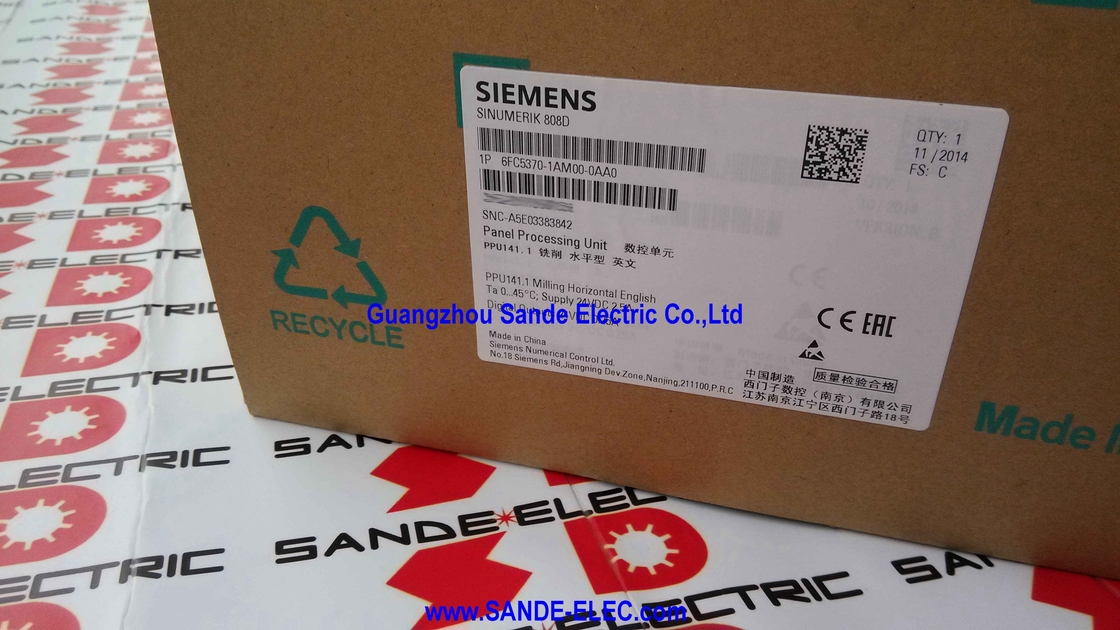
Siemens 6FC5370-1AM00-0AA0 | SINUMERIK 808D Milling PPU141.1 — Panel Processing Unit, Up to 3 Feed Axes + 1 Spindle, SINAMICS V60 Interface, English Layout, 4.1kg
Overview
The Siemens 6FC5370-1AM00-0AA0 is the PPU141.1 milling variant for the SINUMERIK 808D — Siemens's entry-level CNC control platform positioned to bring professional-grade CNC capability to cost-sensitive machine tool applications.
The PPU (Panel Processing Unit) concept packages the CNC controller, operator display, machine keyboard, and I/O interfaces into a single compact unit that mounts directly in the machine tool panel.
There is no separate rack-mounted CNC computer, no separate HMI display unit — the PPU141.1 is the complete CNC unit, front face and all.
In the SINUMERIK family hierarchy, the 808D sits below the 828D and 840D sl platforms in complexity and price, but shares the fundamental SINUMERIK programming language and G-code structure.
An operator familiar with 828D or 840D programming works with the 808D without needing separate training on a different G-code dialect. A machine builder who designs for the 808D writes part programs and machine cycles using the same DIN 66025 / ISO 6983 programming conventions that apply across the SINUMERIK range — a significant practical advantage when machine builders serve customers who use multiple Siemens CNC platforms across their production facilities.
The milling variant (-AM in the order number) is configured for machining centres and milling machines — it supports three linear feed axes (X, Y, Z) and one spindle channel, which covers the standard vertical machining centre configuration.
The turning variant (-AT) supports two feed axes and one spindle for lathe applications.
This distinction is implemented in the PPU's pre-loaded software configuration, not in the hardware — the same PPU141.1 hardware runs either the milling or turning software build, depending on the order number suffix.
Key Specifications
| Parameter |
Value |
| CNC Variant |
Milling (3 feed axes + 1 spindle) |
| Feed Axes |
Up to 3 (X, Y, Z) |
| Spindle |
1 channel |
| Drive Interface |
SINAMICS V60 / third-party |
| Digital Inputs |
3 × 24V DC banks (X100–X102) |
| Digital Outputs |
2 × banks (X200, X201) |
| DO Current Rating |
250mA per channel |
| Handwheels |
2 (X10) |
| Serial Interface |
RS232 (X2) |
| Supply |
24V DC |
| Weight |
4.1 kg |
| Language |
English |
| Status |
Active product |
System Architecture — PPU + MCP + Drives
The SINUMERIK 808D control system is structured as three main components that work together:
PPU141.1 (this unit): Contains the NC (Numerical Control) processor, the PLC, the drive setpoint outputs, the encoder inputs, and all machine I/O interfaces. The PPU's front face presents the operator display and CNC keyboard.
The engineer commissions the machine axes, enters machine data, and writes part programs through the PPU's interface.
MCP (Machine Control Panel, 6FC5303-0AF35-0AA0): A separate panel unit that connects to the PPU, providing the machine operator's physical control buttons — spindle start/stop, feed hold, cycle start, emergency stop, and mode selection. The MCP communicates with the PPU through a standard interface.
Drives: The PPU outputs speed setpoints to the axis and spindle drives through setpoint cables.
For the feed axes, SINAMICS V60 Controlled Power Modules (CPM60.1) are Siemens's designated drive for 808D systems, connected via 5m, 7m, or 10m setpoint cables (6FC5548 series).
For the spindle, any inverter or servo spindle drive with an analog setpoint input can be connected through the spindle setpoint cable (6FC5548-0BA05 series).
Digital I/O — Machine Integration and PLC
The PPU141.1 contains an integrated PLC that executes the machine's auxiliary control logic — coolant pump control, tool changer sequences, door interlock monitoring, chuck and tailstock control, safety functions, and operator panel response.
The PLC program runs on the same processor as the NC, and is programmed in the standard SINUMERIK 808D PLC tool using ladder diagram.
The physical I/O that the PLC interacts with connects through the PPU's I/O interfaces:
Digital inputs (X100, X101, X102) receive 24V DC signals from sensors, limit switches, safety relay contacts, operator pushbuttons on the machine, and any other binary field signals the PLC program needs to read.
The digital output interfaces (X200, X201) drive 24V DC loads up to 250mA per channel — sufficient for relay coil control, solenoid valve pilots, indicator lights, and similar actuators.
The fast I/O interface (X21) provides high-speed input and output channels for NC-controlled signals that require timing precision below the PLC scan cycle — such as skip input (for tool length measurement probing), NC output for spindle override, and other time-critical machine functions.
RS232 Interface — Data Transfer and Documentation
The RS232 serial interface on the PPU141.1 provides a standard PC-compatible serial link for transferring CNC programs to and from a PC, connecting a serial HMI terminal, or interfacing with other serial devices.
In machine tool practice, the RS232 port serves as the DNC (Direct Numerical Control) link — a PC or workshop computer stores the library of part programs and transfers them to the machine for each production job, eliminating the need to manually enter programs at the machine keyboard for complex or large parts.
The RS232 port configuration — baud rate, data bits, stop bits, parity — is set in the machine data and must match the settings of the connected PC DNC software or other device. Most modern PCs require a USB-to-RS232 adapter since RS232 native ports are no longer standard on business laptops, and the choice of adapter affects communication reliability at higher baud rates.
FAQ
Q1: The 808D milling variant supports up to 3 feed axes. Can a fourth axis (such as a rotary table) be added?
The base 808D milling software supports three feed axes. For machines requiring a fourth axis, Siemens offers a software option ("additional axis") that extends the control to a fourth servo axis, which can function as a rotary (A, B, or C) or additional linear axis.
This option is activated through a software license key entered in the machine data — no hardware modification is required. The PPU141.1's hardware already includes the physical setpoint output and encoder input for the additional axis; it is the software that activates the fourth channel.
Q2: Can the 6FC5370-1AM00-0AA0 PPU141.1 be used with drives other than the SINAMICS V60?
Yes. The PPU141.1 outputs analog ±10V speed setpoints and reads incremental encoder feedback for each feed axis — the same interface used by many servo drive amplifiers from different manufacturers.
The setpoint cable (6FC5548-0BA05 series) connects the PPU's setpoint output to the drive's speed reference input, and the encoder cable from the motor's incremental encoder feeds back to the PPU's encoder input.
Any drive that accepts a ±10V analog speed reference and whose controlled motor provides incremental encoder feedback (TTL-compatible A/B/Z signals) can work with the PPU141.1. The SINAMICS V60 is Siemens's recommended and tested drive for the 808D system, providing optimised compatibility and commissioning support.
Q3: The PPU is listed as weighing 4.1 kg and made in China. Is this a genuine Siemens product?
Yes. The 6FC5370-1AM00-0AA0 is a Siemens OEM product manufactured at Siemens's production facility in China — a common manufacturing location for Siemens products targeting the Asian and cost-sensitive global machine tool market.
The -0AA0 suffix designates the English-language version for international markets.
The same PPU hardware is also produced in a Chinese-character layout version (6FC5370-1AM00-0CA0) specifically for the Chinese domestic market.
Both versions are genuine Siemens SINUMERIK 808D components supported by Siemens's global technical support and documentation infrastructure.
Q4: What software is used to write PLC programs for the SINUMERIK 808D?
The SINUMERIK 808D's PLC is programmed using the ladder diagram editor included in the SINUMERIK 808D Toolbox software, which Siemens provides with each system.
The Toolbox runs on a Windows PC and includes the PLC programming environment, the machine data editor, the part program editor, and the configuration tools for setting up the drive interfaces and I/O assignments.
Programs are compiled in the Toolbox and downloaded to the PPU via the RS232 port or USB memory stick.
The 808D's PLC is not compatible with STEP 7 or TIA Portal — it uses a simplified PLC environment specifically designed for the 808D platform.
Q5: Does the PPU141.1 support DXF file import for contour milling programs, or only manual G-code entry?
The SINUMERIK 808D's part program entry is primarily through the keyboard on the PPU or through downloading programs written on a PC. DXF import — the ability to read CAD geometry files and automatically generate NC programs from contour data — is not a standard feature of the basic 808D software.
For complex milling contours requiring CAM-generated programs, the typical workflow is to generate the G-code on a PC-based CAM system (Mastercam, Fusion 360, HSMWorks, etc.) and transfer the resulting NC program file to the 808D via RS232 or USB memory stick.
The 808D's contour programming capabilities in the standard package cover cycles for pocket milling, drilling, and standard contour operations through its cycle support functions.



 Your message must be between 20-3,000 characters!