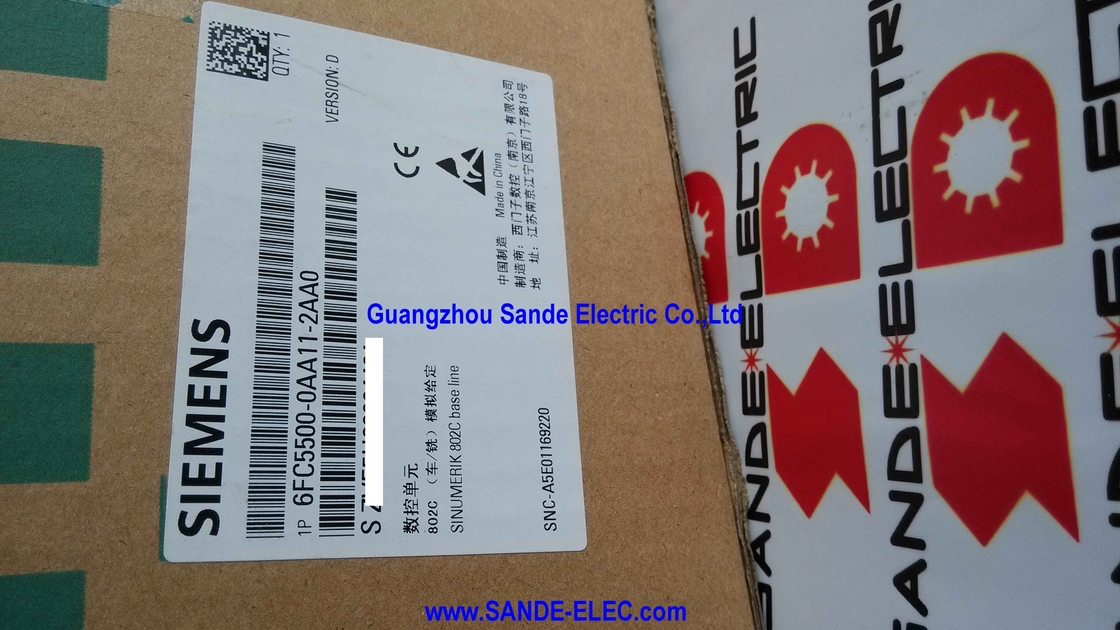
Siemens 6FC5500-0AA11-2AA0 | SINUMERIK 802C Base Line — Complete CNC Basic Package, 3 Analog Drives + 1 Spindle, 48/16 DI/O, Operator Panel + MCP, Toolbox and Logbook
Overview
The Siemens 6FC5500-0AA11-2AA0 is the SINUMERIK 802C Base Line basic package — Siemens's entry into the absolute lowest segment of the CNC market, designed to bring genuine CNC control to the simplest machine tool applications without the cost or complexity of higher-tier SINUMERIK platforms.
The "2AA0" suffix identifies this as the China-market version of the 802C Base Line, while the function and content are identical to the worldwide -1AA0 version.
Everything a machine tool needs to operate as a CNC system is in this package.
The Operator Panel Control integrates the CNC processor, PLC, display, keyboard, and the Machine Control Panel in a single compact assembly — there is no separate rack, no separate monitor, no separate controller unit to mount and wire.
The peripheral I/O module handles the 48 digital inputs and 16 digital outputs that connect the machine's sensors, limit switches, solenoids, and motor contactors to the CNC.
The toolbox CD contains the commissioning software and documentation. The logbook tracks the system's configuration history.
The "Base Line" positioning in the SINUMERIK product hierarchy is deliberate: this is the control system for machines that need CNC capability but cannot justify the investment in 808D, 828D, or higher platforms.
A small workshop converting a manual lathe to CNC, a vocational training centre equipping students with their first CNC machine, a machine builder targeting cost-competitive markets — these are the scenarios where the 802C Base Line makes practical sense.
Key Specifications
| Parameter |
Value |
| Package Contents |
OPC+MCP, 48/16 DI/O, Toolbox, Logbook |
| Drive Axes |
Up to 3 analog (±10V) |
| Spindle |
1 analog |
| Encoder Types |
TTL / Resolver |
| Programming |
DIN 66025 (G-code) |
| Machine Types |
Turning + Milling |
| Market |
China (2AA0 suffix) |
| Status |
Discontinued |
Analog Drive Interface — Broad Compatibility in Retrofit Applications
The 802C Base Line's ±10V analog speed reference output for each axis is the universal language of servo drive systems from the 1970s through the 2000s. Every analogue servo amplifier from Siemens, Indramat, Fanuc, ELMO, and dozens of other manufacturers responds to ±10V — the CNC's output voltage commands the drive's speed reference, and the encoder mounted on the motor reports the actual position back to the CNC.
This analog interface architecture is why the 802C Base Line is effective in the retrofit market.
A manual lathe built in the 1980s with conventional drive motors can be upgraded to CNC control by adding servo motors with TTL encoders, connecting them to a SIMODRIVE Base Line drive amplifier (or equivalent analogue servo drive), and wiring the 802C Base Line as the CNC controller.
The machine gains full NC program execution, automated cycle control, and position accuracy — at a fraction of the cost of replacing the machine entirely.
The compatibility with TTL encoders (incremental A/B/Z signals) and resolvers (analogue sine/cosine sensors) broadens the hardware selection even further.
Resolvers are inherently robust and contamination-resistant, often preferred in workshop environments with coolant and swarf. TTL encoders are widely available and well-established. Both connect directly to the 802C Base Line's feedback inputs.
DIN Programming and the Manual Machine Mode
The 802C Base Line executes programs written in DIN 66025 — the German national standard (essentially identical to ISO 6983) that defines the G-code and M-code programming language used in virtually all CNC machine tools worldwide.
A programmer trained on any other Siemens CNC, or on Fanuc, Mitsubishi, or most other major CNC platforms, already knows the DIN 66025 fundamentals. G00 for rapid traverse, G01 for linear feed, G02/G03 for circular interpolation, M03/M04/M05 for spindle control — these are universal.
Beyond standard G-code execution, the 802C Base Line offers a "manual machine" user interface specifically designed for turning machines.
In this mode, the control allows the operator to drive axes manually with the handwheel while the CNC tracks position, switch seamlessly between conventional operation and NC cycle execution without changing the machine setup, and run pre-programmed cycles (turning, drilling, thread cutting) triggered by simple soft key selections rather than full NC programs.
This dual operation mode — CNC machine and conventional machine in the same control — is particularly valuable in small-batch workshops where most work is conventional but occasional complex parts require CNC precision.
48/16 Digital I/O — Machine Integration Scope
The 48 digital inputs and 16 digital outputs of the 802C Base Line's peripheral module handle the complete binary interface between the CNC and the machine tool's mechanical and electrical systems:
The 48 inputs accommodate: reference point switches for all axes (returning the machine to a known position on startup), travel limit switches (both hardware limits and software limit monitoring inputs), spindle orientation sensor (for tool change positioning), coolant level and pressure monitoring, door interlock and guard monitoring, tool holder clamping sensors, and operator panel inputs beyond those handled directly by the MCP.
The 16 outputs command: coolant pump contactor, tool change actuators, spindle brake, gear change solenoids, indicator lamps, and alarm devices.
For machines requiring additional I/O beyond the base 48/16, expansion through external relay panels or additional I/O devices connected through available serial interfaces is an option within the system's overall architecture.
FAQ
Q1: What is the difference between the 6FC5500-0AA11-2AA0 (China) and the 6FC5500-0AA11-1AA0 (worldwide)?
The -2AA0 suffix designates the China domestic market version of the SINUMERIK 802C Base Line basic package.
The functional content — hardware, software, I/O module, toolbox, logbook — is identical between the two versions.
The distinction is in Siemens's regional ordering and distribution system: the -2AA0 version is sold through Siemens's China distribution channels and has been type-approved and adapted for the China market.
For procurement within China, the -2AA0 is the appropriate order number; for international procurement, the -1AA0 is used. Both variants are compatible with the same documentation and technical support resources.
Q2: What is the maximum number of part program blocks (NC steps) the 802C Base Line can store?
The 802C Base Line's NC program storage is deliberately sized for simple, low-complexity programs consistent with its positioning in the machine tool market.
The exact storage capacity is defined in the SINUMERIK 802C Base Line system documentation, which specifies the non-volatile memory available for part programs.
Programs for typical turning cycles and milling contours in this control's intended application range — simple shaft turning, face milling, drilling patterns — typically require only a few hundred blocks, well within the available storage.
For applications requiring very large programs (complex contours generated by CAM), the 802C Base Line's positioning suggests programs be split or the machine type reconsidered.
Q3: Can the 802C Base Line control a fourth axis — for example, a rotary table on a milling machine?
The standard 802C Base Line supports up to three feed axes and one spindle.
There is no software option for a fourth axis in this control generation, unlike the SINUMERIK 808D which offers an additional axis option.
If a milling application requires a fourth axis, the appropriate choice is the 808D milling variant with the additional axis software option, or a higher-tier SINUMERIK control.
The 802C Base Line is fundamentally a three-feed-axis controller.
Q4: Is the toolbox included in the package compatible with Windows 10 and current PC operating systems?
The SINUMERIK 802C Base Line toolbox software was developed during the Windows XP/2000 era.
Compatibility with Windows 10 and later operating systems may be limited or require compatibility mode settings.
For commissioning and parameterisation of 802C Base Line systems using current computers, checking Siemens Industry Online Support for the latest toolbox version and its Windows compatibility notes is recommended.
Many maintenance engineers maintain a dedicated older laptop with Windows XP or Windows 7 specifically for legacy SINUMERIK 802 series work.
Q5: What drives are specifically designed to work with the 802C Base Line?
The SIMODRIVE Base Line drive family is Siemens's specifically designed drive partner for the 802C Base Line — a cost-optimised analogue servo drive using the same ±10V setpoint interface with TTL encoder feedback that the 802C Base Line outputs.
The SIMODRIVE Base Line provides matched performance (torque, speed range, dynamic response) appropriate for the machine tool class that the 802C Base Line controls.
Third-party analogue servo drives with ±10V input and TTL encoder feedback are also compatible, provided the drive's performance envelope and encoder interface specifications are verified against the 802C Base Line's requirements for the specific machine axis.



 Your message must be between 20-3,000 characters!