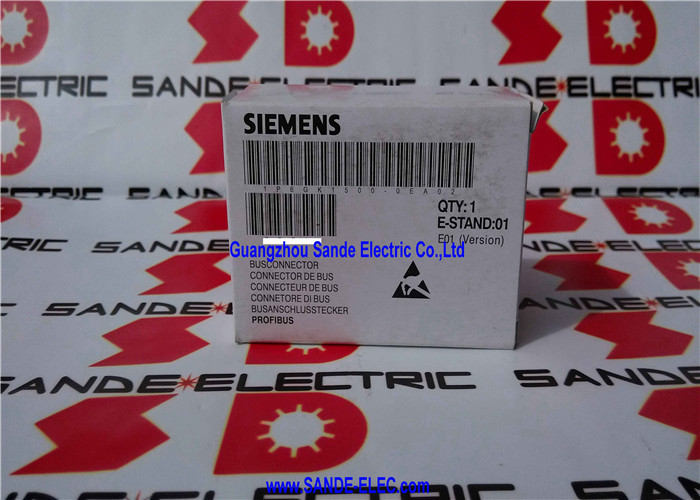
Siemens 6GK1500-0EA02 | PROFIBUS RS 485 Bus Connector — 180° Axial Cable Outlet / 12 Mbit/s / Isolated Terminating Resistor / Metal Enclosure
The Straight Connector for PROFIBUS Networks
The 6GK1500-0EA02 is Siemens' 180° PROFIBUS bus connector — the plug that physically connects a device's Sub-D port to the PROFIBUS RS 485 cable network. Every PROFIBUS RS 485 node needs a connector like this: the connector bridges the device's Sub-D socket to the fieldbus cable, provides a through-connection for the daisy-chain bus, and at the end nodes, activates the terminating resistor that closes the network correctly.
The 180° (axial) cable outlet means the PROFIBUS cable exits straight backward from the connector — axially in line with the device's connector port. This is the layout required by devices where the cable must route horizontally away from the panel or cabinet, or where the available clearance behind the connector does not allow an angled outlet. Siemens offers 35° and 90° outlet variants for other installation geometries; the 6GK1500-0EA02 is specifically the 180° straight-out version for Industry PC connections, SIMATIC operator panels (OP), and Optical Link Modules (OLM).
The built-in terminating resistor with isolating function is the feature that makes this connector suitable for both standard bus nodes and bus termination positions. At the first and last node on each PROFIBUS segment, the bus termination must be activated — the switch on the connector engages the terminating resistor network. The "isolating function" means that when the termination switch is activated, it also electrically isolates the bus from the device's internal circuitry at that connector position — allowing the bus to continue operating even if the device at that node is powered off.
The metal enclosure provides shielding continuity, electromagnetic robustness, and mechanical durability that plastic connectors do not — essential in industrial environments where PROFIBUS cables may be in cable ducts running alongside power conductors.
Key Specifications
| Parameter |
Value |
| Part Number |
6GK1500-0EA02 |
| Cable Outlet |
180° (axial) |
| Transfer Rate |
9.6 kbit/s to 12 Mbit/s |
| Pins |
9-pin Sub-D |
| Terminating Resistor |
Built-in, isolating function |
| Housing |
Metal |
| Dimensions |
57 × 15 × 39mm |
| Operating Temp |
0 to 60°C |
| Ambient Temp |
−25 to +80°C |
| IP Rating |
IP20 (mounted) |
| Replaces |
6GK1500-0EA00 |
Terminating Resistor — When to Switch It On
On a PROFIBUS RS 485 segment, exactly two terminating resistors must be active — one at each end of the segment. All connectors between the first and last must have their termination switch set to OFF. The bus connector's termination switch is typically accessible from outside the installed connector:
- First node in segment: Switch ON
- Intermediate nodes: Switch OFF
- Last node in segment: Switch ON
Incorrect termination causes reflections on the RS 485 cable — spurious communication errors, intermittent device dropouts, and degraded performance that increases with cable length and bus speed.
FAQ
Q1: What is the difference between the 6GK1500-0EA02 (180° outlet) and the 6GK1901-0DA20-0AA0 (35° outlet)?
The cable outlet angle determines how the PROFIBUS cable exits the connector. The 6GK1500-0EA02 at 180° routes the cable axially straight out from the back of the connector — ideal for Industry PCs and OLM installations where the cable must route horizontally. The 35° outlet variant routes the cable at a shallow downward angle, reducing the space required behind the device. Specify the outlet angle based on the available cable routing space and the installation geometry.
Q2: At what cable speed does the PROFIBUS cable type matter for this connector?
Below 1.5 Mbit/s, most standard RS 485 cable types are adequate. Above 3 Mbit/s, and especially at 12 Mbit/s, the PROFIBUS cable specification (surge impedance, capacitance, attenuation per metre) becomes critical. At 12 Mbit/s, Siemens recommends PROFIBUS FastConnect cable (Type A per IEC 61158) to achieve reliable communication over the full 100m segment length. The connector is rated to 12 Mbit/s; the cable must match the speed.
Q3: Can the terminating resistor isolating function be used to temporarily disconnect a device from the bus?
The isolating function allows the device at the end node to be powered off without destroying the bus termination — the bus continues to operate normally because the connector's internal terminating network remains active and isolated from the unpowered device. However, the "isolation" does not remove the node address from the bus or prevent the bus master from generating error messages for the missing node. It is a hardware isolation for termination continuity, not a bus node isolation function.
Q4: What screw torque is recommended for the 9-pin Sub-D connector screws?
Siemens specifies 0.2–0.3 Nm for the Sub-D socket retention screws on PROFIBUS bus connectors. Under-torqued screws allow the connector to work loose over time, especially in environments with mechanical vibration. Over-torqued screws can crack the connector housing. Use a calibrated screwdriver for the 0.2–0.3 Nm range.
Q5: Where is the 6GK1500-0EA02 sourced?
Through Siemens' SIMATIC NET distribution network and the broad industrial automation accessories aftermarket. The 6GK1500-0EA02 is a widely stocked item — it replaces the earlier 6GK1500-0EA00 and is actively available through Siemens Industry Mall, authorised distributors, and the PROFIBUS accessory aftermarket.


 Your message must be between 20-3,000 characters!