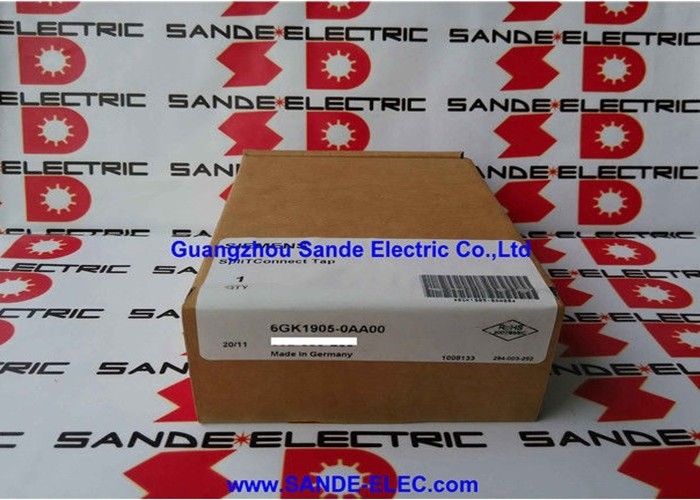
Siemens 6GK1905-0AA00 | PROFIBUS PA SpliTConnect TAP — Insulation Displacement, IP67, 31.25 kbit/s, −40 to +85°C, 54×84×49mm, Silicon-Free, 10 Units Per Pack
Overview
The Siemens 6GK1905-0AA00 is the PROFIBUS PA SpliTConnect TAP — the field connection node that branches individual process instruments off the main PROFIBUS PA trunk cable without cutting, splicing, or interrupting the trunk.
Each TAP mounts at the point along the trunk cable where a field device connection is needed, uses insulation displacement technology to pierce the cable insulation and make contact with the conductors, and provides a standardised spur connection point for the field device.
The result is a structured, consistent, and mechanically robust PROFIBUS PA segment assembly that connects flow meters, pressure transmitters, level gauges, temperature sensors, and analytical instruments to the digital fieldbus with a fraction of the time and risk that conventional T-box or junction box wiring requires.
PROFIBUS PA is the process instrumentation variant of the PROFIBUS fieldbus family, standardised at the physical layer by IEC 61158-2 and widely deployed in oil and gas, chemical, pharmaceutical, water treatment, and food and beverage processing since the mid-1990s.
It transmits digital communication at 31.25 kbit/s over a two-wire cable that simultaneously powers the field instruments — replacing the conventional 4-20mA analog wiring one-for-one on the same two-wire runs while adding bidirectional digital communication, device diagnostics, parameterisation access, and the ability to connect multiple instruments to a single cable pair rather than running individual cables to each instrument.
The TAP's insulation displacement connection mechanism is the key to its installation efficiency.
The PROFIBUS PA trunk cable — a shielded two-wire twisted pair — passes through the TAP body without being cut. When the TAP is closed, its IDC contacts pierce through the cable's outer insulation and sheath to make contact with the signal conductors, establishing both the electrical connection and the mechanical retention simultaneously.
No stripping, no tinning, no crimping, no screwdriver — the connection is made entirely by the mechanical action of closing the TAP housing.
This consistency matters: IDC connections made correctly to specification produce the same reliable contact resistance every time, whereas hand-stripped and screw-terminal connections depend heavily on the installer's technique.
Key Specifications
| Parameter |
Value |
| Connection Method |
Insulation displacement (IDC), no cable stripping |
| Data Rate |
31.25 kbit/s |
| Protection |
IP67 |
| Dimensions (H×W×D) |
54×84×49mm |
| Ambient Temperature |
−40 to +85°C |
| Material |
Plastic |
| Design |
Silicon-free |
| Mounting |
Wall / DIN rail |
| Pack Contents |
10 units per pack |
| Weight (10-pack) |
2.29 kg |
| Country of Origin |
Germany |
| Status |
Active product |
IP67 Protection — Field Deployment Conditions
The IP67 rating of the SpliTConnect TAP certifies that the assembled device resists complete ingress of dust (IP6X — dust-tight) and withstands temporary submersion in water up to 1 metre depth for 30 minutes (IPX7).
This level of protection makes the TAP suitable for direct field mounting at instrument connection points in process plant environments without requiring an additional protective enclosure over the connection node itself.
Process plants present a wide range of environmental stresses for field-mounted components. Outdoor installations face rain, humidity cycles, temperature extremes, and occasional flooding of equipment trenches.
Indoor process areas in chemical plants may have regular washdown with pressurised water for hygiene or safety cleaning, and the associated water spray reaching all exposed surfaces.
The IP67 rating covers both these scenarios — the TAP's sealed housing prevents water and contaminants from reaching the internal connection points during normal cleaning and inclement weather conditions.
The −40 to +85°C operating temperature range extends the TAP's usable environment well beyond typical industrial ranges.
At −40°C, the TAP remains operational in arctic outdoor installations without heated enclosures. At +85°C, it tolerates elevated ambient temperatures in process areas near reactors, heat exchangers, and similar high-temperature equipment without requiring shading or thermal insulation.
The wide range reflects Siemens' process plant focus for the SpliTConnect system — process instruments must remain in communication across seasonal and process temperature extremes, and the connection infrastructure must match the instrument's environmental rating.
Silicon-Free Design — Pharmaceutical and Food Industry Requirements
The 6GK1905-0AA00 is specified as silicon-free — meaning the materials used in the housing, seals, and components do not contain silicone compounds.
This is a specific requirement for installations in pharmaceutical manufacturing and food and beverage processing, where silicone contamination of the product stream is a product quality and regulatory concern.
Silicone compounds can migrate from sealing materials and gaskets onto surfaces that contact process fluids, ingredients, or product packaging, and the resulting contamination can be difficult to detect and may affect product quality testing or regulatory compliance.
By specifying silicon-free construction throughout, the SpliTConnect TAP can be installed in sensitive areas without requiring additional assessment or protective measures against silicone migration.
For pharmaceutical applications where the facility operates under FDA, EU GMP, or equivalent regulatory frameworks, the silicon-free specification is often a purchasing requirement that is verified against supplier documentation.
The 6GK1905-0AA00's product specification explicitly identifies this characteristic, simplifying the qualification of the component for regulated environments.
SpliTConnect System — Segment Assembly Architecture
The 6GK1905-0AA00 TAP fits within a complete structured fieldbus assembly ecosystem:
The segment trunk cable (PROFIBUS PA FC cable, Siemens type or equivalent) runs from the DP/PA coupler at the segment head to the far-end terminator, with individual TAPs attached at each field device location along its length.
SpliTConnect TAPs (this unit) connect at each instrument's spur take-off point along the trunk. Each TAP accommodates the trunk cable pass-through and the spur drop-off to the individual instrument.
Spur connections can use the standard M12 round connector interface (with SpliTConnect M12 outlet inserts) or direct terminal connection.
SpliTConnect Couplers (6GK1905-0AB00) enable branch-point or neutral-point topologies by connecting two or more TAP assemblies at a central node, creating the star or hybrid segment structures used when instruments are geographically clustered.
SpliTConnect Terminators (6GK1905-0AE00 for safe areas, 6GK1905-0AD00 for Ex areas) close both physical ends of the assembled segment cable with the required 100Ω/1µF termination network.
Together, these components build a PROFIBUS PA segment that can be pre-assembled, tested in the workshop, and installed in the field — reducing field termination errors and enabling easier segment reconfiguration when the plant layout changes during operation or expansion.
FAQ
Q1: The TAP uses insulation displacement technology. Does this permanently damage the trunk cable, or can the trunk cable be reused if a TAP is removed?
IDC connections penetrate the cable insulation and make contact with the conductor.
While the connection can be physically removed, the pierced insulation at the former connection point represents a potential weak spot for moisture ingress and should be sealed or the cable section replaced if the TAP is permanently removed.
In practice, SpliTConnect TAPs are rarely removed from a segment once installed — if an instrument's location changes, a new TAP connection is made at the new location and the old TAP is capped.
The IDC concept is designed for field-permanent installation rather than frequent reconnection at the same cable point.
Q2: The TAP is rated to +85°C. Does this apply to both the ambient temperature and the cable surface temperature?
The +85°C rating refers to the ambient air temperature at the TAP's installation location.
The trunk cable itself carries the 31.25 kbit/s signal and powers field instruments — the cable's steady-state current is low and heat generation in the cable is minimal.
The cable temperature in normal operation is determined primarily by ambient temperature rather than self-heating.
However, if the TAP is mounted against a heated surface (a pipe, vessel wall, or equipment surface) that conducts heat to the TAP above the ambient air temperature, the effective operating temperature of the TAP would be higher than the ambient reading and should be evaluated against the +85°C limit.
Q3: Can the SpliTConnect TAP be used in PROFIBUS DP installations, or only PROFIBUS PA?
The SpliTConnect TAP is designed specifically for PROFIBUS PA, which operates at 31.25 kbit/s using the IEC 61158-2 current-modulation physical layer over two-wire cable. PROFIBUS DP operates at completely different data rates (up to 12 Mbit/s) using a voltage-mode RS-485 physical layer over a different cable type with different characteristic impedance (150Ω for PROFIBUS DP vs 100Ω for PROFIBUS PA).
The SpliTConnect TAP's IDC contact geometry, impedance characteristics, and signal handling are optimised for PROFIBUS PA cable only and must not be used with PROFIBUS DP cable.
Q4: The TAP dimensions are 54×84×49mm. How is it physically mounted on the PROFIBUS PA cable?
The trunk cable passes through a cable entry opening in the TAP housing. When the housing is assembled around the cable, the IDC contacts engage the cable conductors by piercing the insulation as the housing is closed and secured.
The assembled TAP can then be wall-mounted (using mounting lugs on the housing) or DIN rail-mounted with the appropriate DIN rail adapter.
The mounting is independent of the cable connection — the cable itself is not load-bearing in the mounting, and the TAP should be additionally secured to the mounting surface to avoid mechanical stress on the cable at the IDC connection point.
Q5: How many field devices can be connected through a single SpliTConnect TAP, and what is the maximum spur length from TAP to instrument?
Each SpliTConnect TAP provides one spur connection point for one field device (or for a SpliTConnect coupler node connecting to a branched sub-segment).
For multiple instruments at the same physical location, multiple TAPs can be cascaded or connected via a coupler.
The maximum spur length from the trunk (TAP) to an individual instrument depends on the segment configuration and the number of instruments — the PROFIBUS PA specification defines a total segment current budget and cable length budget that must be observed.
As a practical guideline, individual spurs to instruments should typically not exceed 30 metres for standard segment configurations, and the total trunk cable length limit (up to 1,900 metres for a standard PA segment with 32 instruments) must be respected across the whole segment assembly.



 Your message must be between 20-3,000 characters!