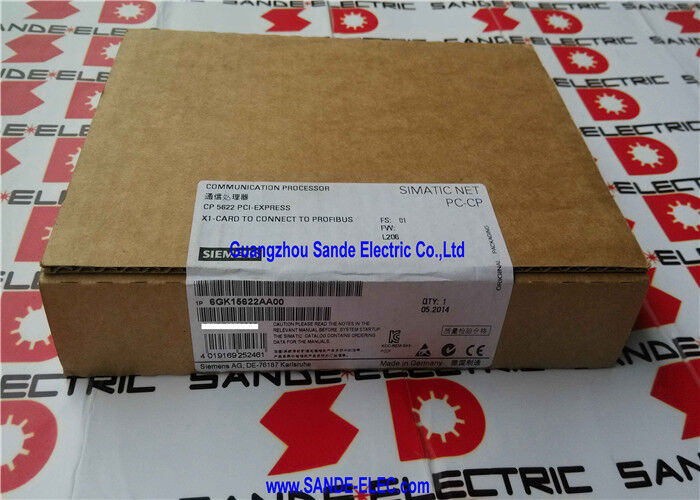
Siemens 6GK1562-2AA00 | CP 5622 PROFIBUS/MPI Communications Processor — PCIe X1 Card, Up to 12 Mbit/s, PROFIBUS DP Master/Slave, PG/OP, S7, FDL, 32/64-bit OS, D-Sub Connector
Communication Services:
- PROFIBUS DP Master Class 1 (cyclic data exchange with DP slaves)
- PROFIBUS DP Master Class 2 (acyclic data access, diagnostics — with SOFTNET-PB DP)
- PROFIBUS DP Slave (with SOFTNET-PB DP Slave package)
- PG/OP communication (STEP 7, SIMATIC PDM, SCOUT)
- S7 communication (with SOFTNET-PB S7 software)
- Open communication — FDL SEND/RECEIVE
Overview
The Siemens 6GK1562-2AA00 is the CP 5622 — a PCI Express X1 communications processor card that connects a standard PC or Siemens PG (programming device) to PROFIBUS and MPI industrial networks.
It is the practical hardware bridge between the engineering world — where STEP 7, TIA Portal, SIMATIC PDM, and STARTER run on Windows computers — and the factory floor fieldbus infrastructure where PLCs, drives, instruments, and process controllers communicate over PROFIBUS DP and MPI.
PROFIBUS DP, the dominant fieldbus in European and global process and factory automation installations through the 1990s and 2000s, continues to be the communication backbone of enormous quantities of installed automation equipment worldwide.
Every Siemens S7-300, S7-400, S7-1500, distributed I/O module, SIMOREG DC drive, and SINAMICS drive configured for PROFIBUS uses this protocol.
Connecting a PC to that network for programming, commissioning, diagnostics, or asset management requires hardware like the CP 5622 — a card whose small footprint and PCIe interface make it the natural choice for modern engineering workstations.
The PCIe X1 physical format is the key hardware compatibility element.
While the original CP 5611 and CP 5613 cards used conventional PCI slots (which are no longer present in most current-generation desktop and workstation motherboards), the PCIe X1 slot is standard on virtually every desktop and workstation platform manufactured since the mid-2000s.
The CP 5622 fits into any PCIe slot regardless of lane count — an X1 card runs correctly in X1, X4, X8, or X16 mechanical slots — making it compatible with any standard PC or engineering workstation without requiring specific slot selection.
Key Specifications
| Parameter |
Value |
| Product Designation |
CP 5622 |
| Interface |
9-pin D-Sub (PROFIBUS / MPI) |
| Transfer Rate |
9.6 kbit/s – 12 Mbit/s |
| Slot Type |
PCIe X1 (fits x4, x8, x16) |
| Protocol |
PROFIBUS DP and MPI |
| OS Support |
32-bit and 64-bit Windows |
| DP Master Class 1 |
Yes (cyclic, native) |
| DP Master Class 2 |
Yes (with SOFTNET-PB DP) |
| DP Slave |
Yes (with SOFTNET-PB DP Slave) |
| S7 Communication |
Yes (with SOFTNET-PB S7) |
| FDL Open Communication |
Yes |
| Protection |
IP20 |
| Operating Temperature |
+5 to +55°C |
| Dimensions (H×W×D) |
112×18×101mm |
| Weight |
0.16 kg |
| Country of Origin |
Germany |
Communication Services in Depth
The CP 5622's value lies in the breadth of communication services it supports when combined with the appropriate Siemens SOFTNET software packages. Understanding which services require which software helps clarify what the hardware alone provides versus what requires additional licensing:
PG/OP communication is provided by the card's basic driver without additional software licenses. This is the communication service used by STEP 7 (Classic), TIA Portal, DriveMonitor, STARTER, and SIMATIC PDM to reach PLCs, drives, and intelligent field devices for programming, parameterisation, and live monitoring.
Any engineer with STEP 7 or TIA Portal installed, a CP 5622 in their PC, and a PROFIBUS cable running to the network can immediately read and write PLC programs, monitor variable tables, and access drive parameter sets.
PROFIBUS DP Master Class 1 — cyclic data exchange with DP slaves — is also natively supported.
This is the communication mode that a runtime application on the PC uses to exchange process data with PROFIBUS slaves in real time, identical to what a PLC DP Master does.
Applications like SCADA/HMI systems, data acquisition tools, and OPC servers can use this mode to continuously read process values from sensors, instruments, and drive status words connected as PROFIBUS slaves.
PROFIBUS DP Master Class 2 — acyclic access for diagnostics and parameterisation during runtime — requires the SOFTNET-PB DP software package.
This mode allows online parameter changes to instruments and drives while they remain in normal cyclic operation, which is the communication model used by SIMATIC PDM for field device management and by drive commissioning tools that adjust parameters during live operation.
S7 communication (PUT/GET between S7 controllers and PC) requires SOFTNET-PB S7. DP Slave operation — placing the CP 5622 in a slave role to receive cyclic data from a PROFIBUS Master — requires SOFTNET-PB DP Slave.
Installation and OS Compatibility
Physical installation requires opening the PC chassis and inserting the CP 5622 into any available PCIe slot.
The card's low-profile bracket fits standard half-height PCIe slots; a full-height bracket should be confirmed for full-size cases. The 9-pin D-Sub PROFIBUS connector exits the rear panel, where a standard PROFIBUS cable with 9-pin D-Sub male connector attaches.
PROFIBUS termination resistors must be enabled at both physical ends of the PROFIBUS cable segment — the CP 5622's connector typically provides the PC-end termination.
Operating system compatibility spans current 64-bit Windows versions as well as legacy 32-bit environments.
Siemens maintains an updated OS compatibility list under Entry ID 22611503, which should be verified for the specific Windows version in use before installation, particularly for newer Windows releases that may require driver updates.
Multiple CP 5622 cards can be installed in the same PC simultaneously — relevant for multi-network engineering workstations serving as PROFIBUS commissioning hubs on projects with multiple independent PROFIBUS segments that must be accessed from the same laptop or desktop.
FAQ
Q1: Is any additional software required to use the CP 5622 with STEP 7 or TIA Portal for PLC programming?
For basic PG/OP communication — which covers all STEP 7 and TIA Portal programming, monitoring, and online diagnostics tasks — no additional software beyond the card's own driver package and STEP 7 / TIA Portal is required.
The driver installs through Windows and makes the card available as a PROFIBUS interface to Siemens engineering tools.
SOFTNET software packages are only required for the additional communication services (DP Master/Slave runtime, S7 communication PUT/GET) used by runtime applications or specific diagnostic tools beyond the standard engineering software functions.
Q2: The card fits PCIe X1, X4, X8, and X16 slots. Does using a larger slot provide any performance advantage?
No. PCIe card performance is determined by the card's own interface design, not by the width of the slot it is installed in.
The CP 5622 uses a PCIe X1 interface, which provides sufficient bandwidth for PROFIBUS at all data rates up to 12 Mbit/s.
Installing it in an X4 or X16 slot uses more of the physical slot than the card actually uses — this is mechanically and electrically compatible and does not affect performance in either direction.
Q3: Can the CP 5622 be used with a laptop, or only with desktop PCs?
The CP 5622 requires an internal PCIe slot, which is available in desktop PCs and workstations but not in standard laptops (which have PCIe Mini, M.2, or Thunderbolt interfaces instead).
For laptop PROFIBUS connectivity, Siemens offers the CP 5711 (USB to PROFIBUS adapter) or external interface devices that connect via USB or Thunderbolt.
The CP 5622 is the appropriate choice for fixed engineering workstations and desktop commissioning PCs installed permanently in control rooms or workshops.
Q4: Does the CP 5622 support MPI communication as well as PROFIBUS DP, and are there any restrictions?
Yes. MPI (Multi-Point Interface) is the Siemens-proprietary programming and communication interface used natively by S7-300 and older SIMOREG drives.
MPI runs on the same physical RS-485 cable as PROFIBUS and is selected at the software configuration level rather than through different hardware.
The CP 5622's D-Sub connector handles both PROFIBUS and MPI connections — the protocol is selected in the SIMATIC software's interface configuration.
Note that MPI is limited to lower data rates (up to 12 Mbit/s nominally, but typically 187.5 kbit/s or 1.5 Mbit/s in practice) and fewer nodes than PROFIBUS DP, and its use is primarily for legacy S7-300 CPU connections and drive communications where PROFIBUS DP is not configured.
Q5: How many PROFIBUS slaves can the CP 5622 manage simultaneously as a DP Master?
As a PROFIBUS DP Master, the CP 5622 supports up to 125 addressable slave nodes on a PROFIBUS segment (the maximum defined by the PROFIBUS standard).
Practical network size is limited by the total amount of cyclic input/output data configured, the data rate, and the update cycle time requirements of the connected application.
In a typical engineering workstation application — where the CP 5622 is used for commissioning and diagnostics rather than runtime process control — the number of simultaneously active slaves is determined by the scope of the project being worked on rather than by a hard hardware limit.



 Your message must be between 20-3,000 characters!