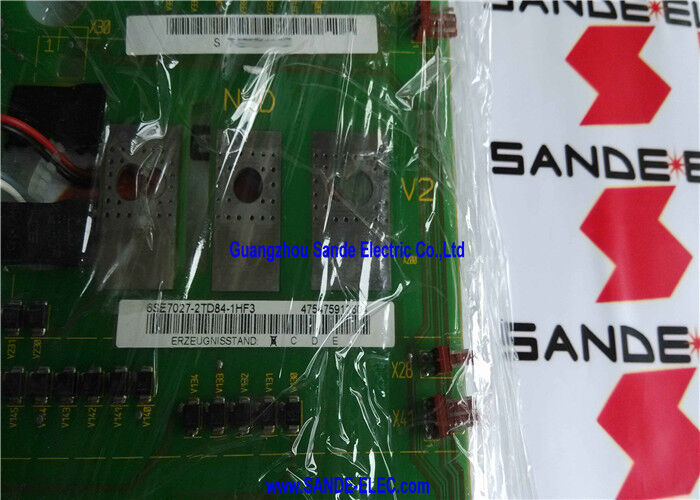
6SE7027-2TD84-1HF3 | Siemens SIMOVERT MASTERDRIVES PEU Power Controller Module — 72A / 510–620V DC / 1.5 kg / Base Drive
PEU at 72A — The TD84 Voltage Class
The 6SE7027-2TD84-1HF3 is the PEU (Power Electronics Unit) for SIMOVERT MASTERDRIVES drives in the 72A / 510–620V DC class — identified by the TD84 voltage designation. The confirmed DC bus specification (510–620V DC) places this PEU in the MASTERDRIVES' standard inverter voltage class.
Within the MASTERDRIVES PEU family, the 72A rating is shared across different voltage class variants:
- 6SE7027-2ED84-1HF5: PEU 72A at 380–460V AC input class
- 6SE7027-2TD84-1HF3: PEU 72A at TD84 voltage class (510–620V DC bus)
Both serve 72A-rated MASTERDRIVES drives, but the TD84 and ED84 designations identify different drive variants — confirming the correct PEU from the installed drive's nameplate is essential.
Key Specifications
| Parameter |
Value |
| Output Current |
72A |
| DC Bus Voltage |
510–620V DC |
| Configuration |
Base Drive |
| Weight |
1.5 kg |
| Module Type |
PEU (Power Electronics Unit) |
| Series |
SIMOVERT MASTERDRIVES |
72A in the MASTERDRIVES Context
At 72A output current, the 6SE7027-2TD84-1HF3 PEU serves the mid-range MASTERDRIVES applications:
Motor power at 72A / 380–460V AC: Approximately 37–45kW of three-phase motor power — the class covering large industrial fans, heavy pumps, conveyors, and machine tool main drives in the 37–55kW range.
Adjacent PEU ratings in the TD84 class: The MASTERDRIVES PEU family at the TD84 voltage class also includes 47A (6SE7024-7TD84-1HF3) — the 47A variant serving smaller motors in the same voltage class, confirmed from adjacent eBay and marketplace listings.
Application Scenarios
MASTERDRIVES power stage fault — TD84 class: A SIMOVERT MASTERDRIVES drive in the 72A TD84 class develops power stage alarms — IGBT fault, DC bus overvoltage, or gate drive failure. The control unit is verified as healthy. 6SE7027-2TD84-1HF3 is replaced, restoring the complete inverter power stage.
Base drive configuration expansion: A facility fitting optional modules to a MASTERDRIVES base drive verifies the installed PEU is 6SE7027-2TD84-1HF3 before proceeding — confirming the base drive hardware before adding communication or braking options.
FAQ
Q1: What is the difference between 6SE7027-2TD84-1HF3 and 6SE7027-2ED84-1HF5 — both are 72A PEU modules?
Both are 72A PEU power electronics units for MASTERDRIVES, but they serve different voltage class drive variants — the TD84 and ED84 designations identify different AC input supply configurations within the MASTERDRIVES range. Always confirm from the installed drive's nameplate which voltage class (TD84 or ED84) applies before ordering, as fitting the wrong PEU variant may cause incompatibility with the drive's control unit.
Q2: What does "Base Drive" mean for 6SE7027-2TD84-1HF3, and what options can be added?
The Base Drive designation indicates this PEU provides the fundamental inverter function — motor speed and torque control from the MASTERDRIVES control unit. Optional expansion capability includes: braking units for rapid deceleration with resistor braking, PROFIBUS or DeviceNet communication boards, encoder feedback modules, and technology option boards for specialised control functions. These options are added to the drive system separately from the base PEU.
Q3: What MASTERDRIVES fault codes indicate a 6SE7027-2TD84-1HF3 PEU fault?
PEU faults produce power-stage alarm codes — F001 (overcurrent), F002 (overvoltage), F006 (IGBT fault), or F026 (gate unit fault) — that appear on the drive's operator panel or parameterisation unit. These indicate a power hardware fault rather than a control unit or communication fault. Confirm the fault code category before removing the PEU — control unit faults produce different alarm patterns and are addressed by replacing the control module rather than the PEU.
Q4: After replacing 6SE7027-2TD84-1HF3, are drive parameters affected?
No. Drive parameters are stored in the MASTERDRIVES control unit — not in the PEU power hardware. Replacing the PEU does not affect any stored motor data, speed limits, ramp times, or control loop tuning. After fitting the replacement and completing the physical installation, power up the drive and verify it passes self-test before enabling the motor.
Q5: What safety precautions apply when replacing 6SE7027-2TD84-1HF3?
Isolate and lock out the mains supply to the MASTERDRIVES unit. The DC bus capacitors in the 72A PEU retain hazardous voltage (510–620V DC range) for an extended period after mains removal. Follow the MASTERDRIVES maintenance manual's capacitor discharge waiting procedure and verify bus voltage is below 50V with a calibrated voltmeter before accessing the PEU. The 1.5 kg PEU requires careful handling — use both hands when removing and installing the module.


 Your message must be between 20-3,000 characters!