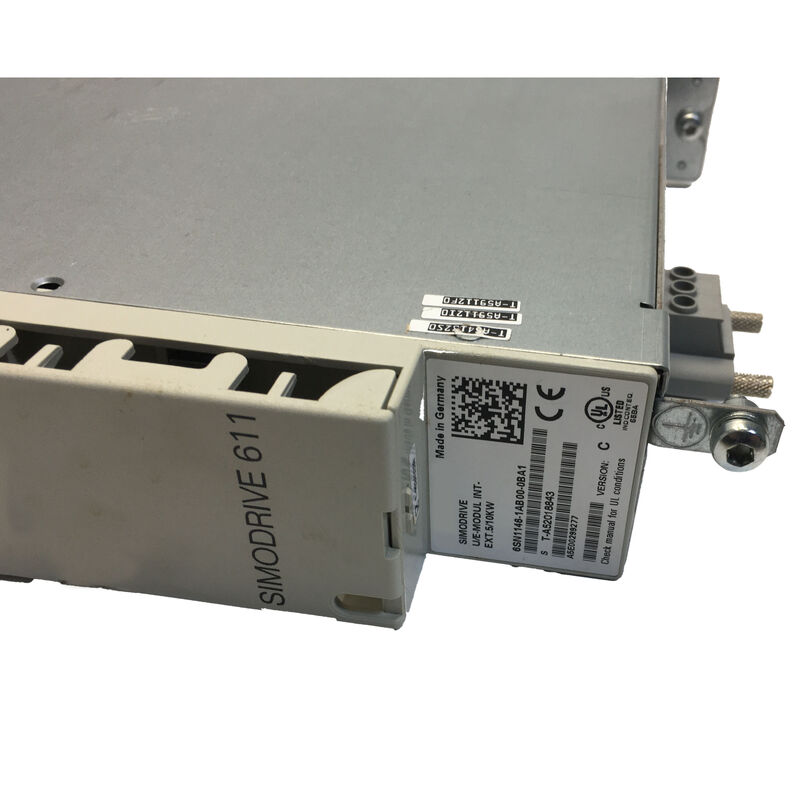
Siemens 6SN1146-1AB00-0BA1 | SIMODRIVE 611 Infeed Module — 5/10kW Unregulated, 380–480VAC Input, DC Link Output, Internal/External Cooling, 98% Efficiency, 6.5kg
Overview
The Siemens 6SN1146-1AB00-0BA1 is the 5/10kW unregulated infeed module for the SIMODRIVE 611 drive system — the module that converts three-phase AC mains into the DC bus voltage that all SIMODRIVE 611 axis modules and spindle modules draw their energy from.
In a SIMODRIVE 611 multi-axis drive cabinet, the infeed module is the power gateway: everything to the right of it on the DC link bus — the feed axis modules driving X, Y, Z, and the spindle module — gets its energy through the infeed module's rectifier and DC link capacitor bank.
The SIMODRIVE 611 was Siemens's primary servo drive system for SINUMERIK CNC machine tools from the mid-1990s through the 2000s, and it is still active in enormous numbers of installed machining centres, turning machines, grinding machines, and production lines across global manufacturing.
When the infeed module fails — typically from capacitor degradation, rectifier diode failure, or control board issues after many years of operation — the entire drive cabinet loses its DC link supply, and every axis on the machine stops.
The infeed module is one of the most critical single points of failure in a SIMODRIVE 611 system, and maintaining a reliable spare is standard practice for machine operators.
The unregulated designation distinguishes this module from the regulated infeed variants.
In a regulated infeed module (such as the 6SN1145 series), active control circuits regulate the DC link voltage to a stable value regardless of input supply variation, and enable energy regeneration back to the mains when the servo axes are braking (the kinetic energy of decelerating machine axes returns to the grid rather than being dissipated as heat in braking resistors).
The unregulated 6SN1146 infeed converts AC to DC through a passive diode rectifier — simpler, more robust hardware with fewer components, but the DC link voltage varies with the AC input voltage and no regeneration is possible; braking energy must be dissipated in pulse resistors.
Key Specifications
| Parameter |
Value |
| Continuous Power |
5 kW |
| Peak Power |
10 kW |
| Input |
3-phase 380–480VAC |
| DC Link Output |
0–490V DC (at 380VAC) to 0–680V DC (at 480VAC) |
| Efficiency |
0.98 (98%) |
| Module Width |
50mm |
| DC Link Cap. (max.) |
1200 µF |
| Cooling |
Internal + external |
| Operating Temp. |
0 to +45°C |
| Weight |
6.5 kg |
| Status |
Discontinued |
The DC Link — What the Infeed Module Powers
The DC link (Zwischenkreis) is the high-voltage DC bus that runs horizontally through the SIMODRIVE 611 cabinet, connecting the infeed module on the left to all axis modules on the right. In a fully populated SIMODRIVE 611 cabinet, this might mean four to eight axis modules, each managing one or two servo axes, all drawing from the same DC link.
The infeed module's job is to maintain adequate voltage and available current on this bus so that every axis module has the energy it needs for its commanded motion.
At steady state — when machine axes are not accelerating — the axis modules draw only the energy needed to hold position against friction, maintain velocity against tool cutting forces, and power the axis's control electronics.
The current demand on the DC link is low. During a rapid traverse acceleration — when all axes simultaneously accelerate to their maximum rapid feed rate — the peak power demand on the DC link spikes sharply.
The 10kW peak rating of the 6SN1146-1AB00-0BA1 defines the module's ability to supply these brief peak demands from the DC link capacitor bank (up to 1200µF) without the DC link voltage collapsing below the axis modules' minimum operating voltage.
The 5kW continuous rating defines the average power the infeed can sustain indefinitely — appropriate for SIMODRIVE 611 installations where the axes collectively require no more than 5kW of continuous input power.
For machines with heavier continuous machining loads, larger infeed modules (6SN1145 or higher-rated 6SN1146 variants) provide higher continuous ratings.
Cooling Options — Internal and External
The 6SN1146-1AB00-0BA1 supports both internal and external cooling, giving machine builders and service engineers flexibility in how the module is installed:
Internal cooling uses a fan mounted inside the module to draw air through the heat sink fins on the module's front or rear surface. This is the default installation approach — the fan is self-contained within the 50mm module width, and no external cooling infrastructure is required.
The internal cooling fan requires adequate airflow through the SIMODRIVE 611 cabinet — typically with a cabinet fan unit at the bottom drawing cool air in and venting warm air out the top.
External cooling mounts the module's power semiconductor heat sink on the outside of the control cabinet — typically through a cutout in the cabinet rear panel.
The heat sink extends outside the cabinet where it dissipates its heat directly to the ambient air outside the cabinet (or to a cold plate connected to a liquid cooling circuit).
This arrangement keeps the heat generated by the infeed module's rectifier circuits outside the control cabinet, reducing the temperature rise inside the cabinet and reducing or eliminating the need for cabinet air conditioning.
External cooling is preferred in installations where the cabinet ambient temperature is marginal, or where the total heat load from multiple drive modules would otherwise require a large and expensive cabinet air conditioner.
98% Efficiency — Energy Flow in the Drive Cabinet
The 6SN1146-1AB00-0BA1's 98% efficiency figure describes how effectively the module converts AC input power to DC link power. At 5kW continuous output, 2% of the input power is dissipated as heat inside the module — approximately 100W.
This 100W heats the module's internal components and the surrounding cabinet air, and must be removed by the cooling system.
At 10kW peak, the heat dissipation rises to approximately 200W for the duration of the peak — brief enough that the thermal mass of the module absorbs the transient without the temperature exceeding safe limits.
The 98% efficiency reflects the low forward voltage drop of the rectifier diodes (typically Schottky or ultra-fast recovery diodes in modern drive rectifiers) and the absence of active regulation circuitry that would introduce additional losses.
A regulated infeed module that actively controls the DC link voltage through switching converters will have slightly lower efficiency due to the switching losses in the active regulation stage.
FAQ
Q1: What is the difference between the 6SN1146 (unregulated) and the 6SN1145 (regulated) infeed modules, and when is each appropriate?
The 6SN1145 regulated infeed module contains an active front-end (AFE) rectifier that uses IGBT switching to regulate the DC link voltage precisely and enable energy regeneration to the mains when drives brake.
This eliminates pulse resistors (braking resistors) and returns braking energy to the grid, reducing operating costs and heat in the cabinet. The 6SN1146 unregulated infeed uses a passive diode rectifier — no active control, no regeneration — and requires pulse resistors to absorb braking energy.
The unregulated module is simpler, more robust, and lower in initial cost. For machine tools with light braking requirements (short travel axes, low inertia), the unregulated infeed is entirely adequate.
For high-inertia spindles or axes with frequent regenerative braking (large machining centres, heavy-duty turning machines), the regulated infeed's regeneration capability provides measurable energy and cost savings.
Q2: Can the 6SN1146-1AB00-0BA1 supply SIMODRIVE 611 axis modules for both linear axes and the spindle simultaneously?
Yes. The SIMODRIVE 611 DC link bus is shared by all modules — feed axis modules and spindle modules alike draw from the same bus that the infeed module supplies.
The infeed module does not differentiate between axis type; it maintains the DC link voltage and supplies whatever current the connected modules demand, up to the peak rating.
The infeed module's continuous and peak ratings must be sized against the total power demand of all connected axis and spindle modules under the worst-case duty cycle for the specific machine application.
Q3: The module is rated 0°C to +45°C operating temperature. What happens if the cabinet ambient exceeds 45°C?
Operation above +45°C ambient requires derating of the infeed module's continuous power rating — the module's cooling system cannot maintain the internal component temperatures within safe limits at full power when ambient is above the design limit.
In practice, SIMODRIVE 611 drive cabinets with adequate ventilation or air conditioning rarely exceed +45°C internally unless the cabinet door is left open in a hot environment or the cabinet ventilation is inadequate.
If the cabinet ambient consistently approaches or exceeds +45°C, external cooling (described above) or supplemental cabinet cooling should be implemented to maintain reliable operation.
Q4: The module is discontinued. Are replacement units and repairs still available?
The 6SN1146-1AB00-0BA1 was discontinued by Siemens OEM production approximately in 2015. However, the installed base of SIMODRIVE 611 machines remains extensive, and the industrial surplus and repair market provides reliable access to this module.
Reputable industrial electronics repair facilities can refurbish failed units — replacing the DC link capacitors (the most common age-related failure), testing the rectifier diodes, and reconditioning the control board.
Refurbished units with warranty from specialised SIMODRIVE repair facilities are a practical and cost-effective maintenance solution for machines where a full drive system upgrade (to SINAMICS S120) is not justified.
Q5: What pulse resistor (braking resistor) is required with this unregulated infeed module?
The 6SN1146-1AB00-0BA1 does not include a pulse resistor — the pulse resistor is a separate module in the SIMODRIVE 611 system.
The appropriate pulse resistor is selected based on the total braking energy and peak braking power of the connected axis modules. Siemens's SIMODRIVE 611 drive configuration documentation provides selection tables correlating the infeed module rating, the connected axis motor sizes, and the appropriate pulse resistor module catalog number.
The pulse resistor module connects to the DC link bus in the same cabinet and absorbs braking energy from all connected axis modules when they decelerate.



 Your message must be between 20-3,000 characters!