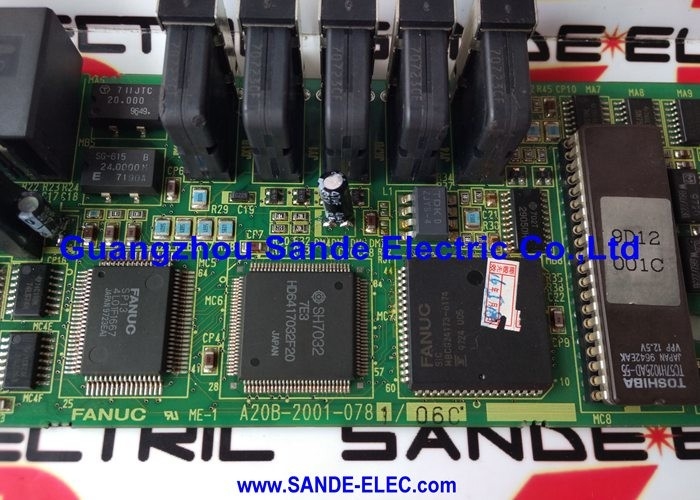
A20B-2001-0781 | FANUC Servo Drive Control PCB — 24VDC / 1A / Class II / 500V Insulation / Conformal Coated / Multi-Layer
PCB Specifications — An Engineering Overview
The A20B-2001-0781 is a control PCB defined by a precise set of electrical and physical specifications. Each parameter reflects a deliberate design choice for its role in FANUC CNC servo drive operation:
24VDC operating voltage: The 24V rail is the standard logic and interface supply for FANUC CNC control boards. Separating the 24V logic supply from the high-voltage DC bus (283–325V) that powers the servo motor output stage ensures the control electronics remain powered even when the main bus is off — allowing controlled shutdown sequencing and diagnostic communication to continue after motor power is removed.
Class II protection (double insulation): Class II means the board is constructed with reinforced or double insulation — no protective earth connection is required. This is standard for low-voltage control boards where earthing of the control circuit is not necessary for safety. The 500V rated insulation voltage confirms the board can withstand fault voltage excursions significantly above its 24V operating level.
Conformal coating: The PCB surface is protected by a conformal coating — a thin polymeric film (typically acrylic or polyurethane) applied over the assembled board. In CNC drive environments, conformal coating protects against humidity, conductive metallic dust from the machine tool environment, and coolant vapour that can enter the drive cabinet despite sealing.
Key Specifications
| Parameter |
Value |
| Operating Voltage |
24V DC |
| Rated Current |
1A |
| Insulation Voltage |
500V |
| Protection Class |
Class II |
| Board Thickness |
1.6mm |
| Base Material |
Fiberglass epoxy (FR4) |
| Construction |
Multi-layer |
| Connectivity |
Edge connector |
| Cooling |
Air cooling |
| Surface Protection |
Conformal coated |
Multi-Layer FR4 Construction — Industrial PCB Standard
The A20B-2001-0781 uses FR4 (fiberglass epoxy) substrate in a multi-layer construction:
FR4: The standard for industrial control PCBs. FR4 provides the dimensional stability required across CNC operating temperature cycles, appropriate dielectric properties for signal integrity between layers, and the mechanical strength to resist flex under the clamping forces of edge connector insertion.
Multi-layer: Signal, power, and ground planes are distributed across multiple internal PCB layers. Dedicated ground planes provide a low-impedance return path for all signal currents, reducing radiated emissions and improving immunity to external interference — both important in the electrically noisy environment of a CNC drive cabinet.
1.6mm: Standard industrial PCB thickness. Fits standard edge connector slots without modification.
Application Scenarios
Servo drive control board replacement: A FANUC CNC servo drive develops a control fault traced to the A20B-2001-0781 board. Replacing this board restores the drive's control function while leaving the high-current power stage hardware intact.
Drive cabinet refurbishment: During a planned overhaul of a FANUC servo drive system, the A20B-2001-0781 is replaced as part of a PCB renewal programme, resetting the control board's service life.
FAQ
Q1: What does Class II protection mean for the A20B-2001-0781, and why does it matter?
Class II (double insulation) means the board is designed so that insulation failure at any single point cannot result in a dangerous voltage reaching the user or the earthed enclosure. This is achieved through reinforced insulation between the primary circuit and accessible conductive parts. For a 24VDC control board in a CNC cabinet, Class II confirms that the board meets the safety requirements of its insulation design without requiring an earth connection from the board itself.
Q2: What is conformal coating and how does it protect the A20B-2001-0781?
Conformal coating is a thin, electrically insulating protective film applied to the assembled PCB surface. It conforms to the three-dimensional topology of the board — covering component bodies, lead solders, and PCB traces. For CNC drive applications, it provides protection against: humidity (prevents moisture film on the PCB surface between conductors), metallic dust (common in machining environments), and coolant vapour. The coating prevents surface leakage currents that could cause logic errors or component damage.
Q3: Does the 500V insulation rating mean this board operates at 500V?
No. The 500V is the rated insulation voltage — the maximum test voltage the board's insulation can withstand between conductors without breakdown. The board operates at 24VDC. The 500V insulation rating provides a safety margin of more than 20× above operating voltage, ensuring the insulation remains effective even during voltage transients or fault conditions in the surrounding drive circuitry.
Q4: Why does a 24VDC, 1A control board need a 500V insulation rating?
The A20B-2001-0781 operates inside a servo drive cabinet where the main DC bus voltage is 283–325VDC. Even though the board itself operates at 24V, its proximity to high-voltage bus conductors, cable connections, and other high-voltage components means the insulation must withstand the full cabinet voltage in case of an arc, tracking, or component failure event nearby. The 500V rating ensures the board's insulation maintains its integrity in this environment.
Q5: What are the typical failure symptoms that indicate the A20B-2001-0781 needs replacement?
Servo drive control board faults typically manifest as: drive failing to reach ready state despite correct power supply and motor connections; intermittent servo alarms that clear on reset but recur; communication errors between the drive and CNC; or fault codes that point to the control electronics rather than the motor, encoder, or power devices. Physical inspection for visible damage — cracked conformal coating, discoloured components, damaged edge connector contacts — supports the diagnosis before replacement.



 Your message must be between 20-3,000 characters!