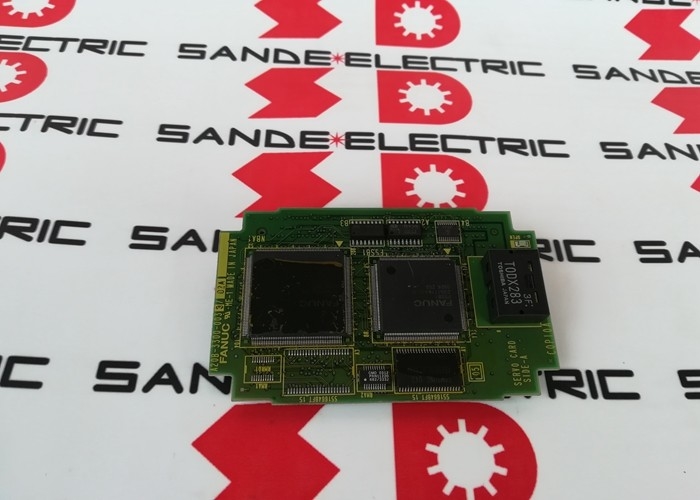
A20B-3300-0033 | FANUC i-Series 2-Axis FSSB Servo Card — Plug-In Module / 16i / 18i / 21i / Model A & B
FSSB Interface — What It Does on This Card
FSSB (Fanuc Servo Serial Bus) is the fibre-optic communication protocol FANUC introduced with the i-series CNC to replace the older analogue and parallel servo interfaces. A single optical fibre loop connects the CNC to all servo amplifiers in the system, carrying axis position commands to each amplifier and returning encoder feedback data to the CNC.
The A20B-3300-0033 implements the CNC side of this FSSB link. It plugs into the main master PCB and connects directly to the fibre-optic FSSB output port. Through this card, the CNC transmits position commands to the connected SVM amplifier chain and receives encoder feedback — coordinating the motion control loops for both of its 2 axis channels.
Key Specifications
| Parameter |
Value |
| Interface |
FSSB (Fibre Optic Servo Serial Bus) |
| Axis Channels |
2 |
| Compatible |
FANUC 16i, 18i, 21i (Model A/B) |
| Type |
Plug-in module |
| Installation |
Main master PCB |
2-Axis Capacity — Extending the System
For a 2-axis CNC (standard CNC lathe with X and Z axes), one A20B-3300-0033 controls both axes through its single FSSB channel. The FSSB daisy-chain connects two servo amplifiers from one card.
For a 4-axis system, two servo cards are installed on the main board — each card handling 2 axes through its own FSSB channel. FANUC i-series Model A and B main boards accommodate multiple servo cards to reach the system's maximum axis count.
The A20B-3300-0033 handles the first FSSB channel (typically axes 1 and 2). A second card handles the next pair of axes if required.
Application Scenarios
Servo communication fault on 16i CNC: A FANUC 16i machining centre generates FSSB communication alarms on both controlled axes simultaneously. The servo drives and motors test correctly. The A20B-3300-0033 plug-in servo card is identified as the fault. Replacing the module restores FSSB communication and clears the axis alarms.
18i lathe servo card replacement: A turning centre with FANUC 18i control develops intermittent axis position errors. Testing confirms the A20B-3300-0033 is delivering inconsistent FSSB timing. A replacement card restores consistent servo communication on both axes.
FAQ
Q1: Does the A20B-3300-0033 work with both Model A and Model B i-series CNC?
Yes. CNC Electronics confirms this card is for "16i, 18i, 21i model A and B." The plug-in socket on both Model A and Model B main boards accepts the same A20B-3300-0033. However, the main board itself differs between Model A and Model B — the servo card is the same, but only install it in the compatible main board generation.
Q2: What servo amplifier types connect to the A20B-3300-0033 via FSSB?
The FSSB interface connects to FANUC's Alpha-i and Beta-i series servo amplifier modules that include an FSSB optical fibre input port. Older analogue (Type-A or Type-B) servo amplifiers are not compatible with FSSB. Confirm the installed servo amplifiers have FSSB connectors before expecting this servo card to communicate with them.
Q3: Can the A20B-3300-0033 be used on its own for a 2-axis lathe without additional servo cards?
Yes. A 2-axis CNC lathe (X and Z axes) requires only one A20B-3300-0033 to control both axes. The card's FSSB channel connects to two servo amplifiers in a daisy-chain arrangement — the FSSB signal goes from the card to the first amplifier and continues to the second. One card is sufficient for the complete axis configuration of a standard 2-axis machine.
Q4: What CNC parameters are relevant to the A20B-3300-0033?
FSSB-related parameters in the CNC define the node address of each servo amplifier on the FSSB chain, the number of connected amplifiers per FSSB channel, and the FSSB communication cycle time. These parameters are held in the CNC's SRAM and are not affected by replacing the A20B-3300-0033 card. After fitting a replacement card, the CNC should re-establish FSSB communication automatically using the existing parameters.
Q5: Is the A20B-3300-0033 the same as the A20B-3300-0030 or other nearby part numbers?
Adjacent part numbers in the A20B-3300-003x range are different boards with different axis counts or interface types. The A20B-3300-0030 may be a different axis card (confirmed in previous documentation as an FSSB servo controller for a different axis count or system generation). Each part number serves a specific application — do not substitute adjacent part numbers without confirming the target system's required card specification.



 Your message must be between 20-3,000 characters!