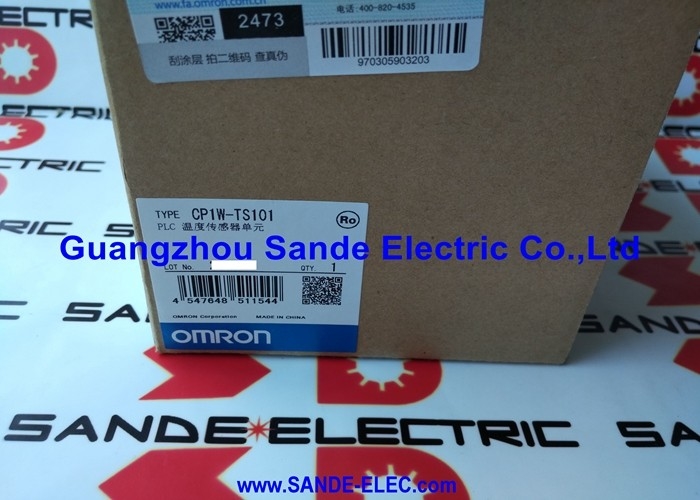
Omron CP1W-TS101 Temperature Sensor Input Unit
Overview
The CP1W-TS101 is a compact temperature input unit for Omron CP-series controllers. It is built for 2 analog temperature inputs, uses Pt100-class resistance thermometer input, and provides 12-bit resolution in a narrow expansion format.
Published product data also shows a compact body size of 90 × 86 × 50 mm and an unpacked weight of 250 g.
What makes this unit practical is its direct fit with compact PLC systems that need temperature measurement without moving to a larger analog platform.
In real control panels, that usually means users can add two RTD channels to an existing CP-series controller while keeping the cabinet simple and the I/O structure easy to maintain.
That is especially useful on smaller machines where temperature data is important but space is limited. This is an engineering inference supported by the unit’s compact format and 2-channel temperature-input design.
Technical Data
| Parameter |
Value |
| Part Number |
CP1W-TS101 |
| Manufacturer |
Omron |
| Product Type |
Temperature input unit |
| Compatible Family |
CP Series |
| Number of Analog Inputs |
2 |
| Temperature Input Type |
Pt100 |
| Resolution |
12 Bit |
| Number of Analog Outputs |
0 |
| Product Height |
90 mm |
| Product Width |
86 mm |
| Product Depth |
50 mm |
| Product Weight |
250 g |
Application Value
The CP1W-TS101 fits well in compact machine automation, heating and cooling skids, small process panels, packaging machines, and utility control systems where a PLC needs direct temperature feedback from Pt100 sensors.
Because it is a dedicated RTD input unit rather than a mixed analog card, it works naturally in applications where stable temperature sensing matters more than general-purpose analog flexibility.
This is an engineering inference based on the published Pt100 temperature-input configuration and CP-series expansion role.
It is also useful in installed-base support. Omron’s CP-series lineup continues to show this module alongside CP-family controllers, which makes it a practical choice for users who want to keep an existing CP-based design intact instead of redesigning the temperature-sensing section around a different hardware family.
Replacement and Selection Perspective
For replacement work, the CP1W-TS101 should be matched by sensor type, channel count, and controller family, not simply by the word “analog.”
In real projects, the difference between an RTD temperature unit and a general voltage/current analog module is fundamental. Matching the same 2-channel Pt100 input style usually preserves the wiring method, sensor scaling expectations, and commissioning workflow with much less risk.
This is an engineering recommendation based on the unit’s published Pt100-only temperature-input role.
FAQ
Q1: What kind of module is CP1W-TS101?
It is a 2-channel temperature input unit for Omron CP-series PLCs.
Its role is to bring Pt100 temperature signals directly into the controller system rather than to provide general analog voltage or current input.
Q2: What applications fit it best?
It fits small automation panels, compact process systems, and machine controls where a CP-series PLC needs a small number of reliable temperature inputs.
In practice, it is well suited to applications where two RTD channels are enough and cabinet space is limited.
This is an engineering inference based on the module’s published 2-channel Pt100 design.
Q3: Why is the Pt100 input type important?
Because the sensor type determines wiring, scaling, and measurement behavior.
A unit designed for Pt100 temperature sensors should be matched to the same sensor class already used in the machine if you want clean commissioning and predictable readings.
This is an engineering inference based on the unit’s published Pt100 configuration.
Q4: Why does exact module matching matter here?
Because a temperature input unit is not interchangeable with a general analog module just because both handle “analog signals.”
The channel type, sensor support, and PLC-side configuration all matter. Matching the exact CP1W-TS101 usually avoids unnecessary programming and wiring changes.
Q5: What should be checked before ordering?
Check the installed part number, confirm that the application uses Pt100 sensors, verify that only 2 channels are needed, and make sure the controller belongs to the same CP-series expansion environment.
Those checks usually prevent the most common replacement mistakes.



 Your message must be between 20-3,000 characters!