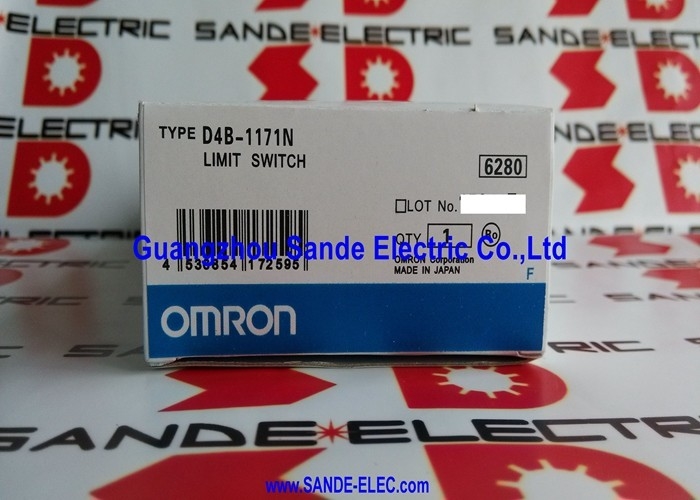
Omron D4B-1171N Roller Plunger Limit Switch
Overview
The D4B-1171N is a metal-housing limit switch built for industrial position detection and machine interlock duty. It belongs to Omron’s D4B-N platform, which is positioned as a robust safety limit switch family with metal construction, direct-opening capability for NC contacts, and wide environmental tolerance.
The exact D4B-1171N model is a roller plunger version with SPDT contact configuration and screw-terminal wiring, making it a practical fit for machinery that needs durable mechanical actuation and straightforward maintenance access.
For product-page positioning, this model is strongest when described as a legacy-capable industrial limit switch rather than as a light-duty control accessory.
Public distributor data identifies the part as obsolete, which means buyers are likely to be searching for it to support installed machinery, repair aging panels, or maintain exact actuator geometry in an existing design.
In those situations, preserving the original mechanical format is often more important than switching to a newer generic substitute.
Key Specifications
| Parameter |
Value |
| Model |
D4B-1171N |
| Manufacturer |
Omron Automation and Safety |
| Series |
D4B-N |
| Category |
Limit Switch |
| Circuit |
SPDT (DB/DM) |
| Switch Function |
On-Mom |
| Current Rating |
10 A (AC), 6 A (DC) |
| Voltage Rating (AC) |
120 V |
| Voltage Rating (DC) |
30 V |
| Actuator Type |
Roller Plunger |
| Mounting Type |
Chassis Mount |
| Termination Style |
Screw Terminal |
| Ingress Protection |
IP67 |
| Part Status |
Obsolete |
Roller Plunger Format — Better for Repetitive Mechanical Actuation
The roller plunger design is one of the most practical features of this model. In machine mechanisms where a cam, moving plate, or actuator surface repeatedly engages the switch, the roller reduces mechanical drag and helps the action stay more consistent over time than a plain plunger would under the same contact conditions.
That makes it well suited to guard positioning, end-of-travel detection, transfer mechanisms, and mechanically timed switching points.
For maintenance teams, that actuator style also matters because it helps preserve the original interaction between switch and machine hardware. When a replacement limit switch must match an installed actuator path, keeping the same roller-plunger geometry is often critical to restoring reliable machine behavior without extra bracket changes.
Metal Housing and IP67 Sealing — Built for Real Plant Duty
The D4B-N family is built around a metal housing and is published with IP67 protection and a broad operating temperature range. That combination gives the D4B-1171N a strong industrial profile for applications where dust, splash exposure, temperature variation, and mechanical wear are part of everyday service conditions.
It is a more rugged platform than the kind of miniature switch used in light equipment or enclosure-only duty.
Because this specific model is now listed as obsolete in distribution channels, its value today is closely tied to maintenance continuity.
Buyers are often looking for it not because it is the newest option, but because it matches the installed hardware and allows a cleaner replacement path in legacy equipment.
FAQ
Q1: What type of machine duty is D4B-1171N suitable for?
It is suitable for industrial position detection, end-of-travel confirmation, guard status monitoring, and machine interlock duty where a mechanically actuated roller plunger is appropriate.
Its metal housing and sealed design make it a good fit for factory equipment rather than light commercial devices.
Q2: Why is the roller plunger format important?
The roller plunger reduces friction at the point of mechanical contact and is often better for repetitive cam or surface actuation than a plain plunger.
In practice, this can help maintain smoother operation and reduce wear in mechanisms that cycle frequently.
Q3: Is D4B-1171N a current production model?
Public distributor data identifies this exact model as obsolete.
That usually means it is being sourced for replacement and maintenance of installed machinery rather than for new standard design work.
Q4: What should engineers check before using it as a replacement?
They should verify the actuator style, contact arrangement, voltage and current ratings, mounting footprint, conduit or terminal layout, and the required operating travel in the machine.
With legacy limit switches, mechanical compatibility is often just as important as electrical compatibility.
Q5: Is it suitable for harsh industrial environments?
Yes, within its published limits. The D4B-N platform is described as a robust metal-housing safety limit switch family, and the exact D4B-1171N listing shows IP67 protection and operation down to -40 °C and up to +80 °C, which supports use in demanding industrial machinery.



 Your message must be between 20-3,000 characters!