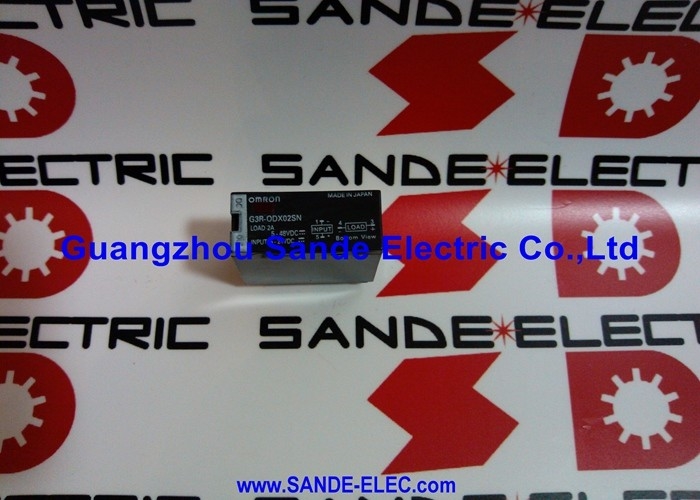
Omron G3R-ODX02SN | G3R-I/O Series DC Solid State Relay — 2A / 4–60V DC Load / 5–24V DC Control / 4,000V Isolation / LED
I/O Interface SSR — Direct Sensor-to-Load Switching
The G3R-ODX02SN is from Omron's G3R-I/O series — solid state relays specifically engineered for the I/O interface role: switching DC loads directly from sensor output signals without an intermediate relay or signal amplifier. The control input accepts 5–24V DC across the typical sensor output voltage range. A PNP proximity sensor output, a PLC transistor output, or a microcontroller GPIO — all connect directly to the G3R-ODX02SN control input at their native signal voltages.
The load output switches 4–60V DC at up to 2A. This covers the full range of 5V logic loads, 12V DC actuators, 24V DC solenoids, and 48V DC industrial loads from a single relay type. Random turn-on mode — non-zero-cross — switches the load immediately at control input activation without waiting for a current zero-crossing. For DC loads, zero-cross switching is not applicable (DC has no AC zero-cross), so random switching is the correct operating mode.
Key Specifications
| Parameter |
Value |
| Load Voltage |
4–60V DC |
| Load Current |
0.01–2A |
| Surge Withstand |
8A for 10ms |
| Control Input |
5–24V DC (nom.) / 4–24V DC (operational) |
| Turn-On Threshold |
4V DC min |
| Turn-Off Threshold |
1V DC max |
| Isolation |
Photocoupler, 4,000V I/O dielectric |
| Indicator |
LED (operation) |
| Mounting |
5-pin plug-in socket |
| Body Width |
13mm |
| Pin Layout |
G2R-1-S compatible |
| Vibration |
10–55Hz, 0.75mm displacement |
| Shock |
1,000m/s² |
| Standards |
UL / CSA |
4,000V I/O Isolation and G2R-1-S Socket Compatibility
The photocoupler isolation between input and output circuits provides 4,000V dielectric strength — conforming to VDE 0884 coupler requirements. This isolation level supports connection to circuits where the control input and load output operate at significantly different reference potentials, and provides protection against transients from the load side reaching the control circuit.
The G3R-ODX02SN uses the same 5-pin plug-in socket footprint as Omron's G2R-1-S power relay. Panels already using G2R-1-S sockets (P2RF-05, P2RFZ-05, or P2RF-05-PU push-in) accept the G3R-ODX02SN directly. This compatibility allows solid-state switching to be substituted for mechanical contact switching in an existing panel layout without rewiring. The G70A I/O terminal block also accepts G3R-I/O modules directly.
FAQ
Q1: What is the difference between the G3R-ODX02SN and G3R-OD201SN?
Both are DC output G3R-I/O solid state relays with the same 5-24VDC control input and 2A load current. The G3R-ODX02SN handles 4–60V DC load voltage; the G3R-OD201SN handles 40–200V DC load voltage at 1.5A. Select based on the load supply voltage — the ODX02SN for 5V/12V/24V/48V DC loads, the OD201SN for 48–200V DC loads.
Q2: What does the LED indicator show on the G3R-ODX02SN?
The LED illuminates when the control input is activated — the relay is in the ON state and switching current to the load. This visual indicator confirms relay activation without test equipment, useful during commissioning and fault diagnosis. An LED on with no load current flowing indicates the relay is commanded on but the load circuit is open.
Q3: Can the G3R-ODX02SN be used with a PLC transistor output directly?
Yes. PLC NPN or PNP transistor outputs at 24V DC connect directly to the control input. The input is rated for 5–24V DC and draws a small current within the range of standard PLC transistor outputs. No current-limiting resistor is required within the 5–24V DC control voltage range.
Q4: What causes the relay to fail to turn off (load stays on)?
Common causes: Control input voltage above 1V DC due to transistor leakage from the driving device (add a pull-down resistor to the control input); voltage induced from adjacent conductors in a cable bundle when control and load cables share the same conduit (separate control and load cables). Internal SSR failure (typically from sustained overload or excessive surge current) can also cause a permanently conducting output.
Q5: What is the maximum inrush current the G3R-ODX02SN can handle?
The relay withstands 8A for 10ms surge current. This covers inrush from capacitive and small inductive DC loads. For loads with higher inrush — large DC motors, large capacitor banks — verify the peak inrush current and duration against this rating. Repeated inrush events at the limit of the rating reduce SSR service life through cumulative thermal stress on the output switching element.


 Your message must be between 20-3,000 characters!