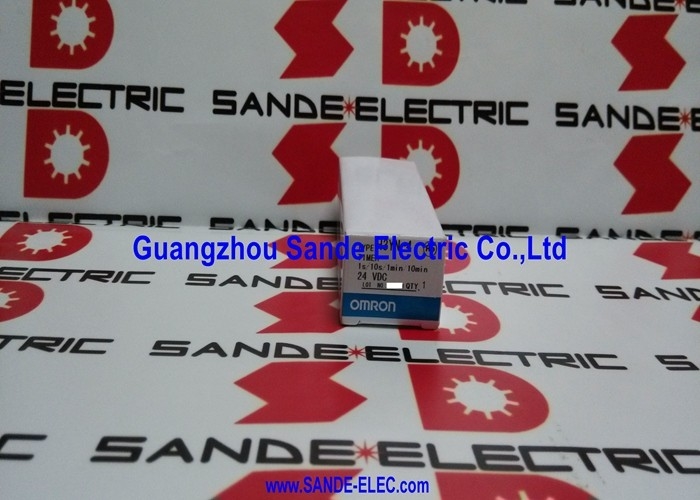
Omron H3YN-4 | Miniature Solid-State Timer — 4PDT / 4-Mode / 0.1 s–10 min / 14-Pin Plug-In / MY Relay Compatible
Four Modes from One Timer — DIP Switch Replaces Multiple Part Numbers
The H3YN-4 is the 4PDT output variant of Omron's H3YN miniature solid-state timer — a single unit covering four distinct timing modes and four selectable time ranges through onboard DIP switches.
Four timing modes:
- ON-delay: Output activates after the set time elapses from power application
- Interval: Output activates immediately at power-on and deactivates after the set time
- Flicker OFF-start: Output repeatedly toggles, starting with the OFF state
- Flicker ON-start: Output repeatedly toggles, starting with the ON state
All four modes are available on the same unit. Switching between them requires a DIP switch change, not a different part number. The factory default is ON-delay mode with the 1-second range — the most commonly used combination in machine control.
Four time ranges selectable by the upper two DIP switch pins: 0.1–1 s, 1–10 s, 0.1–1 min, or 1–10 min. Within each range, the desired time is set by the analog dial on the timer body.
Key Specifications
| Parameter |
Value |
| Output |
4PDT (4-pole double throw) |
| Contact Rating |
3A at 250V AC (resistive) |
| Min Load |
1mA at 1V DC |
| Time Range (short) |
0.1 s to 10 min (4 selectable) |
| Operating Modes |
4 (DIP switch) |
| Factory Default |
ON-delay, 1 s range |
| Supply Voltages |
12/24/48/100–110/125 VDC; 24/100–120/200–230 VAC |
| Terminals |
14-pin plug-in |
| Pin Compatibility |
MY Power Relay |
| Mechanical Life |
10,000,000 operations min |
| Weight |
~50 g |
| Standards |
EN 61812-1 / UL 508 / CSA |
MY Relay Pin Compatibility — Drop-In Replacement in Existing Sockets
The H3YN-4 pin configuration is identical to the Omron MY power relay on the same 14-pin footprint. A MY relay socket (PYF14A or PY14) already installed in a panel accepts the H3YN-4 directly — timing capability can be added to an existing circuit with only the relay swap, without wiring changes. This compatibility also reduces spare part rationalisation; a facility stocking H3YN-4 timers can use them in any panel position currently occupied by MY relays.
The long-time range version (H3YN-41) covers 0.1 min to 10 hours using the same four modes and the same physical format — select H3YN-4 for applications measured in seconds and minutes, H3YN-41 for hours.
FAQ
Q1: How are the operating mode and time range changed on the H3YN-4?
Via the DIP switch on the timer body. The lower two DIP switch pins select the operating mode (ON-delay, interval, flicker OFF-start, flicker ON-start). The upper two pins select the time range (0.1–1 s, 1–10 s, 0.1–1 min, 1–10 min). Change settings with the timer de-energised. The factory default is ON-delay mode, 1-second range.
Q2: What is the difference between H3YN-4 and H3YN-2?
Both are H3YN series multi-mode timers. H3YN-4 has 4PDT output (four poles), suited for circuits that require multiple simultaneous switched contacts. H3YN-2 has DPDT output (two poles). Both carry the same timing modes and time ranges. Select H3YN-4 when four independent contact sets are needed; select H3YN-2 for two-pole applications.
Q3: What socket is needed to mount the H3YN-4 in a panel?
The H3YN-4 requires a 14-pin socket — Omron PYF14A (track mount / front connecting), PY14 (back connecting), or PY14QN. The H3Y-4 socket notes reference models in parentheses for connecting sockets. Sockets and hold-down clips are not included with the timer and must be ordered separately.
Q4: The timer is energised but the output does not activate at the set time. What should be checked?
Verify the supply voltage at the input terminals is within the rated range. Confirm the DIP switch is set to the intended operating mode — ON-delay mode requires the input power to be applied continuously for the set time before the output activates. Check the analog time dial setting is not at minimum (0). If a power interruption occurred during the timing cycle, the timer resets from zero at power restoration.
Q5: What is the difference between H3YN-4 (short range) and H3YN-41 (long range)?
Both are physically identical 4PDT multi-mode timers with the same contact rating and supply options. H3YN-4 covers 0.1 seconds to 10 minutes across its four selectable ranges. H3YN-41 covers 0.1 minutes to 10 hours. The factory default for H3YN-41 is ON-delay mode, 1-minute range. Choose based on the required timing duration.


 Your message must be between 20-3,000 characters!