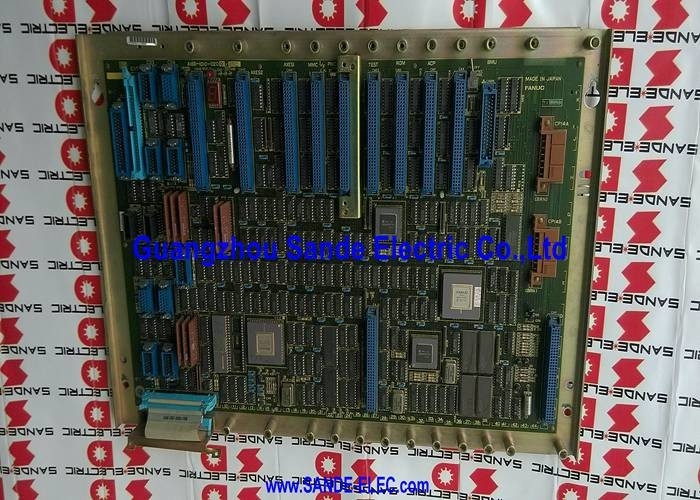
A16B-1210-0030 | FANUC Analog Multi-Axis CNC Control PCB — Up to 3 Axes / Servo Amplifier Interface / Command and Feedback Processing
Analogue Axis Control — The Signal Path Between CNC and Drives
In FANUC's analogue CNC axis control architecture, the axis control PCB sits between the CNC's main interpolation processor and the servo drive amplifiers. The main CPU calculates the required axis movement for each interpolation cycle and hands the result to the axis board. The axis board converts these commands into the analogue signals that the servo drives interpret as velocity or torque references.
The A16B-1210-0030 handles up to three axes simultaneously. For a 3-axis machining centre (X, Y, Z), this single board manages the complete motion interface. For each of its active axes, it:
- Outputs the analogue velocity or torque reference signal to the servo drive
- Receives position feedback from the motor's pulse coder
- Monitors the feedback signal for errors or abnormalities
- Reports axis status back to the main control system
Key Specifications
| Parameter |
Value |
| Interface |
Analogue |
| Axis Capacity |
Up to 3 axes |
| Function |
Axis command + feedback processing |
| Installation |
CNC controller rack (plug-in) |
| Series |
A16B-1210 |
Coordinated Motion Control — Why the Axis Board Matters
Coordinated motion — the simultaneous movement of multiple axes along a programmed path — requires the axis board to update all active axes at the same time. The A16B-1210-0030 receives commands for all three axes at the same moment and updates all three outputs in the same processing cycle.
If one axis is late — if the X-axis command is updated one cycle after the Y and Z — the actual tool position deviates from the programmed path. This is the reason axis boards are designed with simultaneous, synchronised update loops rather than sequential axis processing.
When the A16B-1210-0030 fails or develops a fault, the result is often a single-axis or multi-axis following error alarm — the CNC detects that the commanded and actual positions have diverged beyond an acceptable threshold. After confirming the drive and motor are functional, the axis board is a primary diagnostic target.
Application Scenarios
3-axis machining centre maintenance: A 3-axis CNC machining centre develops a following error alarm on all three axes. Servo drives and motors test correctly. The A16B-1210-0030 axis control board is identified as the fault. Board replacement restores coordinated 3-axis motion.
Preventive spare stock: A machine shop operating multiple FANUC CNC systems with analogue axis boards maintains an A16B-1210-0030 as a workshop spare, enabling immediate board swap on a board-level failure.
FAQ
Q1: What is the difference between an analogue axis board and a digital axis board?
An analogue axis board generates a continuously variable DC voltage (typically ±10V) as the velocity or torque reference for the servo drive. A digital axis board communicates via a serial digital bus (such as FSSB fibre optic in later FANUC generations). Analogue axis boards are the earlier architecture; digital interfaces replaced them in subsequent CNC generations. The A16B-1210-0030 is the analogue type.
Q2: What servo drive types are compatible with the A16B-1210-0030?
Analogue axis boards interface with servo drives that accept an analogue velocity reference input — typically FANUC's earlier AC and DC servo drive generations that pre-date the digital FSSB interface. Confirm the specific servo drive series installed on the machine against the A16B-1210-0030's output signal specification before fitting a replacement.
Q3: Can the A16B-1210-0030 be used for only 2 axes instead of 3?
Yes. The board supports up to 3 axes, but it is not required to use all three channels. A 2-axis CNC lathe (X and Z) uses two of the three axis channels; the third channel is simply unused. The CNC parameter configuration determines which channels are active and which are left unused.
Q4: What happens if only one of the three axes on the A16B-1210-0030 fails?
If one channel on the axis board fails — for example, the Y-axis output develops a fault — only that axis generates an alarm. The other two axes may continue operating normally. However, the machine cannot execute any programme requiring the failed axis. Replace the A16B-1210-0030 to restore the faulty channel; the board serves all three axes, so replacing it is the only repair option short of component-level board repair.
Q5: Does replacing the A16B-1210-0030 require any CNC parameter changes?
Normally, no. CNC axis parameters — including servo loop gains, axis assignments, and position error limits — are stored in the CNC's parameter memory, not in the axis board. Replacing the A16B-1210-0030 with a board of the same specification restores the axis interface hardware without requiring parameter modification. Verify that all axes move correctly at low speed before returning the machine to production.


 Your message must be between 20-3,000 characters!