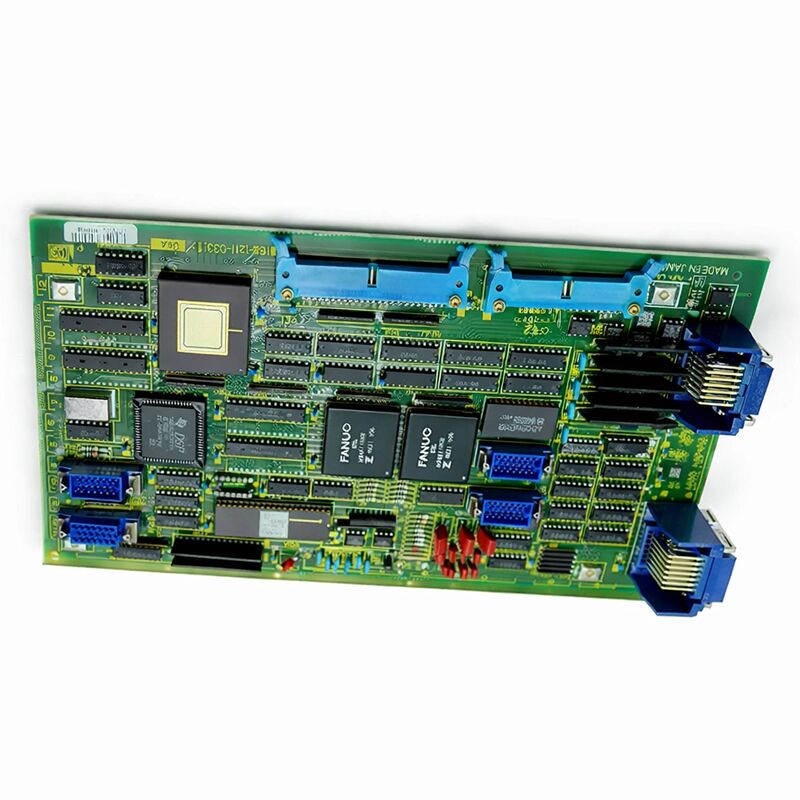
FANUC A16B-1211-0270 | System 10 / 11 Digital Control Add-Axis PCB — 2 Axes, Japan Origin
Part Number: A16B-1211-0270
Manufacturer: FANUC Corporation (Japan)
Product Type: Digital Control Add-Axis PCB (2 Channels)
Board Series: A16B-1211
Compatible Systems: FANUC System 10, System 11
Axis Count: 2 (additional axes)
Description: 10/11 Digital Control Add Axis PCB, 2 Axis
Overview
The A16B-1211-0270 is the 2-axis additional axis control board for FANUC's System 10 and System 11 CNC controllers. It is an expansion board — not a standalone controller — that extends the axis count of existing System 10/11 CNC configurations by providing digital servo control for two additional axes.
Adding this board to a base System 10/11 installation allows machines that require more controlled axes than the standard configuration provides to operate within the same proven controller platform.
FANUC's System 10 and System 11 were high-performance CNC platforms designed for complex machining applications — large machining centres, multi-pallet production lines, and machines requiring coordinated multi-axis motion.
The base controller axis count was often sufficient, but the most demanding machine designs needed further expansion. The A16B-1211-0270 provided that expansion with two additional digitally controlled axes.
The board interfaces with the digital servo drives of its era. System 10/11 machines typically used FANUC S series and similar digital drive units, and the axis expansion board's digital interface matched these drives.
The two additional axes served by this board are fully integrated into the CNC system — they participate in coordinated motion with the primary axes, appear in the part program as standard controllable axes, and respond to the same G-code commands as any other axis in the system.
Key Specifications
| Parameter |
Value |
| Part Number |
A16B-1211-0270 |
| Manufacturer |
FANUC Corporation |
| Product Type |
2-Axis Digital Control Add-Axis PCB |
| Board Series |
A16B-1211 |
| Compatible Systems |
FANUC System 10, System 11 |
| Additional Axes |
2 |
| Drive Type |
Digital servo drives |
| Origin |
Japan |
| Operating Temperature |
0 – 55°C |
| Storage Temperature |
−20 – 60°C |
| Humidity |
75% RH max (non-condensing) |
| Condition Available |
New (surplus) / Refurbished / Repaired |
System 10/11 Architecture and Axis Expansion
FANUC's System 10 and System 11 were part of the product line that positioned FANUC at the high end of the CNC market in their era. These controllers powered large, capable machine tools — machines with large workspaces, high material removal rates, and demanding precision requirements.
The axis expansion architecture was a deliberate design choice: by building the base controller around a defined axis count and providing expansion boards for applications that needed more, FANUC created a flexible platform that could serve a wide range of machine designs without requiring fundamentally different controllers.
The A16B-1211-0270 adds two axes to the System 10/11 configuration.
In a machine that uses this board, the controller's interpolation logic coordinates all axes simultaneously — both the primary axes from the main controller boards and the additional axes from this expansion board.
The part program operates across all axes as a unified system. A contour that requires simultaneous motion on four or more axes executes with all axes moving in coordination, regardless of which physical board handles each axis.
The digital interface on this board was a key feature. Digital axis control provided better noise immunity and more consistent behaviour than earlier analogue axis interface approaches.
In the complex electrical environment of a large CNC machine cabinet — with motor power cables, encoder feedback cables, and control signal cables all running in close proximity — digital signal integrity was a practical benefit.
Axis Board as a Critical Subsystem
From the machine's perspective, the additional axis board is not an optional extra — on machines that were built to require its function, it is as essential as the main controller board. A machine designed for five-axis simultaneous machining cannot perform its intended operations with only three controllable axes.
When the A16B-1211-0270 fails, the two additional axes it serves become unavailable, and the machine's capability is reduced to whatever the remaining primary axis count allows.
This criticality means that having a tested spare on hand is prudent for operations where System 10/11 machines contribute to production schedules that cannot easily absorb unplanned downtime.
The board is old enough that sourcing a replacement when needed may require lead time.
Proactive spare management avoids the situation where a board failure becomes a prolonged machine outage.
Maintenance on Boards of This Age
The A16B-1211-0270 is a product from FANUC's System 10/11 era — boards that are now several decades old. Electronic components age. Electrolytic capacitors, which appear throughout the power conditioning and signal processing circuits on this board, have finite service lives that are measured in years under the operating conditions of a CNC controller cabinet.
A board that is showing erratic behaviour — intermittent axis faults, alarms that come and go without clear mechanical or electrical cause — is often exhibiting early-stage capacitor degradation. This is a sign of age rather than catastrophic failure, and it is often reversible through component-level refurbishment.
Replacing the board's electrolytic capacitors with new components of the same specification restores the power supply conditioning and can return the board to reliable service for many more years.
Board refurbishment is an economical option for components of this age and scarcity.
Given how difficult original-specification replacement boards are to source, a professionally refurbished and functionally tested board is a high-value resource.
FAQ
Q1: On a System 11 machining centre, the 4th and 5th axes both alarm at power-on. The first three axes are normal. Is the A16B-1211-0270 the likely cause?
Simultaneous failure of both axes served by the expansion board, while the primary axes remain normal, is the characteristic fault pattern for an axis expansion board failure. Both failed axes share the A16B-1211-0270 as their common board.
If the servo drives and motors for the 4th and 5th axes test as undamaged, the expansion board is the primary suspect.
Confirm by checking whether the board's connector is fully engaged before concluding the board has failed.
Q2: Only one of the two axes on the A16B-1211-0270 generates an alarm. The other expansion axis is normal. Does this indicate the board or the drive/motor?
A single-axis fault from a two-axis expansion board is more ambiguous. If the board has a single-channel circuit failure (an input circuit or output driver for that specific channel), the board can fail one axis while the other remains functional.
However, single-axis faults more commonly indicate a drive, motor, or cable fault on that specific axis.
Test the drive and motor on the affected axis before concluding the board has failed. If external components are confirmed good, the board's single-channel circuit has failed.
Q3: After years of reliable service, the additional axes started showing occasional position errors that correct themselves. No alarm is generated. What is happening?
Self-correcting position errors without alarm generation suggest intermittent signal disturbances in the expansion axis path rather than outright component failures.
The most likely causes are: a connector with developing contact resistance, an aging capacitor on the board producing occasional supply glitches that cause brief control signal disturbances, or a cable with an intermittent connection.
Inspect and reseat all connectors in the expansion axis path.
If the condition persists after connector service, the board's capacitors are the next focus.
Q4: The A16B-1211-0270 was removed and examined. Several electrolytic capacitors show visible bulging or electrolyte leakage. Can the board be repaired?
Visible bulging or leakage from electrolytic capacitors indicates the capacitors have failed and should be replaced. This is a repairable condition.
The affected capacitors should be desoldered and replaced with new capacitors of the same or equivalent specification.
The board should be cleaned of any electrolyte residue, which is chemically active and can damage PCB traces and adjacent components if left in place.
After capacitor replacement, the board should be functionally tested before reinstallation. This repair restores the board effectively.
Q5: The System 11 machine is being decommissioned. Can the A16B-1211-0270 be used in a System 10 machine that also needs axis expansion?
System 10 and System 11 both appear in the A16B-1211-0270's compatibility.
Whether a board pulled from a System 11 installation is directly usable in a System 10 machine depends on the specific controller configurations and any hardware or software version requirements that may differ between the two installations.
Verify the axis assignment parameters in the target machine are compatible with the board, and confirm no hardware configuration differences exist between the System 10 and System 11 axis expansion interfaces before installation.


 Your message must be between 20-3,000 characters!