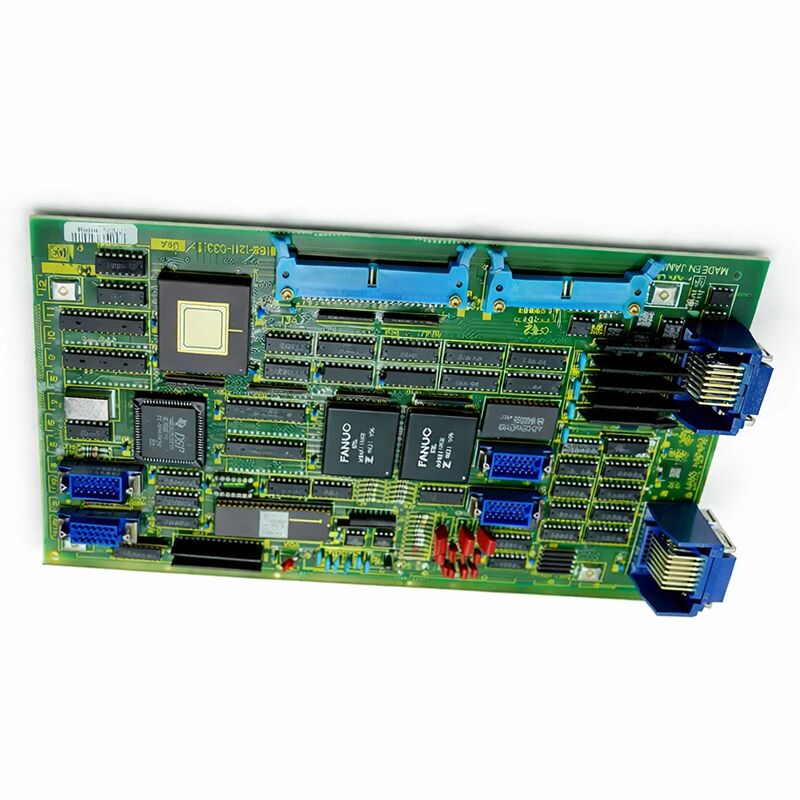
FANUC A16B-1211-0270 | Series 10/11 Digital Control Add Axis PCB — 2 Axis, Japan Origin
Part Number: A16B-1211-0270
Manufacturer: FANUC Corporation (Japan)
Product Type: Digital Control Add Axis PCB — 2 Axis
Board Series: A16B-1211
Compatible Systems: FANUC Series 10 / 11
Overview
The A16B-1211-0270 is the 2-axis digital control add axis PCB for FANUC Series 10 and 11 CNC systems. It extends the axis capability of these controllers by adding two additional digitally controlled servo axes to the base configuration.
In FANUC Series 10/11 architecture, the base controller manages a set of axes through the main control board. When the application requires more axes than the base configuration supports, an add axis board provides the expansion.
The Series 10 and 11 were FANUC's high-performance CNC generation of their era — controllers designed for demanding multi-axis machine tools including machining centres with rotary tables, large turning centres with live tooling, and complex multi-path configurations.
The add axis PCB exists because these applications often required more axes than a single control board configuration could accommodate.
Digital control in this context means the axis control operates through a digital servo interface — commands, feedback, and position data travel as digital values rather than analog voltages. This was an advancement from the earlier analog servo systems and provided more precise and repeatable axis control.
The A16B-1211-0270 implements this digital control interface for two additional axes.
Key Specifications
| Parameter |
Value |
| Part Number |
A16B-1211-0270 |
| Manufacturer |
FANUC Corporation |
| Product Type |
Digital Control Add Axis PCB |
| Board Series |
A16B-1211 |
| Axis Count |
2 axes |
| Control Type |
Digital servo control |
| Compatible Systems |
FANUC Series 10 / 11 |
| Origin |
Japan |
| Operating Temperature |
0 – 55°C |
| Storage Temperature |
−20 – 60°C |
| Humidity |
75% RH max (non-condensing) |
| Condition Available |
New (surplus) / Refurbished / Repaired |
Axis Expansion in FANUC Series 10/11
FANUC's Series 10 and 11 CNC systems were designed for flexibility. The base controller handled the primary axes.
Optional add axis boards extended the controller's capability to handle secondary and tertiary axes — rotary tables, indexers, subspindles, and additional linear axes on complex machine tools.
The add axis board does not operate independently.
It works in coordination with the main control board, receiving interpolated motion commands and managing the servo communication for its assigned axes.
The CNC's motion planning runs centrally; the execution of those motion commands for the additional axes is handled by this board.
Two axes on a single board is the efficient configuration for this application.
Machines that needed three or four additional axes could install multiple add axis boards or combine this board with other expansion options.
The board occupies one slot in the controller rack and adds two fully functional digital servo channels.
Digital Servo Interface — What It Controls
Each axis channel on the A16B-1211-0270 handles the communication path to the servo amplifier for that axis. In FANUC's digital servo architecture, the CNC sends position references to the servo amplifier via a high-speed serial link.
The amplifier executes the position loop locally, using feedback from the motor's encoder.
The add axis board implements the CNC side of this serial link for its two axes.
It generates the command data that the servo amplifiers receive and processes the feedback data that comes back. Position error, actual speed, alarm state — all of this flows through the board.
The board also participates in the CNC's interpolation — for axes that move in coordinated paths with other axes, the timing of the position commands must be synchronised across all axes.
The add axis board coordinates with the main control board to achieve this synchronisation.
Sourcing for a Legacy Platform
The Series 10 and 11 represent a mature FANUC generation.
These controllers were produced for the machining centre and turning centre market at a time when multi-axis digital servo control was advancing rapidly. Many of the machines they were installed in remain productive today.
FANUC no longer manufactures new A16B-1211 series boards for the Series 10/11 platform.
Available supply comes from surplus new-in-box stock, refurbished boards from decommissioned machines, and repaired units.
For production machines where the add axis board is a single point of failure for specific machine axes, holding a tested spare in-house eliminates sourcing time from any future repair scenario.
FAQ
Q1: The third and fourth axes on the Series 11 machine alarm with a servo error. The first two axes are normal. Is the add axis PCB the likely fault?
A servo alarm isolated to the axes controlled by the add axis board — with the main axes operating normally — is strongly indicative of an add axis board fault or a fault in the servo amplifiers connected to that board.
Check the servo amplifier alarm displays for each affected axis first.
A servo amplifier alarm identifies the fault at the amplifier level. If amplifiers are clear and only the CNC is alarming on those axes, the add axis board becomes the primary suspect.
Q2: Can axes from the A16B-1211-0270 be programmed and interpolated with axes on the main board?
Yes. Axes on the add axis board are fully integrated into the CNC's motion control. They participate in coordinated multi-axis interpolation with the main board's axes.
The CNC treats all axes as part of a unified motion system regardless of which board manages each axis's servo communication.
Q3: The add axis board was replaced. The axes it controls home normally but positioning is offset. Why?
Position offsets after an add axis board replacement typically indicate that the servo amplifier parameters for those axes need to be verified or restored. Some positioning data or compensation parameters may reside in the amplifier or in the CNC's parameter memory.
Confirm the CNC parameter backup is complete and that the axis parameters for the affected axes match the previous configuration.
Q4: Can a different A16B-1211 variant replace the A16B-1211-0270?
Different suffix numbers in the A16B-1211 series indicate different functions. The -0270 is specifically the 2-axis digital control add axis variant for Series 10/11.
Other suffix numbers in the series are different board types — sub CPU boards, graphic boards, PMC boards.
Only the -0270 suffix is the correct replacement for the 2-axis digital add axis function.
Q5: How should the A16B-1211-0270 be tested before installation in a running machine?
The board can be visually inspected for component damage, connector condition, and corrosion before installation.
Functional testing requires the Series 10/11 controller environment — the board cannot be independently tested outside the system it is designed for.
A supplier who provides boards tested within a Series 10/11 system offers more assurance than a board that has been inspected but not powered under load.
If possible, test the replacement board in a known-good controller before committing to installation in the production machine.


 Your message must be between 20-3,000 characters!