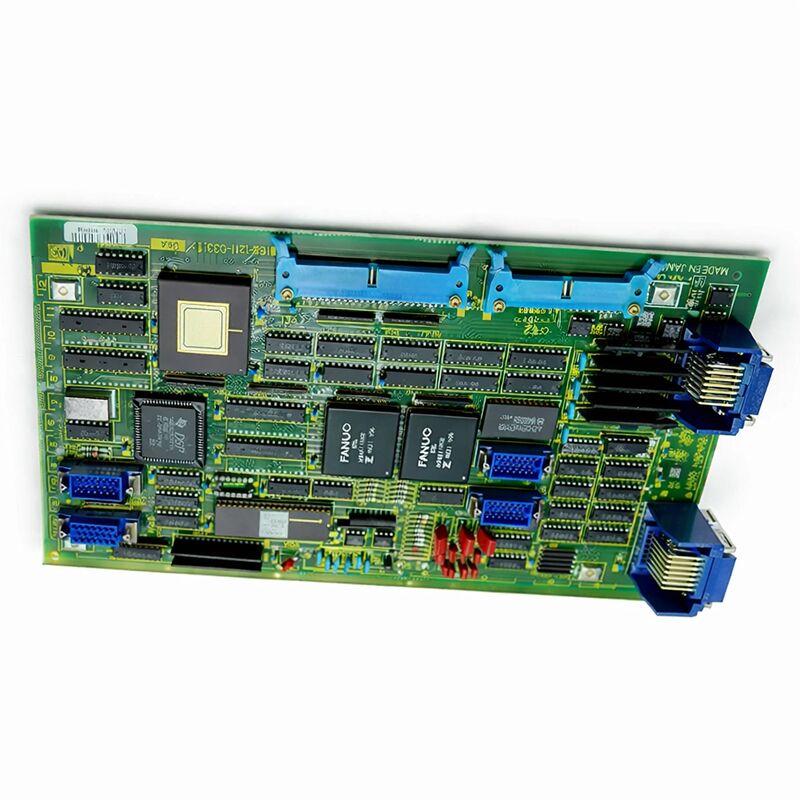
FANUC A16B-1211-0271 | A16B-1211 Series Axis Control PCB — System 10 / 11 CNC, Japan Origin
Part Number: A16B-1211-0271
Manufacturer: FANUC Corporation (Japan)
Product Type: Digital Axis Control PCB
Board Series: A16B-1211
Compatible Systems: FANUC System 10, System 11 and compatible
Application: Digital servo axis control / axis expansion
Overview
The A16B-1211-0271 is a printed circuit board from FANUC's A16B-1211 series — the family of axis control and expansion boards that served the System 10 and System 11 CNC controller platforms.
This series covered the various axis control board variants that System 10/11 installations required: single-channel boards for individual axis applications, dual-channel boards for paired axis control, and interface variants for different drive generations.
The A16B-1211-0271 is one specific member of this family, serving its defined function in the System 10/11 axis control architecture.
FANUC's System 10 and System 11 represented the high-performance end of FANUC's CNC product line before the transition to the 0-C and Series 15 platforms.
These controllers powered complex machine tools — machining centres with multiple controlled axes, turning centres with live tooling, and multi-function machines demanding coordinated motion across many axes simultaneously.
The A16B-1211 series axis boards were the hardware that made this multi-axis capability possible.
Every axis card in the A16B-1211 series fills the same architectural role: it provides the servo interface between the main controller and the servo drive units for its assigned axes.
It converts the controller's position commands into servo drive signals and processes the encoder feedback that returns position data to the controller.
The A16B-1211-0271 performs this function for the System 10/11 axes it is configured to serve.
Key Specifications
| Parameter |
Value |
| Part Number |
A16B-1211-0271 |
| Manufacturer |
FANUC Corporation |
| Product Type |
Digital Axis Control PCB |
| Board Series |
A16B-1211 |
| Compatible Systems |
FANUC System 10, System 11 |
| Application |
Servo axis interface and control |
| Construction |
Through-hole (non-SMT) |
| Origin |
Japan |
| Operating Temperature |
0 – 55°C |
| Storage Temperature |
−20 – 60°C |
| Condition Available |
New (surplus) / Refurbished / Repaired |
A16B-1211 Series — The System 10/11 Axis Board Family
The A16B-1211 series encompasses a range of axis control boards for the System 10 and System 11 platforms, each variant covering a specific combination of axis count, interface type, and drive generation.
The variants cluster around their axis count (single-channel and dual-channel) and drive interface requirements (digital, serial, analogue). Within this family, part numbers in close sequence tend to be similar in function but differentiated by channel count, hardware revision, or minor interface differences.
The A16B-1211-0271 occupies its position within this series as one of the boards that System 10/11 multi-axis configurations depended on.
In machines where this specific board was specified, it serves an axis or group of axes that the controller must control to execute its operations.
The machine cannot run those axes without a functional board of this type installed.
For System 10/11 machine owners, the A16B-1211 series boards are among the most critical legacy components to maintain supply access to.
The machines themselves often have decades of productive life remaining.
The electronics, however, require attention and — when boards eventually fail — replacement with tested equivalent units.
Axis Control in the System 10/11 Context
The axis board's function can be understood through the closed-loop control path it participates in. The CNC controller calculates target positions based on the part program. The interpolation calculates where each axis should be at each servo update cycle.
The axis card receives this target position, computes the position error (the difference between target and actual), and generates a velocity demand signal.
The servo drive receives this velocity demand and outputs motor current accordingly.
The motor moves. The encoder on the motor sends position data back to the axis card, which reports the actual position to the controller.
This loop closes several hundred times per second for each axis.
The A16B-1211-0271 participates in this loop for the axes it serves.
Its circuits must perform correctly at the servo update rate for those axes. Any degradation in the circuits — increased noise in the position feedback, distortion in the velocity command signal, instability in the power supply feeding the board's logic — appears as axis performance degradation.
The effect may be subtle at first (slightly higher following errors, marginal surface finish) and progress to clear servo alarms as the degradation worsens.
Through-Hole Construction and Age Considerations
The A16B-1211-0271 is from an era of through-hole PCB construction. All active components — ICs, transistors — and passive components — resistors, capacitors — are mounted by insertion through the board and soldered on the reverse side. This construction style, older than the surface-mount technology that succeeded it, has one practical advantage in maintenance: components are individually accessible with standard soldering equipment.
At the age these boards have reached, electrolytic capacitors are the most common failure risk.
Their electrolyte evaporates slowly over the years, and their electrical properties drift. Capacitors in the board's power supply filtering section are especially important — when they degrade, the board's internal supply voltages develop ripple that corrupts both the velocity command signal and the feedback processing.
Preventive refurbishment, replacing all electrolytic capacitors before they fail, is the preferred maintenance strategy for boards that are showing early signs of age-related behaviour.
FAQ
Q1: The System 10/11 machine produces inconsistent axis behaviour on the axis served by this board — sometimes running correctly, sometimes generating following error alarms, with no consistent trigger. What should be investigated?
Inconsistent following errors without a clear trigger are one of the characteristic symptoms of an aging electrolytic capacitor in the axis card's power supply section.
The degraded capacitor causes the board's internal supply voltage to have excessive ripple, which occasionally exceeds the threshold that disturbs the servo loop.
The fault is intermittent because the capacitor is marginal, not fully failed. Capacitor replacement on the board — or replacement of the board with a refurbished unit — is the appropriate response.
Q2: The board was removed for inspection and shows no visible damage. Can it be assumed to be functional?
No. Visual inspection reveals obvious faults — burned components, cracked components, corrosion — but most electronic component failures produce no visible signs.
An electrolytic capacitor can fail electrically while appearing intact externally.
Functional testing of the board in a controlled environment with actual servo motor loading is the only way to confirm its operational status.
A board that passes visual inspection but has been in service for many years should still be functionally tested before being relied upon in a production machine.
Q3: After replacing this board, the machine's axis performance is similar to before but the following error during contouring has slightly increased. All parameters were restored from backup. What else could affect this?
Slightly increased following error after board replacement with correct parameters can indicate a difference between the old and replacement board's characteristics at the analog output circuit level. Some variation in component tolerances between boards of the same part number is normal.
The servo tuning parameters (position loop gain, velocity feedforward) may need minor adjustment to re-optimise performance with the new board.
These adjustments are small — starting from the original parameters and making incremental changes while monitoring following error is the correct approach.
Q4: The machine occasionally generates a servo alarm that clears when the axis in question is jogged slowly. No alarm appears during slow moves but rapid traverse triggers the fault. What does this suggest?
Alarms that appear only during rapid traverse point to a speed-dependent problem.
The most common cause in an aging axis card is degraded smoothing capacitors in the velocity command output circuit.
At low speeds, the command signal errors are small enough that the drive's velocity control handles them.
At rapid traverse speeds, the command is noisier, causing velocity deviations that the drive flags as an alarm. This is a board-level issue requiring repair or replacement.
Q5: Is there a risk that a board from a System 11 machine installation will not be compatible with a System 10 machine, given they share this series?
The A16B-1211 series served both System 10 and System 11 platforms, but specific variants within the series may have been tailored for one platform or the other.
Before installing a board from a System 11 machine into a System 10 machine (or vice versa), confirm that the specific board part number is listed as compatible with both platforms in the applicable hardware documentation.
If documentation is unavailable, consult a specialist familiar with System 10/11 configurations before proceeding.


 Your message must be between 20-3,000 characters!