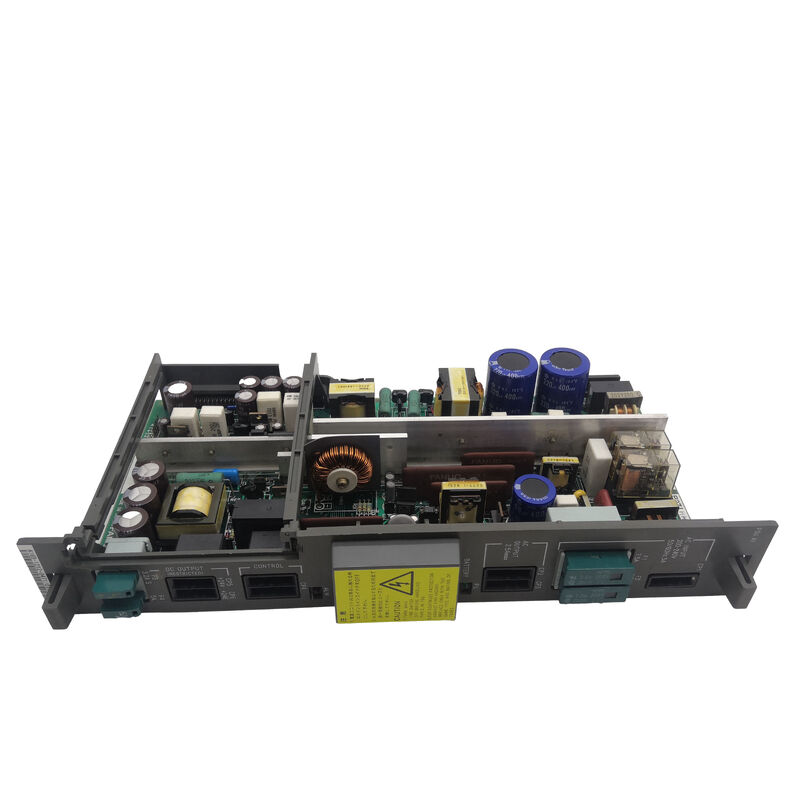
FANUC A16B-1212-0250 | Zero Control Analog 3/4 Axis PCB F
Product Overview
The FANUC A16B-1212-0250 is identified as a Zero Control Analog 3/4 Axis PCB F, a board designed for CNC applications that use analog axis-control architecture.
It belongs to the A16B-1212 series, a product family associated with dependable control-board performance in industrial machine environments.
This PCB is suited to systems where analog control handling remains part of the original machine design.
In such installations, maintaining the correct board type is critical because analog axis-control boards are closely tied to the behavior of the control system, signal processing path, and motion command structure.
When the original board begins to fail, the machine may show unstable axis response, inconsistent control behavior, or startup faults that are difficult to trace without board-level replacement.
For maintenance departments and industrial parts suppliers, the A16B-1212-0250 is a practical solution for supporting legacy or long-running CNC equipment that still depends on established FANUC analog control architecture.
Key Product Data
| Parameter |
Value |
| Part Number |
A16B-1212-0250 |
| Brand |
FANUC |
| Product Type |
PCB / Control Board |
| Board Description |
Zero Control Analog PCB F |
| Axis Capacity |
3/4 Axis |
| Control Type |
Analog |
| Application |
CNC control system |
| Typical Use |
Replacement, maintenance, repair support |
Product Features
Designed for analog axis-control systems
The A16B-1212-0250 is intended for CNC environments where analog control remains part of the original machine structure.
That makes it especially relevant for service teams maintaining earlier FANUC platforms.
Suitable for 3-axis and 4-axis control layouts
Because the board is associated with 3/4 axis control, it is useful in machines where multi-axis motion coordination must be preserved without changing the original control design.
Reliable choice for repair workflows
In industrial practice, replacing the correct control PCB often restores machine function more efficiently than attempting unsupported substitutions.
This is especially true in systems where axis behavior depends on correct board-level matching.
Built for long-term industrial support
Many machine tools continue producing for years with their original CNC configuration.
Boards such as the A16B-1212-0250 remain important in aftermarket support because they help extend the useful life of installed equipment.
Typical Applications
- CNC repair and troubleshooting
- Analog axis-control board replacement
- 3-axis machine maintenance
- 4-axis machine servicing
- Spare parts inventory for established FANUC systems
FAQ
Q1: What does “Analog 3/4 Axis PCB” mean in practical machine terms?
It means the board is used in a CNC control structure designed around analog axis-control handling for three-axis or four-axis machine configurations.
In practical use, this type of board belongs to the control section that supports motion-related processing and coordination.
For industrial service engineers, this usually indicates the board should be treated as a function-specific CNC replacement part, not as a general-purpose electronic card.
Q2: Why is this board still relevant in modern maintenance work?
Many factories continue running robust legacy equipment because the mechanical structure of the machine remains productive even after many years of use.
In those cases, the weakest point is often the electronics, not the machine frame or spindle assembly.
A correct replacement board like A16B-1212-0250 can help restore operation and avoid the cost of a full control retrofit.
Q3: What symptoms might lead a technician to inspect this board?
A technician may investigate this board when the machine shows axis-related startup alarms, unstable control response, intermittent operation, or unexplained control-side faults after power-up.
While final diagnosis always depends on the full system, the PCB becomes a likely checkpoint when power supply, wiring, and drive hardware have already been reviewed.
Q4: What installation practices are important for analog CNC boards?
Good installation practice includes ESD-safe handling, checking connector alignment, verifying terminal cleanliness, inspecting for bent pins, and confirming the board is seated correctly. In analog-control systems, shielding, grounding, and cabinet noise control are especially important because poor electrical conditions can affect stability and shorten board life.
Q5: How should buyers evaluate a replacement analog axis board?
Industrial buyers should look at exact part number consistency, physical condition, connector quality, visible PCB damage, and whether the supplier understands CNC spare-parts handling.
It is also useful to confirm whether the board is intended for tested replacement stock, since control boards in machine tools must perform under continuous-duty conditions rather than casual bench use.


 Your message must be between 20-3,000 characters!