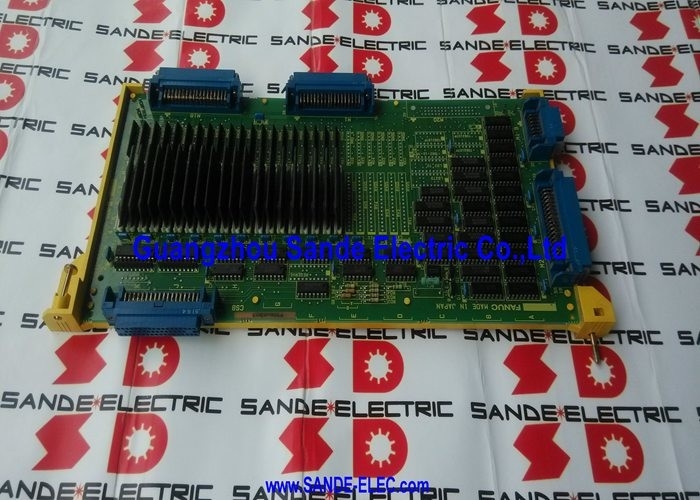
A16B-2200-0090 | FANUC Series 15 / 150 4-Channel Digital Axis Control Board — 6058 / 6066 Drive Interface / PWM / 15-MA / 15-TA / Up to 16-Axis
FANUC Series 15 — High-Axis-Count CNC for Complex Machines
The FANUC Series 15 (and its 150 variant) was FANUC's flagship CNC platform for complex, high-axis machine tools during its production era. While most machining centres and lathes require 3 to 5 axes, the Series 15 was designed specifically for machines where axis count is high — large machining centres with pallets and rotary tables, multi-spindle turning centres, flexible manufacturing cells, and dedicated production machines for aerospace or heavy engineering components.
The A16B-2200-0090 is one of the axis control boards that makes this high-axis capability possible. By stacking multiple 4-channel boards in the Series 15 CNC cabinet, the control builds its axis count in groups of 4 — up to 16 total axes when four boards are installed.
Key Specifications
| Parameter |
Value |
| Axis Channels |
4 (per board) |
| Signal Type |
Digital PWM |
| Drive Compatibility |
FANUC 6058, 6066 servo drives |
| Maximum System Axes |
16 (with 4 boards) |
| Compatible |
15A, 15M, 15-MA, 150M, 15-MF, 15-TT, 15-TA, 15-TF |
Scalable to 16 Axes — Building Up the System
A single A16B-2200-0090 provides 4 axis channels. FANUC's Series 15 architecture allows multiple axis boards to coexist in the same CNC:
4 axes: One A16B-2200-0090 — a compact 15A configuration for a 4-axis machining centre.
8 axes: Two boards — a 4-axis machining centre with a pallet rotary axis and additional linear axes.
12 axes: Three boards — suitable for multi-axis turning centres or machines with complex rotary table and head configurations.
16 axes: Four boards — the maximum configuration, used on very large and complex machine tools such as multi-pallet flexible machining systems or dedicated transfer machine sections.
The boards in a multi-card configuration work independently but within the same CNC's command and feedback framework. Each board handles its own 4 axes; the CNC coordinates all boards simultaneously through the BASE register system.
Application Scenarios
4-axis machining centre axis fault: A FANUC 15-MA machining centre develops an axis alarm on one of its four servo axes. After ruling out the drive and motor, the A16B-2200-0090 axis board is identified as the fault source. Replacement restores the faulty axis channel.
16-axis transfer machine maintenance: A large transfer machine uses four A16B-2200-0090 boards to control 16 machining stations simultaneously. One board develops an axis alarm on channels 5–8 (board 2 of 4). The failed board is replaced without disturbing the other three boards or their axes.
FAQ
Q1: Can the A16B-2200-0090 control digital Series 15 servo drives other than the 6058 and 6066?
The A16B-2200-0090 is specifically designed for the FANUC 6058 and 6066 series digital servo drives. These drives use the PWM interface protocol that the axis board generates. Newer FANUC servo drive series (Alpha, Alpha-i, Beta-i) use different communication interfaces (Type-A, Type-B, or FSSB) and are not compatible with the A16B-2200-0090.
Q2: What is BASE 0, BASE 1, and BASE 2 in the Series 15 axis board architecture?
BASE 0, 1, and 2 are shared memory command registers in the Series 15 CNC's internal bus. The main CPU writes position increment commands into these registers each interpolation cycle. The A16B-2200-0090 reads the appropriate BASE register for each of its 4 axes and translates the command data into PWM drive signals. This memory-mapped architecture allows the CPU and axis board to exchange commands without direct processor-to-processor communication.
Q3: How are the axis channel assignments set up when multiple A16B-2200-0090 boards are used?
In a multi-board Series 15 configuration, each A16B-2200-0090 board is assigned a base axis number through parameter settings and the board's physical position in the CNC. The first board handles axes 1–4, the second handles axes 5–8, and so on. The axis assignment parameters are configured in the CNC's axis parameter table — changing these parameters incorrectly can result in axes being assigned to the wrong board, causing control errors.
Q4: Is the A16B-2200-0090 suitable for Series 15-B or 15-C systems?
The A16B-2200-0090 is confirmed for the Series 15-A (Model A) generation — systems designated 15A, 15-MA, 15-TA, 150M, 15-MF, 15-TT, and 15-TF. The Series 15-B and 15-C introduced different axis board hardware as part of their updated servo architectures. Confirm the CNC's specific model generation before ordering.
Q5: What happens when one of four A16B-2200-0090 boards fails in a 16-axis system?
Only the 4 axes controlled by the failed board go into alarm. The remaining three boards and their 12 axes continue functioning normally — the other axis boards are independent. The CNC will display alarms for the affected axes, and those axes will be inhibited. The machine can still operate on its remaining axes if the production process allows it, while the repair is arranged.


 Your message must be between 20-3,000 characters!