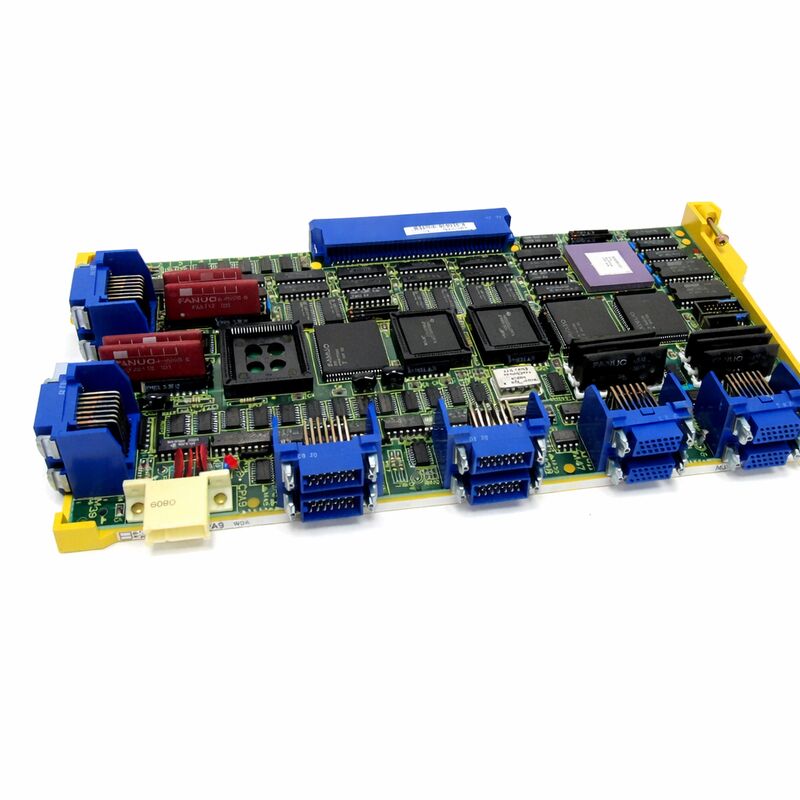
FANUC A16B-2200-0360 | 3/4 Digital Axis Card — 32-Bit FANUC 0-C Control / 40 MHz / 0C, 0D, 0F Platforms
The FANUC 0-C Platform — Where This Card Lives
The FANUC Series 0-C was FANUC's compact 32-bit CNC platform for small to medium machine tools through the 1990s, covering lathes, machining centres, and grinders built around the 0C, 0D, and 0F control specifications. The 0-C generation introduced 32-bit processing into FANUC's compact CNC architecture, and the A16B-2200-0360 is one of the axis control cards that made that architecture work.
In the 0-C modular design, the master board handles overall CNC processing, while dedicated axis cards manage the servo and spindle motion loops. The A16B-2200-0360 handles up to 3 or 4 digital axes — the specific count depends on the machine's original axis configuration. At 40 MHz, it belongs to the more capable end of the 0-C axis card range; the processing speed determines how tightly the servo loops run and how quickly the card responds to axis commands.
Machines built on this platform are still in active production globally. When the axis card fails in one of these CNCs, the motion section goes down — the machine cannot run. The A16B-2200-0360 is the correct like-for-like replacement that restores the original axis configuration without changes to the control software or wiring.
Key Specifications
| Parameter |
Value |
| Part Number |
A16B-2200-0360 |
| Type |
3/4 Digital Axis Card |
| Control Platform |
32-bit FANUC 0-C |
| Processing Speed |
40 MHz |
| Interface |
0C, 0D, 0F servo/spindle |
| Series |
A16B-2200 |
| Status |
Discontinued |
| Origin |
Japan |
Three Specifications, One Selection Decision
"3/4 axis" — the axis-count scope. This card controls 3 or 4 digital servo/spindle axes simultaneously. A 2-axis card or an analogue axis card from the same A16B-2200 family serves different positions and is not a substitute.
"32-bit 0-C" — the control generation. This card is matched to the 0-C master board architecture. It is not compatible with the 0i, 16i, or 18i i-Series CNC generations, nor with the older 8-bit 0-A or 0-B platforms.
"40 MHz" — the processing class. Within the A16B-2200 series, cards at different clock speeds serve different performance tiers. The 40 MHz designation is part of the card's identity and should match the specification of the original installed card.
Before Ordering — Five Checks
Confirming a replacement A16B-2200-0360 against the installed machine takes less than five minutes and eliminates the most common ordering mistakes:
- Read the installed card label — confirm A16B-2200-0360 exactly, including the full suffix. Adjacent A16B-2200 variants can look similar while serving different functions.
- Confirm 32-bit 0-C control — verify the machine CNC is the 0-C generation (not 0i, 16i, or any other series).
- Confirm digital (not analogue) axis card — the 0-C platform used both digital and analogue axis cards in different configurations.
- Separate axis card fault from amplifier fault — if the fault pattern is limited to the axis control path (alarms point to the servo loop computation layer rather than to a specific drive module), the axis card is the likely suspect.
- Check for adjacent card issues — in the 0-C architecture, the master board and axis card communicate closely; verify the master board is operating normally before replacing the axis card.
FAQ
Q1: What does the 3/4 designation mean — is this a 3-axis or 4-axis card?
The card supports up to 4 digital axis channels. In machines configured for 3 axes it runs 3 channels; in 4-axis machines it runs 4. The specific axis assignment depends on the machine's original installation. The card does not need to be changed between 3-axis and 4-axis configurations — the axis count is set in the CNC parameters.
Q2: Is the A16B-2200-0360 compatible with FANUC 0i-C or 16i controls?
No. This card is specific to the 32-bit FANUC 0-C platform. The 0i, 16i, 18i, and related i-series CNC controls use a different architecture and different axis card series. The A16B-2200 series does not cross-install into i-series controls.
Q3: The machine alarms on all controlled axes simultaneously. Could this be the A16B-2200-0360?
Simultaneous alarms on all axes point to the common axis control layer — the A16B-2200-0360 is the primary suspect. Before replacing the card, also check the power supply voltages delivered to the axis card and verify the master board is not generating upstream faults that propagate to the axis card.
Q4: Can the A16B-2200-0360 from a different 0-C machine be used as a replacement?
Yes, provided it carries the same part number A16B-2200-0360 and was confirmed functional before removal from the donor machine. The card does not store machine-specific parameters — CNC parameters are held in the control unit's SRAM. After fitting the replacement, parameters are unaffected and no re-entry is needed, provided the SRAM module is intact.
Q5: The A16B-2200-0360 is discontinued. How is a reliable unit sourced?
Through the FANUC 0-C aftermarket — legacy FANUC CNC parts specialists and tested surplus dealers. Request confirmation that the unit was tested in a live 0-C CNC system, not only visually inspected. ESD-safe packaging for shipping and storage is required. For machines still running 0-C controls in production, holding a spare axis card on-site is a practical precaution — axis card failure stops the machine completely with no workaround.


 Your message must be between 20-3,000 characters!