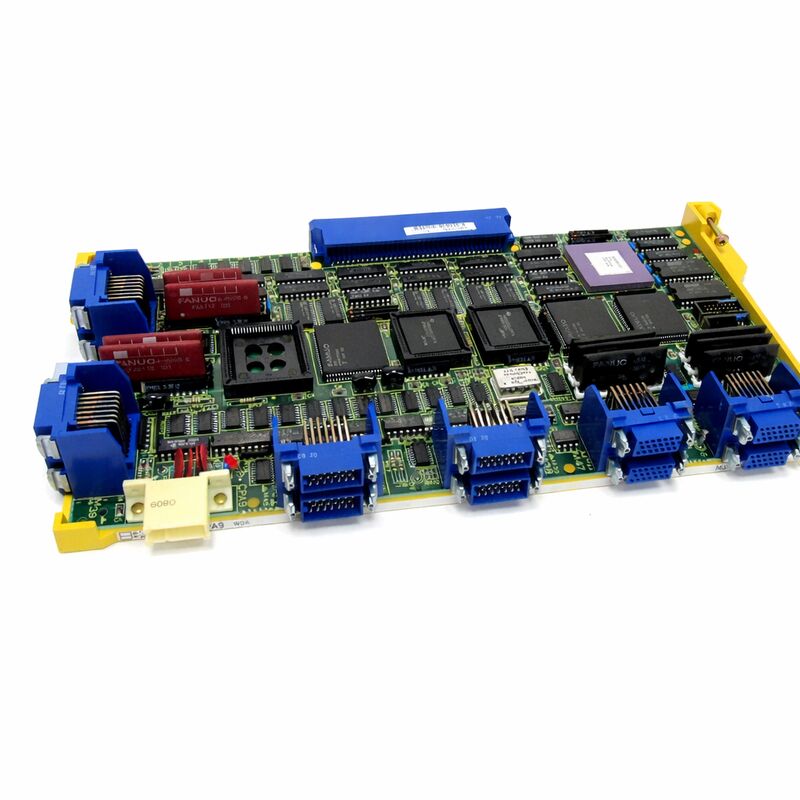
FANUC A16B-2200-0361 2-Axis Digital Servo PCB
If the control system uses an early FANUC 0-series digital axis arrangement, the board that manages axis control is often more important than the amplifier itself. The A16B-2200-0361 is consistently described as a 2-axis control PCB, axis card, or 1–2 axis digital servo PCB, and several listings tie it to 32-bit 0T / 0-C / 0C/F/00C control environments.
A repair specialist also notes that this board is normally fitted to an earlier 32-bit master board and used in Series 0 Model C configurations, where it provides a PWM servo interface for S-series servo drives and C-series servo amplifiers. That gives this part a clearly defined role: it is a servo axis control board for machines that still depend on the original 0-series digital servo structure.
Product Data Snapshot
| Parameter |
Value |
| Brand |
FANUC |
| Part Number |
A16B-2200-0361 |
| Model Number |
A16B22000361 |
| Board Type |
Axis Card / 2-Axis Control PCB |
| Axis Capacity |
1–2 axes / 2-axis board |
| Control Style |
Digital servo control |
| Bit Architecture |
32-bit |
| Control Context |
0T / 0-C / 0C-F / 00C references appear in listings |
| Installation Context |
Earlier 32-bit master board |
| Typical Drive/Amplifier Context |
S-series drives and C-series servo amplifiers |
Typical Uses
A16B-2200-0361 is most relevant in FANUC 0-series CNC systems where one or two digital servo axes are controlled through the original axis-card layout. It is commonly suited to axis-card replacement, digital servo control repair, and service work on early 32-bit 0-series controls.
Because this board is tied to the axis-control layer, it is best used where the rest of the control remains in the same family and there is no need to redesign the drive architecture. In practice, it fits machine tools that still rely on legacy FANUC control hardware and require board-level restoration instead of full control conversion. This last sentence is a grounded inference from the board type and control-family references.
FAQ
Q1. What type of board is the A16B-2200-0361?
It is a 2-axis digital servo PCB, also described as an axis card or 1–2 axis servo board. Listings repeatedly tie it to 32-bit 0T / 0-C / 0C/F/00C control environments.
Q2. What does this board do in the system?
This board handles the axis-control side of the CNC. A repair specialist describes it as a digital axis PCB fitted to an earlier 32-bit master board, where it provides PWM servo interface functions for S-series drives and C-series servo amplifiers.
Q3. What should be checked when selecting A16B-2200-0361?
Confirm the exact board number, the control generation, and whether the machine uses a 0-series digital servo configuration with a 1–2 axis board. It is also important to verify the installed master-board style and whether the servo section is built around the same 32-bit axis-card arrangement.
Q4. How should the “2-axis / 32-bit / 0C” description be interpreted?
Each part of that description matters. “2-axis” indicates the board’s control capacity, “32-bit” points to the control generation, and the 0C / 0T / 00C references identify the machine-control family the board is associated with. A board that matches only the connector layout but not the control generation is not a safe substitute.
Q5. How should faults be diagnosed before replacing this board?
Start by distinguishing axis-card problems from amplifier-side problems. If the machine shows axis-control instability while the amplifier power section is still functional, or if the affected axis path matches the board’s 1–2 axis control scope, the PCB becomes a stronger candidate. It is also useful to confirm whether the installed system is an earlier 32-bit master-board setup before replacing the axis board.


 Your message must be between 20-3,000 characters!