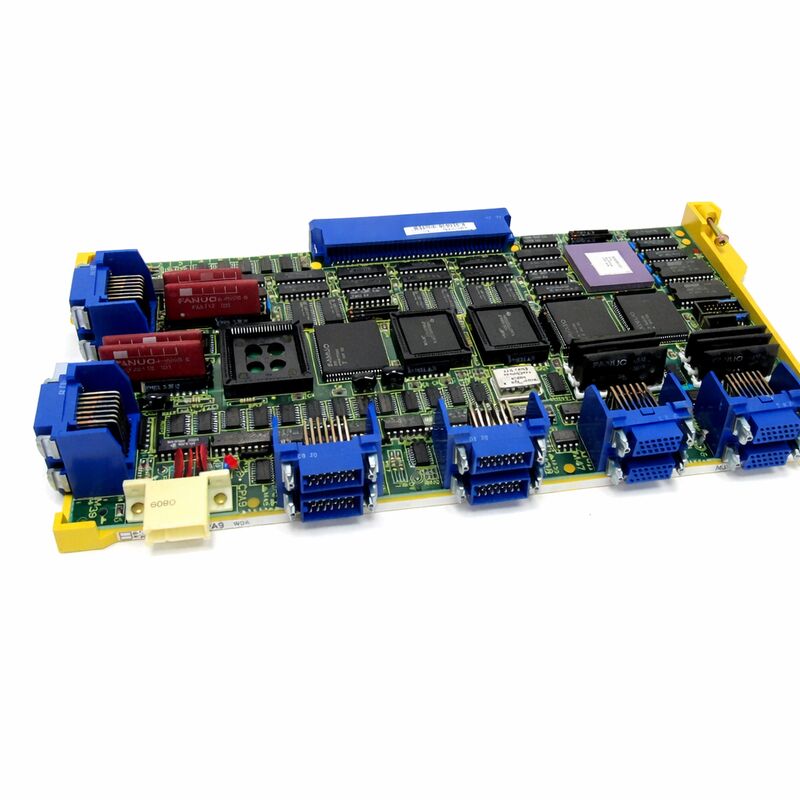
FANUC A16B-2200-0371 | A16B-2200 Series CNC Control PCB — FANUC Machine Tool Automation, Japan Origin
Part Number: A16B-2200-0371
Manufacturer: FANUC Corporation (Japan)
Product Type: CNC Control PCB Module
Board Series: A16B-2200
Application: FANUC CNC controller systems — machine tool automation
Overview
The A16B-2200-0371 is a printed circuit board from FANUC's A16B-2200 series — a family of CNC control boards that spans axis control modules, communication and interface PCBs, memory and graphics boards, and various function boards serving the FANUC CNC controller range from Series 15 through to the 0-series C and D generations.
This series was produced during one of the most productive periods of FANUC's CNC engineering, when the company was equipping the global machine tool industry with controllers capable of handling the complexity of modern multi-axis machining, serial servo drive communication, and PMC-based machine automation.
The A16B-2200 series covers function-specific boards that plug into the controller's backplane alongside the master or main CPU board. Each board in the series has a defined role: some handle the high-speed communication between the CNC and the digital servo drives; others manage the I/O signals between the controller and the machine's field wiring; still others handle memory storage, graphics processing, or communication with external devices.
The specific function served by the A16B-2200-0371 positions it within the controller configuration it was designed for.
Key Specifications
| Parameter |
Value |
| Part Number |
A16B-2200-0371 |
| Manufacturer |
FANUC Corporation |
| Product Type |
CNC Control PCB Module |
| Board Series |
A16B-2200 |
| Application |
FANUC CNC controller and machine tool systems |
| Origin |
Japan |
| Operating Temperature |
0 – 55°C |
| Storage Temperature |
−20 – 60°C |
| Humidity |
75% RH max (non-condensing) |
| Condition Available |
New (surplus) / Refurbished / Repaired |
A16B-2200 Series — A Generation of CNC Board Engineering
The A16B-2200 series is the CNC board generation associated with FANUC's Series 15 and contemporary 0-series platforms — a period when FANUC was transitioning from analogue to digital servo systems, introducing serial axis communication, and building the hardware architecture for the high-performance multi-axis machining that the industry was increasingly demanding.
Within this series, the functional variety is substantial. Axis boards in the A16B-2200 family manage the servo update cycles — they receive position commands from the CNC's interpolation and translate them into the PWM or serial signals that the servo amplifiers need.
Other boards in the series serve the machine interface: they handle the discrete inputs and outputs that connect the controller to the machine's hydraulic solenoids, limit switches, tool change mechanisms, and operator panel.
Communications boards provide RS-232C and other serial interfaces for program transfer and DNC operation.
The A16B-2200-0371 contributes its specific function to this ecosystem.
The board's role within the controller architecture it serves is what distinguishes it from other boards in the series, and matching the correct board to the correct controller configuration is the fundamental requirement for any replacement.
Working with Legacy A16B-2200 Series Boards
The A16B-2200 series boards are legacy components — no longer in current production, but still essential to thousands of machine tools operating worldwide. Machines built around the Series 15 and 0-C/0-D CNC platforms during their production years represent major capital investments that their owners intend to maintain in service. The control electronics, not the mechanical structure, typically limit these machines' service lives.
The aftermarket supply chain for A16B-2200 series boards is well established. Tested surplus units from decommissioned controllers are available from specialist CNC parts suppliers.
Professional refurbishment services — which include capacitor replacement, contact cleaning, and functional testing in a representative CNC system — extend service life considerably. Board-level repair addresses specific component failures. Between these options, most A16B-2200 series boards can be kept functional as long as the machine they serve continues to produce.
Identifying the correct board requires the exact part number from the installed board's label.
The A16B-2200 series contains many variants, and boards that appear physically similar can serve entirely different functions in the controller. Part numbers that differ by even a single digit are not interchangeable.
Fault Diagnosis and Replacement
A failed A16B-2200 series board produces alarms in the functional area it serves. An axis board failure produces servo alarms. An I/O board failure produces I/O communication errors.
A memory board failure may prevent the controller from initialising at all. Identifying the alarm code and its alarm category — servo, PMC, I/O, system — is the first step in isolating which board in the controller requires attention.
Before replacing the suspected board, reseat it and clean its connector contacts.
A significant fraction of apparent board failures are in fact connector-level issues.
If reseating clears the fault, no board replacement is necessary. If the fault persists, and if a confirmed-good substitute board is available for a swap test, this is the most definitive way to confirm the fault is in the board and not in the backplane or connected circuitry.
FAQ
Q1: The CNC alarm points to a fault in the functional area that the A16B-2200-0371 serves. How do I confirm the board is the fault source before ordering a replacement?
Start by reseating the board and cleaning its edge connector contacts. Retest. If the alarm persists, consult the controller's maintenance manual to identify any test points on the board and any diagnostic procedures associated with the specific alarm.
If a confirmed-good equivalent board is available for temporary substitution, the swap test definitively confirms or clears the board as the fault source.
If not, and all other causes have been eliminated, proceed with replacement.
Q2: A refurbished A16B-2200-0371 was installed. The original alarm cleared, but a different alarm appeared immediately. What does this indicate?
A new, different alarm after board replacement that clears the original alarm typically means either a secondary fault that was masked by the original, or a parameter/configuration mismatch between the replacement board and the controller.
Check whether the replacement board has the correct hardware revision. Review the new alarm's documentation.
If the new alarm relates to a configuration or parameter issue, address the parameter first.
Q3: How should a spare A16B-2200-0371 be stored?
Anti-static packaging is essential — bare PCBs are vulnerable to electrostatic discharge damage in storage. Keep the board in a stable temperature, low-humidity environment. Avoid temperature cycling. Label clearly with the part number, revision, and storage date.
Inspect annually for any signs of corrosion or component deterioration.
For long-term storage, periodic power-up testing confirms the board remains functional.
Q4: The machine is 25 years old and the A16B-2200-0371 is no longer available from FANUC. What are the options for sourcing a replacement?
The independent CNC spare parts market is the primary source for obsolete A16B-2200 series boards.
Specialist suppliers hold tested surplus stock from decommissioned machines, offer exchange services, and in many cases can perform board-level repairs.
Some suppliers also offer system-level CNC retrofits that replace the entire controller assembly with modern equivalent hardware — an option that eliminates the legacy board availability concern entirely, though at higher initial cost.
Q5: The CNC occasionally resets without any alarm code being displayed. The power supply has been confirmed good. Could the A16B-2200-0371 be responsible?
Unexplained resets without alarm codes are often caused by marginal supply voltages reaching the board — either from a power supply that is within spec under normal conditions but marginal under load, or from a degraded decoupling capacitor on the board itself that allows transient voltage dips to momentarily interrupt the board's logic.
Measure the supply voltage at the board's power input connectors, not just at the supply output.
If the voltage is stable at the supply but not at the board, the connector or a board-side capacitor is the likely cause.


 Your message must be between 20-3,000 characters!