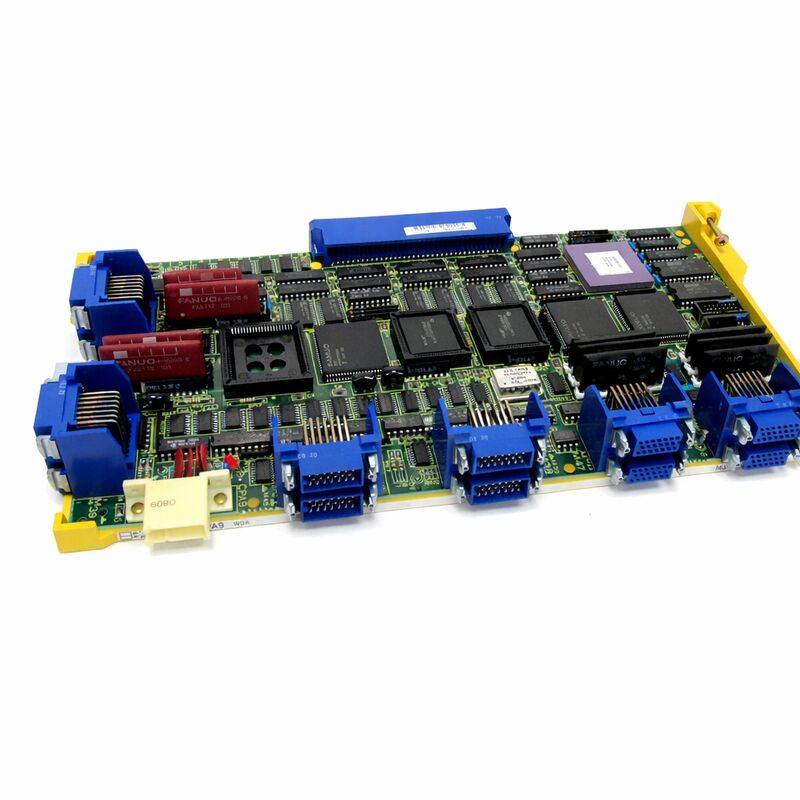
FANUC A16B-2200-0390 | Series 0-C / 0-D / 0-F 3/4-Axis Serial Axis Board — Alpha Servo Interface, Feedback PCB
Part Number: A16B-2200-0390
Cross Reference: A16B22000390
Manufacturer: FANUC Corporation (Japan)
Product Type: Axis Control / Feedback PCB — 3/4-Axis Serial Axis Board
What This Board Does
The A16B-2200-0390 is the 3/4-axis serial axis control board for FANUC's Series 0-C, 0-D, and 0-F CNC systems. In FANUC terminology, the axis board — also called the feedback PCB — is the board that closes the servo loop: it receives position commands from the CNC's main processor, reads encoder feedback from the servo amplifiers, calculates position error, and sends corrective velocity commands back to the drives in real time.
Without this board functioning correctly, the CNC has no reliable picture of where any of the machine axes actually are. The controller cannot close the position loop, servo alarms follow immediately, and axis motion is impossible.
This particular board runs in the 32-bit masterboard configuration of the 0-C/0-D/0-F platform and uses the Type A serial interface for FANUC Alpha series servo amplifiers — covering digital and serial servo/spindle configurations, which is the standard for 0-C machines retrofitted or built with Alpha-series drives.
The Series 0-C was one of FANUC's most widely deployed CNC platforms through the late 1980s and 1990s. Many 0-C equipped machines remain in production, which is why the A16B-2200-0390 continues to trade actively in the CNC aftermarket. Exchange units, outright surplus, and repair services are all available.
Diagnostics and Replacement
Axis board failures on the 0-C platform typically present as servo alarm 9 (servo not ready), axis alarms on specific channels, or position feedback errors. Before concluding the board has failed:
- Check the connector between the board and the main board socket — corrosion or a loose contact produces identical alarm symptoms to a failed board
- Verify the feedback cables from the servo amplifiers to the board are fully seated and undamaged
- If only one axis is alarming and others are normal, the fault may be in that axis's amplifier or encoder rather than the axis board
A hard failure of the A16B-2200-0390 — where servo alarms appear on all axes simultaneously and do not clear on reseating — is a clear indicator the board needs replacement.
Key Specifications
| Parameter |
Value |
| Part Number |
A16B-2200-0390 |
| Type |
3/4-Axis Serial Axis Board |
| CNC Platform |
FANUC Series 0-C, 0-D, 0-F |
| Servo Interface |
Type A serial (Alpha series) |
| Drive Compatibility |
Digital, serial (±analogue) |
| Masterboard |
32-bit |
| Status |
Discontinued, aftermarket active |
| Origin |
Japan |
FAQ
Q1: The 0-C CNC shows servo alarm 9 on all axes. Could the A16B-2200-0390 be the cause?
Yes. Servo alarm 9 on all axes simultaneously — rather than on a single axis — points to the axis board rather than an individual servo amplifier or encoder. Re-seat the board's connector first. If the alarm persists, the board has failed. Single-axis alarms are more likely to be amplifier or encoder faults.
Q2: What servo amplifiers is this board compatible with?
Alpha series FANUC servo amplifiers (Type A serial interface) in digital and serial configurations. The 0-C platform with this 32-bit masterboard typically runs Alpha SVM (servo amplifier modules) and SPM (spindle amplifier modules). Analogue configurations are compatible but rare on this board generation.
Q3: Does replacing the A16B-2200-0390 require any parameter changes?
The axis board itself does not store CNC parameters — those reside in the controller's SRAM. After a like-for-like replacement, the CNC reads its parameters normally. Verify servo parameter settings after replacement, particularly the encoder type and feedback interface settings, to confirm they match the installed hardware.
Q4: Can the A16B-2200-0390 be repaired at component level?
Yes. CNC electronics specialists with 0-C axis board experience can perform component-level repair — replacing failed optocouplers, feedback interface ICs, or damaged connectors. Exchange and repair services are both widely available for this board. Repair is particularly cost-effective when the fault is localised and the alternative is sourcing from limited surplus stock.
Q5: How is a surplus A16B-2200-0390 verified before installation?
Inspect the board for corrosion, damaged solder joints, and bent connector pins before fitting. Re-seat all connectors firmly after installation and verify that all axes respond normally before returning the machine to production.


 Your message must be between 20-3,000 characters!