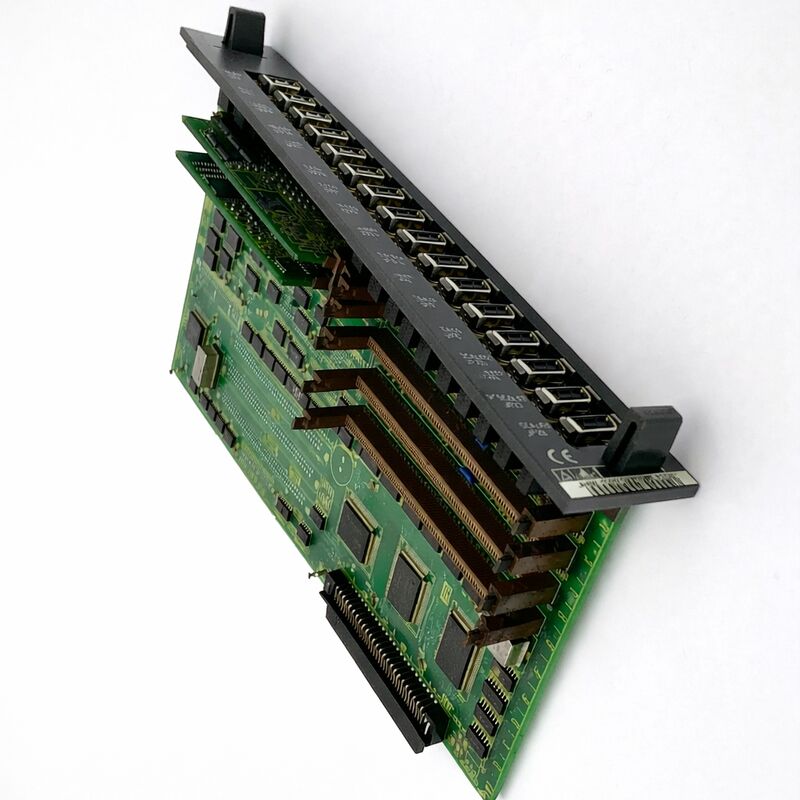
FANUC A16B-2200-0931 | Series 16-A OPT2 PCB — Additional Axis & 2nd Spindle Expansion Board
Part Number: A16B-2200-0931
Manufacturer: FANUC Corporation (Japan)
Product Type: Option 2 (OPT2) PCB — Additional Axis Expansion Board
Compatible CNC Systems: FANUC Series 16-A (16-MA, 16-WA, 16-TA)
Overview
The A16B-2200-0931 is the Option 2 (OPT2) axis expansion printed circuit board for the FANUC Series 16-A CNC control — designated F16M/T in FANUC's internal product coding.
This board plugs into the Series 16-A system backplane alongside the main CPU board and other option boards, expanding the control's servo axis capacity by up to four additional axes and adding a second spindle CPU.
Combined with the base axis control on the main board, the A16B-2200-0931 enables the Series 16-A to manage up to eight total servo channels with twin-spindle capability — making it the essential option board for complex multi-axis machining centres, 5-axis machine configurations, and twin-spindle turning centres.
The FANUC Series 16-A was one of FANUC's most capable CNC platforms of its generation — a significant step up from the Series 0-C in processing power, servo performance, and maximum axis count.
The 16-A was deployed on large-format machining centres, mill-turn centres, gantry machines, and multi-spindle turning centres where the demand for controlled axes exceeded what the base control could manage alone.
The A16B-2200-0931 was the hardware that made these expanded configurations possible.
Discontinued by FANUC, this board is no longer available through FANUC's active production channels.
Its continued availability through the aftermarket keeps a significant population of Series 16-A machines operating at full capability.
Key Specifications
| Parameter |
Value |
| Part Number |
A16B-2200-0931 |
| Manufacturer |
FANUC Corporation |
| Product Type |
Option 2 (OPT2) Axis Expansion PCB |
| Compatible CNC |
FANUC Series 16-A (F16M, F16T, F16W) |
| Additional Axes |
Up to 4 (expandable depending on SMD configuration) |
| Total Axis Capacity |
Up to 8 servo channels with dual spindle |
| 2nd Spindle |
Yes — 2nd spindle CPU included |
| System Backplane |
A02B-0120-B5xx |
| Production Status |
Discontinued by Manufacturer |
| Country of Origin |
Japan |
Series 16-A System Architecture — OPT2 in Context
The Series 16-A control lived in a backplane rack. The rack housed the main CPU board (which handled part program execution, interpolation for the base axes, and primary spindle), the power supply, and available option slots for additional capability boards.
The OPT1 board typically added larger PMC (programmable machine controller) capacity and enhanced graphics. The OPT2 board — the A16B-2200-0931 — added the additional servo axes and second spindle CPU.
When installed, the A16B-2200-0931 extends the control's axis capacity from the base 4–5 axes to up to 8 total servo channels.
The exact number of additional axes activated depends on the SMD (Small Module Device) plug-in modules fitted to the board — different SMD combinations activate different axis count configurations. This modular approach allowed FANUC to use the same PCB across machine configurations requiring 6, 7, or 8 total axes.
The second spindle CPU on the A16B-2200-0931 is separate processing capacity dedicated to controlling a second spindle independently of the primary spindle.
Twin-spindle turning centres and mill-turn machines with both a main and sub-spindle require this capability.
Without the OPT2 board, a Series 16-A machine is limited to a single controlled spindle.
Applications — Machines That Require This Board
A Series 16-A machine equipped with the A16B-2200-0931 typically falls into one of these categories:
5-axis machining centre: A 3-axis machining centre with two rotary axes (B and C, or A and B) for complex surface and 5-sided machining requires all five axes to be simultaneously controlled. The base 16-A axes board handles some, and the OPT2 provides the remaining capacity.
Twin-spindle turning centre: Both spindles require independent speed, position, and synchronisation control.
The OPT2's second spindle CPU handles the sub-spindle while the main board manages the primary.
Gantry-format machine: Large gantry machining centres with dual Y-axis motors on the gantry beam require tandem axis control — two motors working in synchrony on one axis. The additional axis capacity from the OPT2 supports this configuration.
Multi-axis flexible machining cell: Any configuration requiring more than the base axis count for complex part geometries or additional positioning axes.
Replacement and Programming Notes
The A16B-2200-0931 is a programmable board. After physical installation into the backplane, the sub-parameters associated with the additional axes and second spindle must be loaded into the board's memory.
These parameters were backed up by the machine's battery-backed CNC memory.
When replacing the board, the sub-parameters need to be reloaded — either from a stored backup or by re-entering them from the machine's parameter documentation.
Machines running the Series 16-A that lose parameter backup (battery failure with no documented backup) may require a full parameter re-entry from the machine builder's documentation, which can be a time-consuming commissioning task.
FAQ
Q1: The Series 16-A machine now shows servo alarms only on the axes controlled by the OPT2 card, while the base axes (controlled by the main CPU board) operate normally. Is the A16B-2200-0931 confirmed faulty?
Alarms isolated to the OPT2-controlled axes with confirmed-good base axes is a strong indication of A16B-2200-0931 failure.
Before replacing, verify the OPT2 board's power supply rails at the backplane connector and check the board's seating in the rack.
A poorly seated OPT2 board produces exactly this symptom. If the board is well-seated and supply voltages are confirmed, board failure is the likely diagnosis.
Q2: After installing a replacement A16B-2200-0931, the additional axes move but the second spindle does not respond. What is the most common cause?
The most common cause is missing or incorrect sub-parameters for the second spindle.
The OPT2 board holds the spindle parameters for the second spindle independently from the main CPU board's spindle parameters.
If these sub-parameters were not loaded after board replacement, the second spindle function will be inactive even though the board itself is operational.
Reload the second spindle parameters from backup, or re-enter them from the machine's documented parameter file.
Q3: Can the A16B-2200-0931 be used in a Series 16-B or Series 18-A control, or is it specific to Series 16-A?
The A16B-2200-0931 is designed for the Series 16-A backplane and control architecture. Series 16-B and Series 18 use different backplane designs and board interfaces. Physically, the connector layout may differ, and the firmware and protocol expected by the main CPU differ between Series 16-A and later 16-B/18 variants.
Using this board in a non-16-A system would not produce a functional result and risks hardware damage.
Only use the A16B-2200-0931 in Series 16-A systems on backplanes of the A02B-0120-B5xx type.
Q4: The Series 16-A machine is a 5-axis machining centre. The OPT2 board has failed. Is there a newer FANUC board that can replace it, or must the exact part number be sourced?
There is no direct drop-in replacement from a newer FANUC platform. The A16B-2200-0931 is specific to the Series 16-A architecture.
Modern FANUC controls (Series 30i, 31i, 32i) use entirely different hardware and would require a complete CNC upgrade project to retrofit.
For machines where continued Series 16-A operation is the goal, sourcing the A16B-2200-0931 through the aftermarket is the correct path.
For machines where a complete upgrade is being considered, the 5-axis capability can be replicated on modern FANUC platforms with appropriate servo amplifier upgrades.
Q5: How many additional axes does the A16B-2200-0931 actually add, and does this vary by machine?
The A16B-2200-0931 has capacity for up to 4 additional axes, expandable depending on the SMD modules fitted to the board. The exact number of activated axes is a function of both the SMD configuration and the CNC parameters.
A machine with a 6-axis configuration uses the OPT2 to add 2 axes beyond the base 4. An 8-axis configuration uses the full 4 additional axes from the OPT2.
The machine builder sets this at original build time.
When replacing the A16B-2200-0931, source a board with the same SMD configuration as the original, or reconfigure the replacement board's SMDs to match — verifiable from the machine's hardware documentation or by inspecting the removed board.


 Your message must be between 20-3,000 characters!