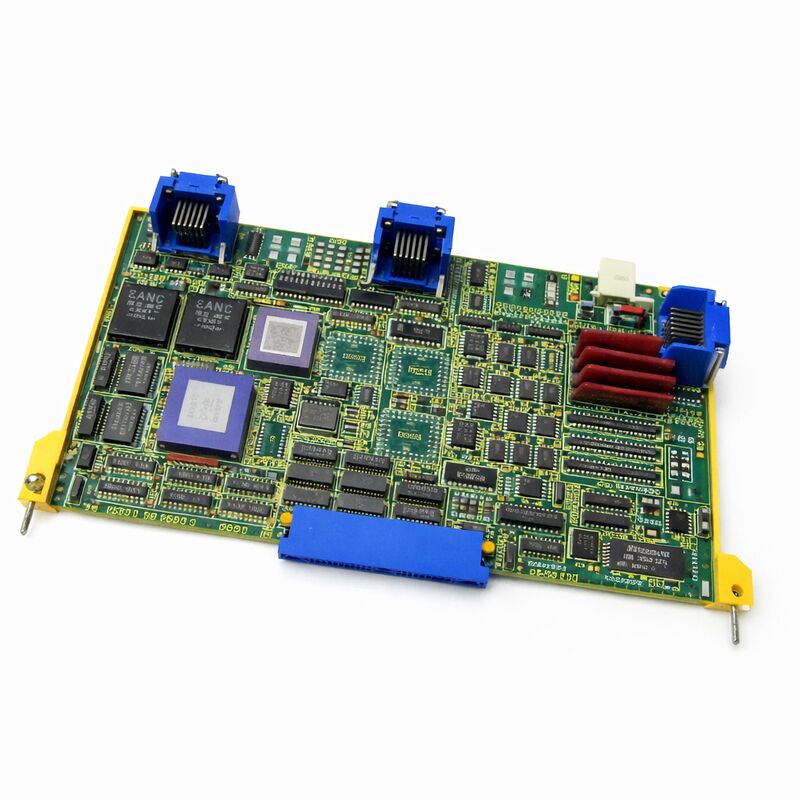
FANUC A16B-2203-0020 | Type B Interface 3/4-Axis Servo PCB — Series 0 / 0-C CNC, 0-MD / 0-TD, Japan Origin
Part Number: A16B-2203-0020
Manufacturer: FANUC Corporation (Japan)
Product Type: 3/4-Axis Servo Interface PCB (Type B Interface)
Board Series: A16B-2203
Description: PCB — 4-Axis Type B Interface, 0/0C Controls; Type B Interface PCB, 3/4 Axis
Overview
The A16B-2203-0020 is the 3/4-axis servo interface PCB with Type B interface for FANUC's Series 0 and 0-C CNC controllers. It is the axis control board that connects the 0-C CNC master board to the Alpha series digital servo amplifier modules, enabling servo-controlled axis motion across up to four machine axes.
The board is designed specifically for the Type B servo interface — the version in which encoder feedback from the servo motor's pulse coder returns through the servo drive unit rather than directly to the CNC controller.
The Series 0-C was one of the most commercially successful CNC platforms FANUC produced.
It powered an enormous range of machine tools — turning centres in 0-TD configuration, machining centres in 0-MD, twin-turret turning centres in 0-TTD, and further variants for grinding, wire EDM, and punch press applications.
The 0-C's modular board architecture allowed machine builders to configure the controller precisely to their machine's requirements, and the axis board was one of the central configurable elements — different axis boards supported different interface types and axis counts to match the specific servo amplifier system installed.
The A16B-2203-0020 belongs to the upgrade generation of 0-C axis boards — the 32-bit architecture version that replaced earlier 16-bit axis cards and enabled the use of FANUC's Alpha series servo drives with Type B interface.
The companion 2-axis board for smaller machines (or for adding the first two axes to a 4-axis configuration) is the A16B-2203-0021.
Key Specifications
| Parameter |
Value |
| Part Number |
A16B-2203-0020 |
| Manufacturer |
FANUC Corporation |
| Product Type |
3/4-Axis Servo Interface PCB |
| Board Series |
A16B-2203 |
| Interface Type |
Type B (encoder feedback via servo drive) |
| Axis Count |
3 or 4 |
| Architecture |
32-bit |
| Compatible Systems |
Series 0/0-C — 0-MD, 0-TD, 0-TTD |
| Compatible Drives |
Alpha series with Type B interface |
| Origin |
Japan |
| Operating Temperature |
0 – 55°C |
| Storage Temperature |
−20 – 60°C |
| Status |
Discontinued by Manufacturer |
Type B Interface — What It Means
FANUC's 0-series used two main servo interface types for the Alpha drive generation: Type A and Type B. Understanding the difference is essential for sourcing the correct axis board.
In the Type A interface, the encoder feedback cable runs from the servo motor's pulse coder back to the CNC controller's axis board. The axis board processes the encoder signals directly and computes axis position. In the Type B interface, the encoder cable terminates at the servo drive unit.
The drive unit processes the encoder signals internally and communicates position data back to the CNC digitally over a serial link.
The CNC controller's axis board receives position data through this serial path rather than directly from the encoder.
Type B is the more modern of the two — encoder signals stay within the drive cabinet and are processed at the drive where the electrical environment is better controlled.
The Type B interface also supports absolute position coders more naturally, since the battery for absolute position retention sits in the servo drive rather than at the CNC.
The A16B-2203-0020 is the axis board that implements this Type B serial communication between the 0-C master board and the Alpha drives.
3 or 4 Axis Configuration
The A16B-2203-0020 supports both 3-axis and 4-axis machine configurations. The axis count is determined by the machine's configuration parameters and the number of servo drives connected. A 3-axis machine — typical for a standard vertical machining centre with X, Y, and Z axes — uses three of the board's four channels.
A 4-axis machine — for a machining centre with a rotary fourth axis, or a turning centre with auxiliary axes — uses all four.
The specific axes assigned to each connector position on the board are defined by the machine builder's wiring and the CNC parameter configuration.
When replacing the board, this wiring arrangement and the associated parameters must be preserved exactly.
0-C CNC Architecture — Where This Board Fits
In the Series 0-C distributed controller architecture, the master board is the central processor that all other boards plug into. The axis board is one of the essential peripheral boards — without it, the controller cannot communicate with the servo drives, and no axis motion is possible.
The master board sends axis position commands to the axis board; the axis board translates these into the Type B serial protocol that the Alpha drives understand.
When the A16B-2203-0020 fails, servo alarms typically appear on all axes simultaneously — because all axis channels share the common axis board.
This contrasts with a single-axis servo amplifier fault, where only the affected axis shows an alarm. Simultaneous alarms on all axes are a diagnostic indicator pointing to the axis board rather than the individual servo drives.
FAQ
Q1: All axis servo alarms appeared simultaneously after a power event. The servo drives and their connections have been inspected and are undamaged. Is the A16B-2203-0020 the fault?
Simultaneous servo alarms across all axes following a power event, with confirmed-good drives and connections, strongly implicate the axis board. The board is common to all axis channels — a fault in its logic, power supply, or interface circuitry affects all axes at once.
Reseat the board on the master board's connectors and clean the contacts. If the alarms persist, board replacement is the appropriate action.
Q2: The machine has Type B interface drives but the available replacement axis board is for Type A. Will it work as a substitute?
No. Type A and Type B axis boards implement fundamentally different servo feedback architectures. A Type A board cannot communicate with Type B interface drives, and vice versa.
The interface type of the axis board must match the interface type of the servo drives installed.
Installing the wrong interface type will produce servo alarm codes immediately on attempting axis movement.
Q3: After installing a replacement A16B-2203-0020, the axes move but with noisy, unstable servo behaviour. Parameters have been restored. What is likely wrong?
Servo instability after a board replacement with parameters restored usually indicates one of two things: the servo parameter values specific to the axis board configuration (gain settings, feedback constants) were not fully captured in the backup, or the firmware version on the new board differs from the original and requires different parameter values for stable operation.
Review the specific servo parameters for each axis against documented values from the machine builder, and confirm the board's firmware revision matches the original.
Q4: The A16B-2203-0020 connects to the Series 0-C master board. Is it compatible with 0-D or 0-F series master boards?
The A16B-2203-0020 is specifically designed for the 0-C generation controller architecture. The 0-D and 0-F master boards may use the same or different axis board specifications depending on the exact model and configuration.
Verify the exact master board part number against FANUC's compatibility documentation before assuming interoperability between generations.
Different generations may use the same axis board in some configurations and different boards in others.
Q5: Only the third and fourth axis show alarms while the first and second axis operate normally. The drives have been swapped and the drives are confirmed good. Does this implicate the A16B-2203-0020?
Partial-axis alarms — where some axes are normal and others are not — are less typical of an axis board fault, since the board processes all axes through shared logic.
Partial failure patterns more commonly point to a specific section of the board's interface circuitry, or to the wiring and connectors serving the affected axes.
Check the connector pins and cables for the third and fourth axis specifically.
If the partial failure pattern persists with confirmed-good wiring, the relevant section of the A16B-2203-0020 has a localised fault and board replacement is appropriate.


 Your message must be between 20-3,000 characters!