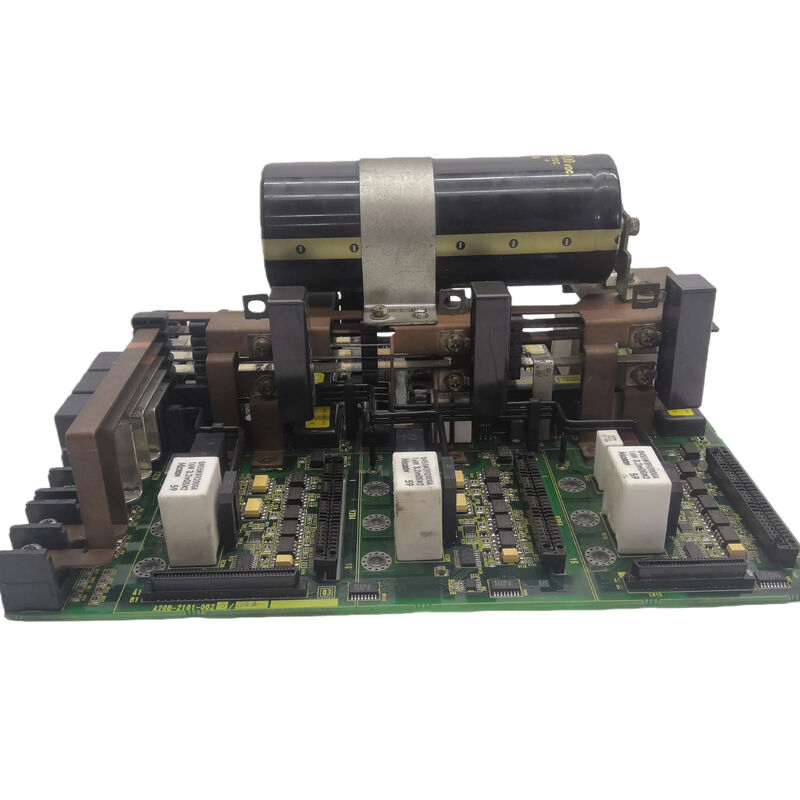
FANUC A20B-2101-0025 | Servo Amplifier Control PCB — A20B-2101 Series Drive Base Board
Part Number: A20B-2101-0025
Manufacturer: FANUC Ltd. (Japan)
Product Type: Servo Amplifier Control PCB — Drive Base Board
Product Series: A20B-2101
Drive Control at the Board Level
The A20B-2101-0025 is a control PCB from FANUC's A20B-2101 series — the family of base boards installed inside FANUC servo and spindle amplifier units. As the amplifier's control board, it handles the critical signal-level functions: processing velocity and torque commands from the CNC, conditioning encoder feedback data, executing the current regulation loop, and generating the gate drive pulses for the IGBT power stage.
This board is distinct from the amplifier's power board (which handles the high-voltage AC rectification and IGBT switching). The A20B-2101-0025 operates at low voltage in the amplifier's signal domain. When the control board fails, the amplifier cannot regulate its output — drive faults appear immediately at power-on, or the axis fails to respond to motion commands despite the power stage being fully operational.
The A20B-2101 series includes several closely related variants, all serving as control base boards for FANUC amplifier families. Adjacent numbers (0021, 0022, 0025) reflect incremental specification differences tied to specific amplifier models and generations. Confirm the exact part number from the installed board's label before sourcing a replacement.
Separating Control from Power
Recognising that the A20B-2101-0025 failed — rather than the power stage — is a key diagnostic step. If the IGBT module measures correctly (no short circuit between phase pairs) but the amplifier still generates drive faults at power-on, the failure is in the control board.
Component-level repair of the A20B-2101-0025 is viable when the failure is localised: a damaged gate driver optocoupler, a failed logic IC, or a degraded feedback signal conditioning component can be replaced without touching the power stage.
Key Specifications
| Parameter |
Value |
| Part Number |
A20B-2101-0025 |
| Type |
Servo Amplifier Control PCB |
| Series |
A20B-2101 |
| Application |
FANUC servo/spindle amplifiers |
| Related Parts |
A20B-2101-0021, 0022 |
| Origin |
Japan |
FAQ
Q1: The amplifier shows drive alarm AL-02 (control power fault) or AL-09 (axis fault) at power-on. Is the A20B-2101-0025 likely the cause?
Yes. Alarms appearing immediately at power-on — before any run command — that are not resolved by the control board receiving valid 24V supply typically point to a control board failure. Check the 24V supply to the amplifier's control section first. If 24V is confirmed present and within tolerance and the alarm persists, the A20B-2101-0025 has failed.
Q2: Can A20B-2101-0022 substitute for A20B-2101-0025?
The two are variants within the same A20B-2101 control board series but carry different hardware specifications tied to specific amplifier models. Substitution without confirming amplifier hardware compatibility is not recommended. Contact a specialist FANUC amplifier repair company with both part numbers to confirm interchangeability before installing.
Q3: The IGBT module was found to be intact. Can the A20B-2101-0025 be replaced without replacing the entire amplifier unit?
Yes. The control board is designed to be replaced separately. With a confirmed-good power stage, only the A20B-2101-0025 control PCB needs replacement. This is cost-effective compared to replacing the entire amplifier, particularly for amplifiers with large IGBT modules.
Q4: After fitting a replacement A20B-2101-0025, the axis runs but position accuracy has degraded. What should be investigated?
Position accuracy degradation after a control board replacement is typically caused by encoder interface parameter mismatches or improperly seated encoder feedback connectors. Verify that all encoder cables are fully seated at the amplifier's feedback connector. Also check that the motor type parameter in the CNC matches the installed motor — a mismatch shifts the encoder feedback scaling.
Q5: Where is the A20B-2101-0025 sourced?
Specialist FANUC amplifier repair companies hold exchange stock for A20B-2101 series control boards. Request the specific 0025 variant — adjacent variants should not be accepted as direct substitutes without compatibility confirmation. Component-level repair of the original board is also a viable path when the failure is localised to an identifiable component.



 Your message must be between 20-3,000 characters!