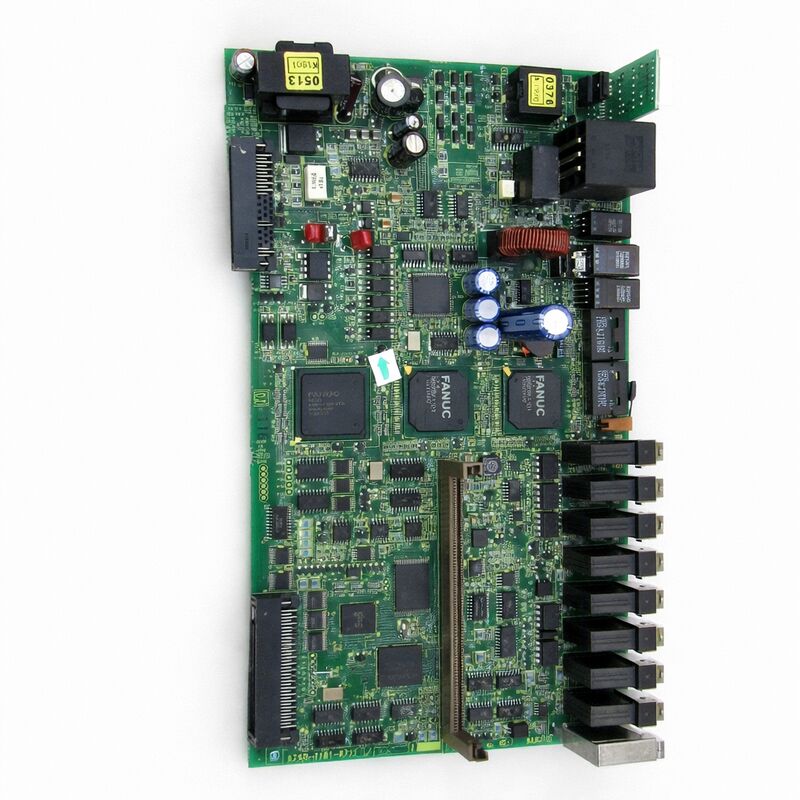
FANUC A20B-2101-0711 | βi SVSP Servo / Spindle Amplifier Control PCB — Beta-i Combined Drive Control Board, A20B-2101 Series, Japan Origin
Part Number: A20B-2101-0711
Manufacturer: FANUC Corporation (Japan)
Product Category: PCB — Beta-i SVSP Servo/Spindle Amplifier Control Board
Series: A20B-2101
Overview
The FANUC A20B-2101-0711 is the control printed circuit board for FANUC's Beta-i SVSP combined servo and spindle amplifier.
The SVSP (Servo and SPindle) is a compact amplifier unit that integrates servo axis control and spindle drive capability into a single module — an approach that reduces cabinet footprint and wiring complexity on smaller and mid-range CNC machine tools where the separate Alpha-i servo and spindle amplifier stacks would be excessive.
The A20B-2101-0711 is the intelligence layer of the SVSP unit.
It handles all the control logic functions that the amplifier needs to operate: receiving velocity and torque commands from the CNC over the FSSB fibre bus, managing the power conversion circuitry, monitoring current feedback from the motor windings, executing the current control loop at high frequency, and reporting drive status, alarm codes, and encoder feedback back to the CNC.
The power stage — the transistor bridges and rectifier that actually switch the motor current — is a separate section of the amplifier.
The A20B-2101-0711 control board tells it what to do and monitors whether it is doing it correctly.
This board is part of the A20B-2101 series, which covers control PCBs for FANUC's Beta-i servo amplifier family.
The Beta-i family uses a different amplifier architecture from the larger Alpha-i series: it is designed for the economical, compact end of FANUC's drive lineup, powering smaller servo motors and spindle motors on turning centres, vertical machining centres, and similar machines where the axis loads do not require the higher-current Alpha-i drives.
Key Specifications
| Parameter |
Value |
| Compatible Amplifier |
FANUC Beta-i SVSP (combined servo/spindle) |
| Board Function |
Drive control logic — command reception, current loop, feedback, alarm |
| CNC Interface |
FSSB fibre-optic serial servo bus |
| Motor Types |
Beta-i servo motors, Beta-i spindle motors |
| Series |
A20B-2101 |
| Status |
Available — refurbished, tested |
| Origin |
Japan |
The Beta-i SVSP Architecture
The SVSP amplifier concept addresses a practical constraint on compact CNC machine tools: cabinet space.
A standard Alpha-i drive configuration for a three-axis machine with spindle requires four separate amplifier modules (PSM power supply, three SVMs, and one SPM), each with its own control board, DC bus connection, and fibre connections. For a small lathe or machining centre, this is significant cabinet real estate.
The Beta-i SVSP integrates servo and spindle drive in one module, typically configured for two or three servo axes plus a spindle. The A20B-2101-0711 control board manages this multi-function configuration from one PCB.
It receives FSSB commands from the CNC for all the servo axes the SVSP handles, plus the serial spindle command for the spindle section, and coordinates the power stage accordingly.
This integration is efficient but creates a dependency: when the control board fails, all drive functions served by that SVSP unit stop simultaneously.
A machine with two servo axes and a spindle all running through one SVSP will lose all axis motion and spindle control if the single A20B-2101-0711 board fails. Fast sourcing of the replacement board is therefore important for restoring production.
Control Board Failure — What to Expect
The A20B-2101-0711 performs continuous self-monitoring. When it detects a fault condition — overcurrent, overvoltage, encoder error, thermal overload, or FSSB communication failure — it generates an alarm code that appears on the CNC's alarm screen and typically on the SVSP amplifier's 7-segment LED display on the front panel.
Servo alarm 4xx codes (particularly SV401, SV404, SV417, and similar) on startup or immediately under load often point to the drive control board when they appear on all axes simultaneously and the motor hardware (cables, encoders, motors) tests correctly.
Drive unit alarm blinking LED codes displayed on the SVSP front panel should be cross-referenced with the FANUC Beta-i amplifier alarm code list. Codes appearing immediately on power-up, before the motors move, often indicate a board-level fault rather than a motor or cable fault.
Simultaneous multi-axis failure is a particularly strong indicator. Individual axis faults usually point to motor or cable problems on that axis.
When all axes served by one SVSP show alarms simultaneously, the SVSP's control board is the most likely common cause.
FAQ
Q1: The SVSP amplifier's LED display shows a flashing alarm code on power-up before the machine moves. Where should the fault investigation begin?
Cross-reference the LED code with the FANUC Beta-i SVSP alarm list in the maintenance manual.
Codes in the 0x or 1x range typically indicate power supply or main circuit issues. Codes in the 3x, 4x, or 5x ranges more commonly indicate control board problems or FSSB communication issues.
For FSSB-related codes, first check all fibre connections at the SVSP's COP connectors.
For alarm codes that persist with fibres confirmed connected, the A20B-2101-0711 control board is the next suspect.
Q2: Can the A20B-2101-0711 be replaced without replacing the entire SVSP amplifier unit?
Yes. The control board is a separate, field-replaceable component within the SVSP amplifier. The board mounts inside the amplifier housing and connects to the power stage circuitry via internal connectors.
With proper ESD precautions and the amplifier powered down, the control board can be removed and replaced.
After replacement, verify that the CNC servo parameters specific to the motor and axis configuration are intact — these are stored in the CNC's SRAM, not the amplifier board, so they should not be lost unless other hardware changes were made.
Q3: After installing a replacement A20B-2101-0711, all axes show SV401 alarm. What is the most likely cause?
SV401 indicates the servo amplifier is not ready. After a control board replacement, the most common cause of immediate SV401 on all axes is the FSSB fibre connection.
During the board replacement, the fibre cables at the COP connectors on the new board may not have been fully re-seated.
Power down, inspect and reseat each fibre connector, ensuring each is fully inserted and latched.
If FSSB fibres are confirmed correct and the alarm persists, verify the CNC's FSSB parameter configuration matches the amplifier's axis assignment.
Q4: Does the A20B-2101-0711 need to be matched to a specific SVSP power rating, or is it universal across the Beta-i SVSP range?
Different SVSP power ratings (e.g., SVSP-20/20/20/40, SVSP-20/20/40-11 etc.) may use different control board variants within the A20B-2101 family.
The control board's firmware and hardware configuration is matched to the specific amplifier type it controls.
Confirm the exact SVSP amplifier model number before ordering a replacement control board, and verify the replacement board's part number is appropriate for that amplifier model. Using a mismatched control board can cause incorrect operation or immediate alarm on startup.
Q5: The SVSP ran in service for several years before the control board failed. What commonly causes Beta-i SVSP control board failure?
Electrolytic capacitor degradation is the most common age-related cause. Control boards in amplifiers that operate in elevated ambient temperatures — a common condition in machine tool electrical cabinets — age faster than those in cooler environments.
Capacitors on power regulation circuits dry out over years of service, causing voltage regulation to fail and triggering alarms that mimic other fault types before the board fails completely. Other causes include connector contact corrosion from coolant mist ingress and occasional transient overvoltage events from the power supply.
Regular inspection of cabinet cooling filters and ensuring adequate ventilation significantly extends control board service life.


 Your message must be between 20-3,000 characters!