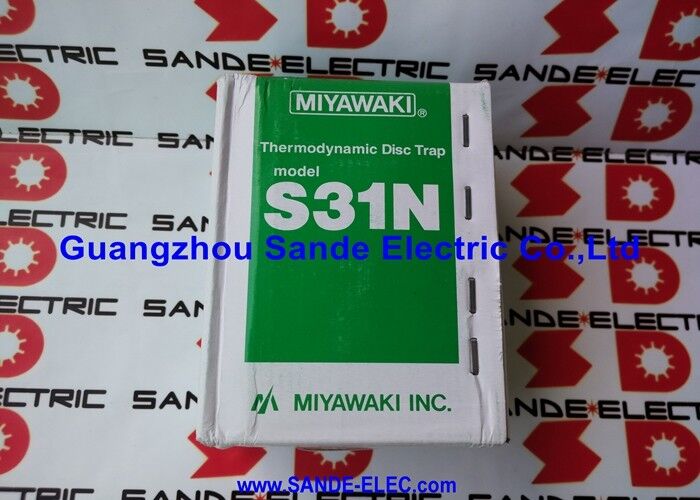
Miyawaki S31N | Disc Type Steam Trap — Thermodynamic / 1.6 MPa / 220°C / DN15 to DN50 / Auto Blow-Off / Cast Iron
Thermodynamic Disc Operation — Automatic Condensate Discharge
The Miyawaki S31N is a disc type steam trap operating on the thermodynamic principle — the trap opens and closes based on the thermodynamic properties of steam and condensate flowing through it, with no external power, mechanical float, or bimetal thermostat required.
When cold condensate fills the trap body, the pressure difference across the disc lifts it open and allows condensate to discharge. As steam or flash steam approaches the trap outlet, the thermodynamic disc responds to the change in flow velocity and pressure — the disc is pressed closed against its seat, stopping steam loss. The disc then stays closed until the steam above it condenses and the cycle repeats.
A standout feature of the S31N is its automatic blow-off mechanism — a bimetal ring that ensures cold condensate and air discharge rapidly during the initial startup of a steam system. Steam locking (where a trap fails to open because it holds residual steam pressure) is a known operational risk in disc-type traps. Miyawaki addresses this with special anti-steam-locking variants: the S31N-G and S31N-2 models (and their flanged equivalents S31NF-G and S31NF-2) for installations where steam locking is a concern.
The S31N is Miyawaki's best-selling steam trap — a position earned by its simple design, wide operating range, low maintenance, and broad industry applicability.
Key Specifications
| Parameter |
Value |
| Model |
S31N |
| Type |
Disc Type (Thermodynamic) |
| Size Range |
DN15A–DN50A (½" to 2") |
| Max Pressure (PMA) |
1.6 MPa (230 psig) |
| Max Temperature (TMA) |
220°C (428°F) |
| Min Differential (⊿PMN) |
0.03 MPa (4.4 psig) |
| Body (DN15–25) |
FCD450 ductile cast iron |
| Body (DN32–50) |
FC250 cast iron |
| Connection |
Threaded (Rc) or flanged |
| Mounting |
Horizontal or vertical |
| Max Flow (DN32–50) |
>2,000 kg/h |
Variants and Size Configurations
| Variant |
Size Range |
Connection |
| S31N |
DN15–DN25 |
Threaded / flanged |
| S31NF |
DN32–DN50 |
Flanged (larger flange format) |
| S31N-G / S31NF-G |
Various |
Anti-steam-locking variant |
| S31N-2 / S31NF-2 |
Various |
Anti-steam-locking variant |
Available flange standards for flanged connections: ASME/JPI 150 lb, 300 lb (not for 2"), DIN PN16, JIS 10K, 16K, 20K. For simple threaded connection, S31N-15 (DN15), S31N-20 (DN20), and S31N-25 (DN25) are the standard size designations.
FAQ
Q1: What is a thermodynamic steam trap and how does the S31N work?
A thermodynamic steam trap uses the difference in thermodynamic properties between steam and condensate to open and close the valve. When condensate is present, it flows through the trap easily, lifting the disc. When steam approaches the outlet, its higher velocity creates a low-pressure region that helps seal the disc against the seat. After the steam above the disc condenses, the disc opens again for the next condensate batch. The cycle is fully automatic and requires no external power.
Q2: What applications is the S31N most suitable for?
The S31N covers steam transport lines (steam main lines, distribution headers), small steam equipment, heat exchangers, food processing and cleaning equipment, and general industrial steam systems. Its wide pressure and temperature range (1.6 MPa, 220°C) covers the majority of standard industrial steam system operating conditions.
Q3: What is the auto blow-off mechanism and why does it matter?
The auto blow-off mechanism is a bimetal ring inside the S31N that detects low-temperature conditions during system startup. Cold condensate and air present in the system at startup would otherwise accumulate in a trap and delay system warmup. The bimetal mechanism holds the trap open during cold startup to rapidly discharge these cold fluids. Once the system reaches normal operating temperature, the bimetal ring returns to its neutral position and the trap operates normally.
Q4: What is the difference between S31N and S31NF?
The S31N covers DN15A to DN25A (½" to 1") using threaded or standard flange connections, with a ductile cast iron body. The S31NF is the larger-size version for DN32A to DN50A (1¼" to 2"), using a different flange format suited to the larger body dimensions. The operating principle and performance are the same; the physical form factor differs to suit the larger pipeline sizes.
Q5: When should the anti-steam-locking variants (S31N-G or S31N-2) be specified?
Steam locking occurs when residual steam pressure above a disc-type trap holds the disc closed even when condensate is present — the trap fails to discharge condensate. This is more likely in heavily insulated traps, high back-pressure systems, or installations with long heat retention. If the standard S31N shows erratic cycling or fails to discharge condensate consistently in a specific installation, specify the -G or -2 anti-steam-locking variant for that position.


 Your message must be between 20-3,000 characters!