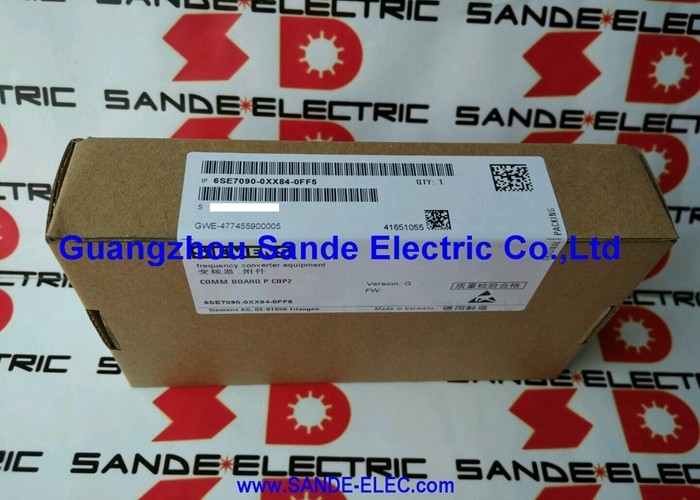
6SE7090-0XX84-0FA0 | Siemens SIMOVERT MASTERDRIVES Motion Control SBP Encoder Board — Incremental Encoder Speed Feedback / Universal Spare
MASTERDRIVES Motion Control — The Role of Encoder Feedback
The SIMOVERT MASTERDRIVES Motion Control (MC) variant is the position-and-speed-controlled member of the MASTERDRIVES family — used where simple open-loop or sensorless vector control is insufficient and precise closed-loop speed regulation or position control is required:
High-accuracy speed regulation: Applications where the motor speed must be maintained precisely regardless of load changes — machine tool feed axes, printing press drives, and tension-controlled winding/unwinding systems.
Position control: Applications where the drive must accurately position the load at a commanded point — robotic axes, coordinate measuring machine drives, and precision linear stages.
Dynamic torque control: Applications requiring fast torque response — servo-driven test stands, dynamic load simulation, and high-cycle pick-and-place systems.
All of these closed-loop functions require accurate real-time speed and position data from the motor — data that the 6SE7090-0XX84-0FA0 SBP board provides by interfacing with an incremental encoder mounted on the motor shaft.
Key Specifications
| Parameter |
Value |
| Module Type |
SBP (Sensor Board for Pulse — incremental encoder) |
| Encoder Type |
Incremental pulse encoder (TTL or HTL) |
| Series |
SIMOVERT MASTERDRIVES Motion Control |
| Format |
Universal spare (0XX84 = cross-range compatibility) |
| Application |
Motor speed and position feedback |
SBP — Sensor Board for Pulse
The SBP (Sensor Board for Pulse) designation identifies the specific encoder interface technology this module supports:
Incremental encoders: Incremental encoders generate A, B, and Z (index) pulse signals — square wave outputs where the A and B channels are 90° apart (quadrature), allowing the MASTERDRIVES control unit to count pulses for speed measurement and direction detection. The Z channel provides a once-per-revolution reference for absolute position recovery after a power interruption.
TTL and HTL signal levels: The SBP board accepts both TTL (5V) and HTL (10–30V) incremental encoder signal levels — covering the standard output levels of industrial incremental encoders. The applicable signal level is set during commissioning to match the connected encoder's output specification.
Signal processing: The SBP board converts the raw encoder signals into a format the MASTERDRIVES control unit can process — providing noise-filtered, level-converted pulse data at the data rate required for the drive's velocity measurement algorithm.
Application Scenarios
Encoder feedback fault — MASTERDRIVES MC drive: A SIMOVERT MASTERDRIVES Motion Control drive develops speed feedback faults — the drive either cannot regulate speed accurately or generates encoder feedback alarms. After verifying the encoder and its cable, the 6SE7090-0XX84-0FA0 SBP board is identified as the fault. Replacement restores accurate incremental encoder feedback.
MASTERDRIVES Motion Control commissioning: A new MASTERDRIVES Motion Control system is being commissioned with an incremental motor encoder. The 6SE7090-0XX84-0FA0 SBP board is installed and configured to match the encoder's output signal type and resolution.
FAQ
Q1: What encoder signals does 6SE7090-0XX84-0FA0 accept?
The SBP board accepts incremental encoder signals with A, B, and Z (index) channels in quadrature format. Signal levels supported are TTL (5V differential) and HTL (single-ended or differential, 10–30V). Confirm the encoder's output signal type and level before commissioning — the SBP board must be configured to match the encoder specification.
Q2: How is the SBP board connected to the MASTERDRIVES control unit?
The SBP board plugs into a defined slot on the MASTERDRIVES control unit (CU) or technology board within the drive unit's control section. External encoder cables connect to the SBP board's terminal block or connector — the board's physical interface isolates the sensitive low-voltage encoder signals from the drive's power electronics. Refer to the applicable MASTERDRIVES Motion Control installation manual for the specific connector positions.
Q3: What is the maximum encoder resolution the 6SE7090-0XX84-0FA0 can handle?
The SBP board is designed for industrial incremental encoders in the standard resolution range used with MASTERDRIVES Motion Control — typically up to several thousand pulses per revolution (ppr). The specific maximum input frequency supported by the SBP board is confirmed in the applicable Siemens MASTERDRIVES hardware documentation. Higher resolution encoders support more precise speed measurement but require adequate input frequency margin.
Q4: Can 6SE7090-0XX84-0FA0 work with absolute encoders as well as incremental encoders?
No. The SBP (Sensor Board for Pulse) is specifically for incremental pulse encoders. Absolute encoders — which provide a unique position value for every shaft position without requiring a home reference cycle — use different interface standards (SSI, EnDat, HIPERFACE) and require a different MASTERDRIVES option board designed for absolute encoder protocols.
Q5: After replacing 6SE7090-0XX84-0FA0, does the drive need re-commissioning?
The SBP board itself does not store drive-specific parameters — these reside in the control unit. After fitting the replacement board, the encoder configuration parameters (signal type, resolution, etc.) must be verified in the drive's parameter set and confirmed as correct before enabling the drive. If the parameters are correctly retained from before the fault, re-commissioning is minimal — confirm correct encoder signal quality and speed feedback accuracy at low speed before full-load operation.


 Your message must be between 20-3,000 characters!