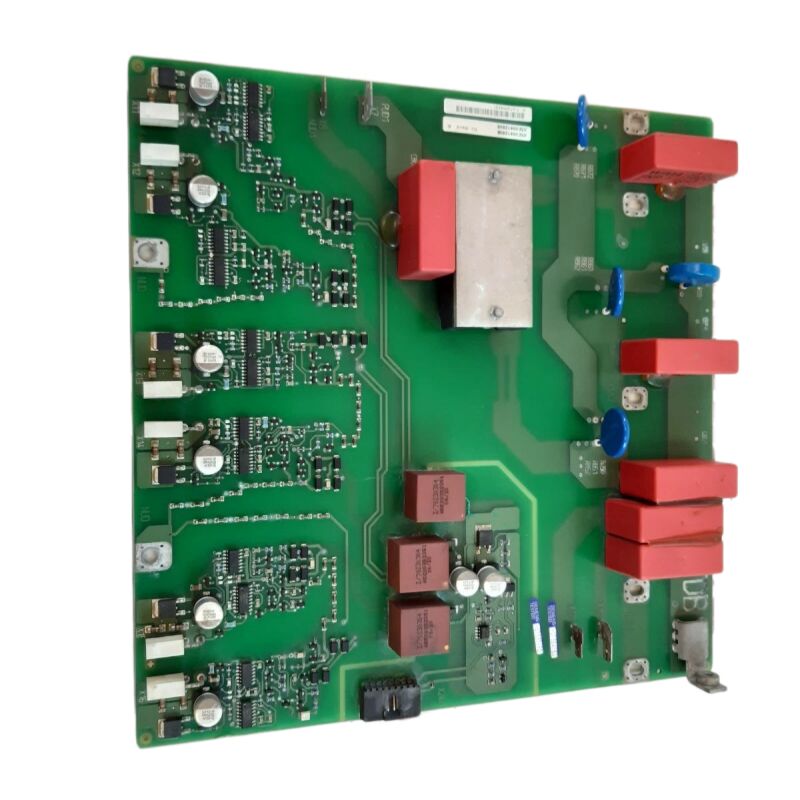
Siemens A5E01105817 | SINAMICS V50 SCR Firing Card — Analog Thyristor Trigger PCB for Water Pump Drive
Part Number: A5E01105817
Manufacturer: Siemens AG (Germany)
Product Type: SCR Firing Card — Analog Trigger PCB (Thyristor Gate Drive)
Product Family: SINAMICS V50
Application: Water pump, fan, and HVAC/W/WW infrastructure drives
Overview
The A5E01105817 is the SCR firing card — the thyristor trigger and analog signal processing board — for the Siemens SINAMICS V50 drive. The V50 was Siemens' infrastructure drive platform designed specifically for water and wastewater, HVAC, and pump applications in the power range from 37 kW to 250 kW (50 to 400 hp).
These are the drives that run building water systems, treatment plant pumps, large circulation fans, and cooling tower installations — loads where variable speed delivers significant energy savings compared to fixed-speed operation with mechanical flow control.
The A5E01105817 occupies a critical position in the V50's power conversion chain.
The drive's AC input stage uses a thyristor (SCR) rectifier — a bank of silicon-controlled rectifiers — to convert the incoming three-phase AC supply into the DC link voltage that feeds the inverter section.
Unlike a passive diode rectifier, the thyristor rectifier is phase-controlled: the firing angle of each thyristor is adjusted to regulate the DC bus voltage and to manage pre-charge of the DC link capacitors during startup.
The A5E01105817 generates these thyristor firing pulses and handles the analogue signal conditioning functions associated with the AC input and pre-charge circuits.
The "analog card" designation applied to this board reflects its role in processing the analogue measurement and control signals in the V50's power conversion front end — voltage measurements, current sensing, and the phase-synchronised timing signals that determine when each thyristor in the rectifier bridge is triggered.
These are fundamentally analogue functions that sit upstream of the drive's digital control processor.
Key Specifications
| Parameter |
Value |
| Part Number |
A5E01105817 |
| Manufacturer |
Siemens AG |
| Product Type |
SCR Firing Card / Analog Trigger PCB |
| Product Family |
SINAMICS V50 |
| Application |
Water, Wastewater, HVAC, Pump/Fan drives |
| Drive Power Range |
37 kW to 250 kW (V50 platform) |
| Function |
Thyristor (SCR) phase-angle firing, analogue signal conditioning |
| Production Status |
Discontinued |
| Country of Origin |
Germany |
SCR Firing — Phase-Angle Control in the V50 Rectifier
A thyristor (SCR) is a semiconductor device that conducts current after receiving a gate pulse, and continues conducting until the current through it falls to zero. In a three-phase converter bridge, six thyristors are arranged so that each one conducts during the portion of the AC waveform cycle assigned to its position.
By varying the firing angle — the point in the AC cycle at which the gate pulse is delivered — the average DC output voltage of the rectifier can be controlled.
The A5E01105817 handles this firing angle control.
It detects the zero crossings of all three AC supply phases — establishing the phase reference for each thyristor position — and generates firing pulses at the commanded angle relative to these references.
The firing angle is set by the drive's main control electronics based on the DC bus voltage setpoint. During normal operation, the firing angle is managed to keep the DC link voltage within its operating range. During startup pre-charge, the firing angle is progressively advanced to gradually build up DC bus voltage without stressing the capacitors.
The board's phase synchronisation circuit must remain locked to the AC supply frequency throughout operation.
Loss of synchronisation — from a transient supply disturbance or a board fault — generates a firing pulse timing error that immediately disrupts the rectifier's controlled output.
Analogue Signal Processing Functions
Beyond SCR triggering, the A5E01105817 performs analogue signal conditioning for the V50's input measurements. AC voltage measurements from the supply terminals are processed through the board's signal conditioning circuits to produce the voltage feedback signals used by the DC bus voltage regulator.
Supply phase voltage magnitude and symmetry data are extracted from these measurements and compared against the drive's threshold parameters — supply fault detection relies on this path.
The board also conditions the armature current measurement from the rectifier circuit.
This current feedback feeds both the rectifier's current limit function and the ground fault detection algorithm.
Accurate current measurement through the A5E01105817 is therefore central not just to normal regulation, but to the drive's protection behaviour.
SINAMICS V50 Platform Context
The SINAMICS V50 addressed a specific market segment: large water, wastewater, and HVAC installations where drive ratings from 37 kW to 250 kW are typical, and where the application profile — long run periods at variable load, relatively infrequent start-stop cycles, pump-specific control functions — called for a purpose-built solution rather than a general-purpose drive.
The V50 included built-in pump-specific functions: multi-pump cascade control, pipe-fill routines to prevent water hammer, dry-run detection, and energy monitoring tailored to the operating profile of water infrastructure.
When the V50 platform was discontinued, Siemens directed replacement to the SINAMICS G120X for this application segment.
The G120X continues the V50's application focus — pump and fan optimised, energy-saving functions built in — but uses IGBT-based rectification rather than thyristor rectification, and uses the current SINAMICS G control architecture rather than the V50's internal architecture.
FAQ
Q1: The SINAMICS V50 is showing a DC bus undervoltage fault at startup, but the AC supply has been confirmed within specification. Could the A5E01105817 be the cause?
DC bus undervoltage at startup with a confirmed healthy AC supply points directly to a problem in the rectifier section or its firing control.
The A5E01105817 is the most likely fault source — a failed firing circuit means the thyristors in the rectifier bridge are not being triggered, so no DC bus voltage builds up despite AC supply being present. Check whether any thyristor pre-charge faults are logged before the undervoltage fault appears.
Also verify the AC phase synchronisation inputs to the board are intact — damaged synchronisation signal connections produce incorrect firing angles that result in low or zero rectified DC output.
Q2: Can the A5E01105817 SCR firing card be repaired at board level rather than replaced?
Component-level repair is viable for boards like the A5E01105817 where the failure is localised to identifiable components — pulse transformers, optocouplers, zero-crossing detection ICs, or passive components in the RC timing networks.
A specialist drive repair company with experience on Siemens analogue trigger boards can often identify and replace the failed component at a fraction of the cost of sourcing a replacement board.
Repair is particularly attractive for discontinued parts where replacement board supply from the aftermarket is limited or uncertain.
Always request a functional load test after repair to confirm all six firing channels perform correctly.
Q3: The V50 drive fires the SCR bridge but shows unbalanced phase currents on the input. The supply has been confirmed balanced. Is the A5E01105817 likely to be causing this?
Unbalanced input currents with a confirmed balanced supply is a classic sign of non-uniform firing angles across the six SCR positions — one or more channels on the A5E01105817 is delivering its firing pulse at a different phase angle than the others.
This can result from a drifted RC component in the timing network for one channel, or from a degraded pulse transformer.
Verify by measuring the phase angle of each thyristor gate pulse relative to its corresponding AC zero crossing, using an oscilloscope.
Non-uniform angles confirm a firing card issue.
Q4: A replacement A5E01105817 has been installed and the drive starts without fault, but the pre-charge time seems longer than before. Is this normal?
Slightly longer pre-charge time after a board replacement can occur if the new board's pre-charge firing angle ramp parameters differ from the original board's component tolerances.
In most cases this is benign and the drive operates normally after the pre-charge completes.
If the pre-charge time is significantly longer — multiple minutes rather than seconds — verify that the DC bus voltage is actually building at a reasonable rate during pre-charge.
Excessively slow build-up with a functional firing card can indicate a pre-charge resistor or contactor issue unrelated to the SCR firing card.
Q5: The SINAMICS V50 has reached end of life and a replacement drive is being planned. What is the recommended migration path?
For pump and fan applications in the V50's power range, the SINAMICS G120X is Siemens' current successor platform. It covers the same 37–250 kW range with pump-specific control functions, energy optimisation, and fieldbus connectivity.
Unlike the V50's thyristor rectifier, the G120X uses an IGBT-based active front end option for improved power quality, or a passive diode rectifier in the standard configuration. Migration planning should account for the differences in control wiring, parameterisation, and fieldbus configuration between the two platforms.
Siemens provides application-specific migration support documentation for V50-to-G120X transitions.


 Your message must be between 20-3,000 characters!