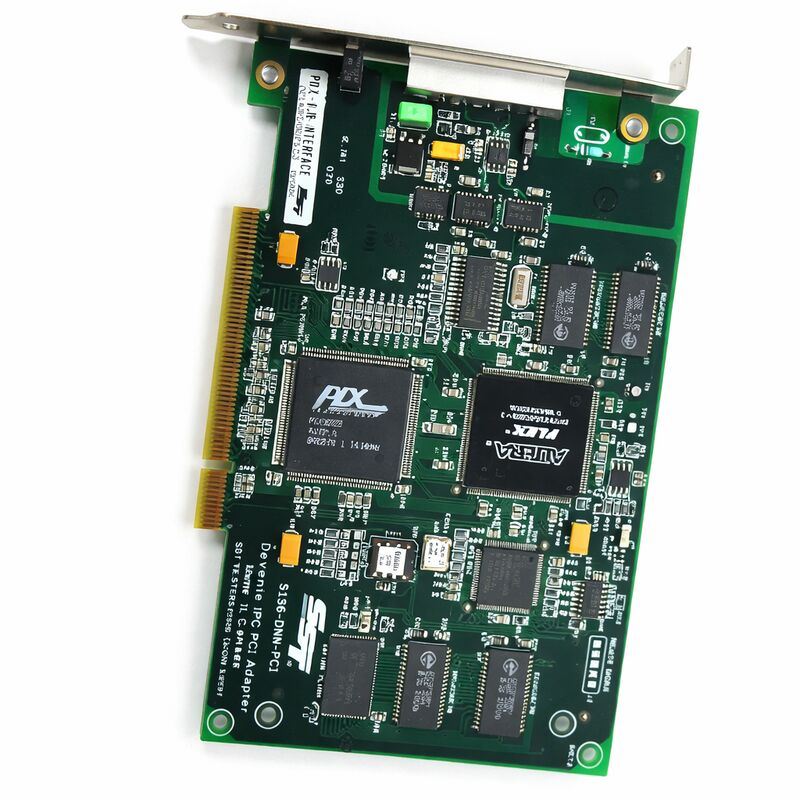
5136-DNP DeviceNet Interface Card
The third model is the most ambiguous of the three because the suffix is missing in the number you sent. Public listings consistently show 5136-DNP as a DeviceNet interface card family, with versions such as 5136-DNP-PCI, 5136-DNP-CPCI, 5136-DNP-104, 5136-DNP-ISA, and 5136-DNP-VME-4.
Across those variants, the shared function is the same: linking a host computer or bus platform to a DeviceNet network.
That makes the 5136-DNP family different from a standard control PCB. It is a communications interface product, and the key selection point is not only the base family name but the bus format suffix.
Public documentation for the PCI version states that it connects a PCI bus computer to DeviceNet, supports 125, 250, and 500 Kbaud, and executes the DeviceNet protocol in hardware.
Other public listings show the same family in CompactPCI, ISA, PC/104, and VME forms.
Confirmed Product Data
| Item |
Details |
| Part Family |
5136-DNP |
| Product Type |
DeviceNet Interface Card |
| Known Variants Seen Publicly |
PCI, CompactPCI, ISA, PC/104, VME |
| Core Function |
Host-to-DeviceNet communication |
| Common PCI Data Seen Publicly |
33 MHz, 32-bit PCI |
| Common PCI Data Rates |
125 / 250 / 500 Kbaud |
| Network Method Mentioned Publicly |
DeviceNet protocol executed in hardware |
| Typical Applications |
HMI, PC control, I/O emulation |
Application Areas
The 5136-DNP family is used wherever a host platform needs to communicate with a DeviceNet network. Public listings for PCI and CompactPCI versions describe applications such as operator interface and HMI, PC-based control, and I/O emulation, which makes this card family a practical fit for industrial systems that need a computer-to-DeviceNet communication layer.
In real installation scenarios, this family is typically used in industrial PC communication projects, DeviceNet-based machine monitoring, HMI integration, and control systems that exchange data with field devices over DeviceNet. The exact application depends on the suffix, because a PCI, CompactPCI, ISA, or PC/104 version must match the host platform already in use.
FAQ
Q1. What type of board is the 5136-DNP?
The 5136-DNP is a DeviceNet interface card family. Public listings identify multiple versions of it, including PCI, CompactPCI, PC/104, ISA, and VME variants, all centered on DeviceNet communication.
Q2. What does this card do in the system?
Its role is to connect a host platform to a DeviceNet network. Public product pages for the PCI and CompactPCI versions describe it as a card that links the bus computer to DeviceNet, with applications including operator interface and HMI, PC control, and I/O emulation.
Q3. What should be checked when selecting a 5136-DNP card?
The first thing to confirm is the suffix, because 5136-DNP by itself is not enough to identify the bus format. A PCI version is not interchangeable with a CompactPCI, ISA, PC/104, or VME version, even though the family name is similar. After that, confirm the target DeviceNet network requirements and the host platform where the card is installed.
Q4. How should the key specifications be interpreted?
For the PCI version, public listings show 33 MHz, 32-bit PCI, a 40 MHz AM186EM microprocessor, 256K RAM, 256K shared RAM, and support for 125, 250, and 500 Kbaud DeviceNet rates. These figures are useful only if the installed card is specifically the 5136-DNP-PCI version; they should not be carried over automatically to other suffix variants.
Q5. What is most important to confirm before replacement?
Before replacement, confirm the full suffix on the board label, the host-bus type, and the required DeviceNet role in the existing system. Within this family, the most common selection mistake is matching the DeviceNet function while missing the physical bus format.


 Your message must be between 20-3,000 characters!