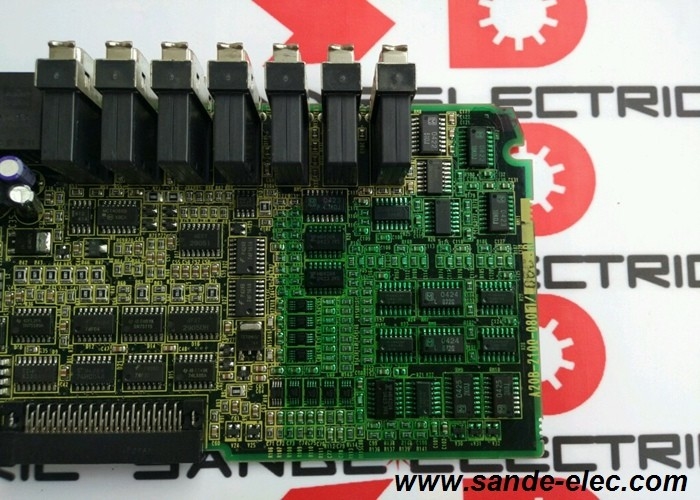
FANUC A20B-2100-0801 | SPM Series Spindle Amplifier Control PCB — A20B-2100 Series / Discontinued
Spindle Drive Intelligence in the A20B-2100 Series
The A20B-2100-0801 is the control PCB inside FANUC's SPM series spindle amplifier modules. In the SPM's two-board architecture, the A20B-2100 series board is the intelligence layer — it handles the spindle speed and torque control loop, manages the PWM gate signals for the power transistors, processes spindle encoder feedback, and manages alarm detection and reporting for the spindle drive system.
The SPM (Spindle Motor Module) is the amplifier that drives the CNC machine's spindle motor — the axis responsible for cutting speed. When the control PCB fails inside an SPM, the entire spindle section becomes inoperative. The CNC generates spindle alarms and the machine cannot perform cutting operations, even if the spindle power stage and motor are physically intact. Replacing the control board while retaining the functioning power stage is the component-level maintenance path that avoids replacing the entire SPM module.
Key Specifications
| Parameter |
Value |
| Part Number |
A20B-2100-0801 |
| Series |
A20B-2100 |
| Application |
SPM spindle amplifier modules |
| Type |
Spindle drive control PCB |
| Status |
Discontinued |
| Origin |
Japan |
Board-Level Service — What This Enables
The SPM module contains two separable board layers: the control PCB (A20B-2100-0801) and the wiring/power board that connects to the spindle motor power transistors. These two boards fail through different mechanisms and can be serviced independently.
Control board alarms — communication faults, initialisation failures, spindle alarm codes that indicate the drive software or feedback processing has failed — point to the A20B-2100-0801. Power board alarms — transistor overcurrent, phase loss, bus fault — point to the wiring/power board.
Identifying which board carries the fault before ordering avoids unnecessary replacement of a healthy component. A control card fault presents as spindle alarm codes at startup or abnormal spindle behaviour that cannot be resolved by motor or cable inspection.
FAQ
Q1: What is the A20B-2100-0801 and what is its role in the spindle system?
It is the control PCB inside FANUC's SPM series spindle amplifier. It handles the spindle speed and torque control loop, processes encoder feedback, generates PWM commands to the power transistors, and manages spindle alarms. When this board fails, the SPM module cannot control the spindle even if the power stage and motor are healthy.
Q2: How is a control PCB fault distinguished from a spindle power stage fault?
Control board faults typically produce spindle alarm codes that persist after confirming motor winding condition and encoder cable integrity. Power stage faults produce overcurrent, transistor IPM alarms, or bus faults that appear regardless of motor connection. If the spindle alarm appears with the motor disconnected, the fault is in the control card rather than the motor or cable.
Q3: Does replacing the A20B-2100-0801 require spindle parameter re-entry?
Spindle motor parameters are stored in the CNC controller's SRAM, not in the spindle amplifier control PCB. For a like-for-like board replacement, spindle parameters are unaffected. Verify the spindle motor type parameters are correctly set in the CNC after installation and confirm normal spindle operation at reduced speed before returning to production.
Q4: What should be checked on a used A20B-2100-0801 before installation?
Inspect the board for component damage, burned areas, or swollen capacitors. Check all connector pins for corrosion or physical damage. Confirm the supplier has functionally tested the board in a live SPM module with a spindle motor under load — bench power-on testing without a motor load does not verify the control loop performance under operational conditions.
Q5: Where is the A20B-2100-0801 sourced after discontinuation?
Through the FANUC SPM aftermarket — CNC spindle amplifier component specialists and legacy FANUC parts dealers. Confirm A20B-2100-0801 specifically from the board's label. SPM modules serve different spindle power classes; adjacent A20B-2100 variants serve different SPM configurations and are not interchangeable.



 Your message must be between 20-3,000 characters!